In the fast-paced digital era, DevOps automation has become a strategic cornerstone for organizations striving to deliver software faster, more reliably, and at lower cost.
For companies like TechEnhance, which specialise in everything from cloud consulting to AI/ML development, embracing automation is not just an operational improvement, it’s a competitive differentiator.
By leveraging automated pipelines, infrastructure as code, self-healing operations and more, startups and mid-market businesses can reduce the time-to-market of new features, mitigate human error, and free up engineering teams to focus on innovation rather than firefighting.
At TechEnhance, our approach combines cloud strategy and architecture (via our Cloud Consulting services) with DevOps automation and managed workflows (via our DevOps Consulting and Managed IT Services offerings).
The combination ensures automation is not just a toolset, but a holistic capability embedded in your delivery lifecycle.
In this article, we’ll explore:
- The key automation tool-categories shaping DevOps in 2025
- How to choose the right tools for your organisation
- How a partner like TechEnhance can help you implement and scale those tools efficiently and purposefully
DevOps Automation: Definitions & Trends
What we mean by “Automation Tools in DevOps”
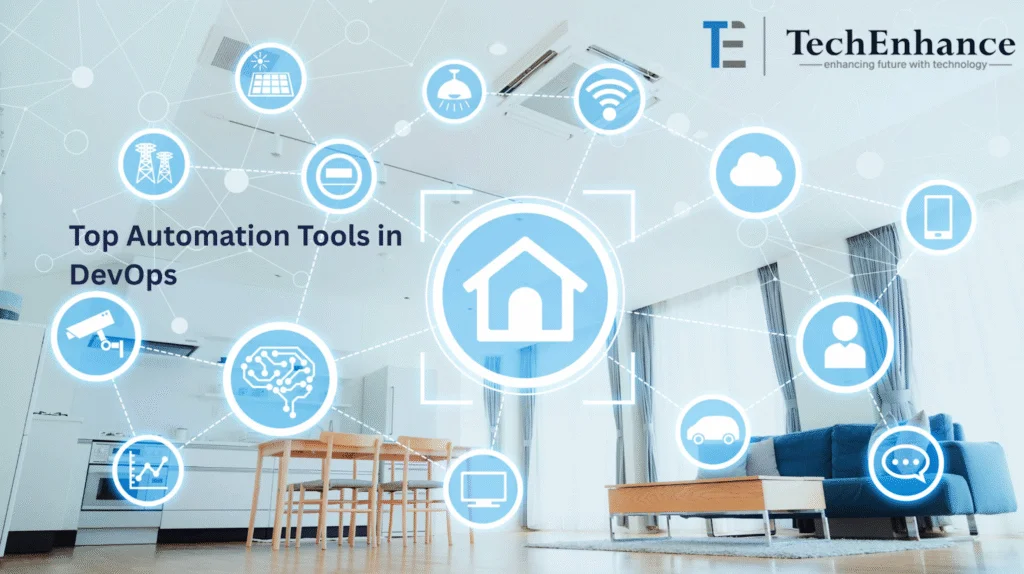
In the DevOps universe, automation tools span disciplines including:
- CI/CD pipelines and release automation: Continuous integration, automated builds/tests and continuous delivery of software into production.
- Infrastructure as Code (IaC) and configuration automation: Scripted provisioning, environment reproducibility, and automated configuration management.
- Monitoring, observability and auto-remediation tools: Automated detection of issues, self-healing workflows and intelligent alerts.
- Container orchestration and platform automation: Automating container lifecycles, service discovery, scaling and deployments.
- AI/ML-enabled operations & DevSecOps automation: Using intelligent tools to automate security scans, incident prediction, log analytics and remediation.
Trends driving automation in 2025
- Cloud-native complexity demands automation: As organisations adopt multi-cloud, hybrid clouds and microservices, manual processes become untenable, making IaC and pipeline automation essential.
- GitOps and policy-driven workflows: Configuration and infrastructure changes are moving into version-controlled repos; changes flow through automated governance and policy gates.
- AI/ML entering DevOps toolsets: Intelligent automation, such as anomaly detection in logs or auto-remediation, is moving from hype to production-ready. TechEnhance’s strength in AI/ML positions it to integrate these next-gen capabilities via our AI Development Services and Data & Analytics practice.
- Startups & SMBs demand speed + scale + quality: For startups and smaller enterprises (TechEnhance’s typical clients), automation is the way to deliver enterprise-grade reliability with lean teams and budgets, especially when supported by managed engineering services such as our Virtual CTO Services.
- Security and compliance built in from the start: DevSecOps automation ensures security scans, policy enforcement and compliance checks are part of every deployment rather than an afterthought.
- From tool adoption to tooling strategy: It’s no longer enough to pick a tool; the conversation is shifting toward implementation, governance, integration, and operational maturity, an area where TechEnhance’s combined offering of cloud, DevOps and managed services stands out.
Key Categories of Automation Tools in DevOps
The DevOps landscape is vast, but in 2025, the following automation categories are shaping how businesses design, deploy, and manage their digital products. TechEnhance’s DevOps Consulting, Cloud Consulting, and Managed IT Services teams integrate these tools to help clients build scalable, efficient, and secure pipelines.
a) Infrastructure as Code (IaC)
Purpose: Automates cloud provisioning and environment setup using code, ensuring consistency, scalability, and traceability.
Popular tools: Terraform, AWS CloudFormation, Pulumi.
Why it matters: IaC reduces configuration drift and enables version-controlled environments that can be spun up or destroyed in minutes.
How TechEnhance helps: Through our cloud and DevOps expertise, we design IaC frameworks that align with business logic and compliance needs, enabling clients to deploy faster while maintaining governance and cost control.
b) Configuration Management & Workflow Automation
Purpose: Keeps infrastructure and app configurations consistent across environments while orchestrating updates automatically.
Tools: Ansible, Chef, Puppet.
TechEnhance angle: We integrate these tools with clients’ cloud stacks to ensure reliable, predictable deployments, all while maintaining high availability through our Managed IT Services framework.
c) Continuous Integration and Continuous Delivery (CI/CD)
Purpose: Automates build, test, and deployment cycles so teams can deliver updates continuously and safely.
Tools: Jenkins, GitHub Actions, GitLab CI, CircleCI.
Why it matters: Automated pipelines minimize manual steps, speed up feedback loops, and improve product reliability.
TechEnhance’s role: We craft end-to-end CI/CD systems tailored to both web and mobile ecosystems, supporting full-stack delivery via our Web Development and Mobile App Development practices.
d) Container Orchestration & Cloud Automation
Purpose: Simplifies the deployment and scaling of microservices using container platforms.
Tools: Kubernetes, Docker Swarm, OpenShift.
Why it matters: Automation here ensures zero-downtime deployments and elastic scalability.
TechEnhance’s role: We provide Kubernetes consulting through our Cloud Consulting service, enabling seamless integration of containers with CI/CD and IaC pipelines.
e) Monitoring, Observability & Self-Healing Systems
Purpose: Enables proactive detection of issues and automated responses before downtime impacts users.
Tools: Prometheus, Grafana, New Relic, Dynatrace.
TechEnhance’s differentiator: By combining observability platforms with AI-driven insights from our AI Development Services, we help clients move toward self-healing systems that automatically predict, isolate, and remediate failures.
f) Security & DevSecOps Automation
Purpose: Integrates security scans, vulnerability management, and compliance checks directly into the pipeline.
Tools: Snyk, Aqua Security, SonarQube.
TechEnhance’s approach: We implement secure-by-design practices, automating risk detection within every build to align with clients’ data protection frameworks.
How to Choose the Right Automation Tools in DevOps
Selecting the best automation stack for your DevOps ecosystem depends on your business goals, team maturity, and technology stack. The wrong toolset can lead to complexity and waste, while the right combination delivers speed and stability. Here’s how TechEnhance helps clients make the right call:
a) Align Tools with Business Outcomes
Start by defining what success means, faster releases, fewer outages, or lower cloud costs. TechEnhance aligns your automation roadmap with measurable KPIs through our Virtual CTO Services, ensuring every tool drives business value rather than adding overhead.
b) Assess Scalability and Integration
Evaluate how each tool fits into your existing environment. For instance, Terraform or Pulumi integrate naturally with AWS or Azure, while Jenkins can trigger automated deployments across multiple cloud environments via our Cloud Consulting engagements.
c) Prioritize Ease of Use and Maintenance
A tool is only as effective as your team’s ability to manage it. Through our Managed IT Services, TechEnhance provides ongoing support and monitoring, so automation systems stay secure, updated, and optimized.
d) Build an AI-Augmented Automation Strategy
With the rise of predictive analytics and generative AI, many organizations are now integrating intelligent automation into DevOps. TechEnhance’s AI Development Services and Data Analytics Services help clients leverage ML models for smarter decision-making, automated anomaly detection, and optimized resource allocation.
e) Adopt a Pilot-First Implementation Model
Before full-scale rollout, start small, pilot critical pipelines, test integrations, and measure impact. TechEnhance guides organizations through pilot-to-production transitions, reducing risk while validating tool performance and ROI.
Implementation Roadmap & Best Practices
Implementing DevOps automation successfully isn’t just about picking the right tools, it’s about creating the right framework, culture, and process around them. TechEnhance follows a structured, outcome-oriented roadmap to help businesses modernize and automate their delivery pipelines effectively.
Step 1: Assessment & Strategy
Before automating, it’s critical to understand current workflows, bottlenecks, and maturity levels.
Through our DevOps Consulting and Virtual CTO Services, we begin with a comprehensive DevOps readiness assessment, identifying which parts of the delivery cycle can be optimized, automated, or restructured.
Step 2: Architecture Design & Tool Selection
Once gaps are identified, our Cloud Consulting team designs a scalable architecture blueprint that supports your automation goals, whether it’s integrating IaC, implementing CI/CD, or containerizing microservices.
We also shortlist tools that best align with your existing tech stack, compliance standards, and long-term scalability targets.
Step 3: Pilot Automation & Continuous Integration
We begin with a pilot implementation, often focused on a single pipeline or environment. Using platforms like Jenkins, Terraform, or Kubernetes, we establish continuous build, test, and deploy cycles, ensuring everything from code quality to security scanning is automated.
Our Managed IT Services team then oversees continuous monitoring and iterative improvement throughout the pilot.
Step 4: Full-Scale Deployment & Governance
Once validated, automation is expanded across environments and teams. This includes policy-as-code enforcement, role-based access control, and continuous compliance monitoring.
TechEnhance’s Data Analytics Services provide visibility into automation performance metrics, enabling stakeholders to track deployment frequency, MTTR (mean time to recovery), and overall ROI.
Step 5: Continuous Optimization
Automation is not a “set it and forget it” task. With AI Development Services, we integrate AI-driven insights into DevOps workflows, predicting bottlenecks, optimizing resource utilization, and even triggering self-healing actions based on system behavior.
Common Pitfalls to Avoid
- Tool sprawl: Avoid adding too many overlapping tools without a cohesive strategy.
- Lack of governance: Define ownership, SLAs, and monitoring upfront.
- Ignoring culture: Automation should empower teams, not isolate them, foster collaboration between developers, ops, and QA from the start.
- Skipping training: Every new tool requires proper onboarding and documentation for sustained adoption.
Case Study: How Automation Transformed Delivery for a FinTech Client
Background
A fast-growing FinTech startup approached TechEnhance to improve deployment frequency and system reliability. Their legacy CI/CD pipeline required manual approvals and repetitive configurations, leading to slow releases and frequent post-deployment issues.
Challenges
- Manual builds and deployments consuming 6+ hours per release
- Inconsistent environment configurations between staging and production
- Lack of automated monitoring and rollback capabilities
- Inefficient infrastructure provisioning slowing scalability
TechEnhance’s Solution
Our DevOps Consulting team performed an initial audit and redesigned the client’s infrastructure using Infrastructure as Code (IaC) via Terraform.
We implemented a CI/CD pipeline using Jenkins integrated with Docker and Kubernetes for container orchestration, all hosted on AWS through our Cloud Consulting services.
To enhance visibility and resilience, we layered automated monitoring and AI-based anomaly detection using capabilities from our AI Development Services.
Results
- Deployment time reduced by 70%, enabling multiple releases per day
- Infrastructure provisioning automated, saving 20+ hours weekly in ops overhead
- Zero configuration drift across environments
- Improved uptime and error recovery, with incidents proactively detected and mitigated
Outcome
Through a mix of automation, AI-driven insights, and managed governance, TechEnhance transformed the client’s DevOps culture into a high-performing, self-sustaining ecosystem. The engagement evolved into a long-term partnership, with our Managed IT Services team providing continuous optimization and monitoring.
Why Partnering with TechEnhance Adds Value
Adopting DevOps automation tools is only half the battle, true success lies in integrating them strategically across your technology ecosystem. That’s where TechEnhance stands apart. We don’t just implement tools; we help you build a culture of automation, efficiency, and reliability.
End-to-End DevOps Expertise
Our DevOps Consulting team brings deep experience in designing and implementing CI/CD pipelines, IaC frameworks, and container orchestration systems. Whether it’s automating build workflows, managing multi-cloud infrastructure, or establishing continuous testing, we ensure every process is optimized for speed and scalability.
Cloud-Native Agility
TechEnhance’s Cloud Consulting services help organizations migrate, optimize, and automate operations across AWS, Azure, and Google Cloud. By combining IaC and auto-scaling, we create cloud environments that are not only efficient but self-optimizing.
AI-Driven DevOps Intelligence
Through our AI Development Services and Data Analytics Services, we inject intelligence into your DevOps pipelines. Predictive analytics detect potential issues before they impact operations, while machine learning models assist with capacity planning and anomaly detection.
Managed Reliability & Long-Term Support
Automation isn’t a one-time project; it requires continuous improvement and oversight. Our Managed IT Services ensure that your automation stack remains secure, up to date, and aligned with evolving business goals. For organizations looking for ongoing technical leadership, our Virtual CTO Services provide strategic oversight, governance, and technology roadmapping.
Unified Engineering Capability
Beyond DevOps, TechEnhance offers complete Web Development and Mobile App Development expertise, ensuring your automation ecosystem connects seamlessly from infrastructure to product delivery. This full-stack integration gives clients a competitive advantage through faster releases and superior product quality.
In short, TechEnhance delivers more than automation, we deliver evolution. Every engagement focuses on measurable impact: faster deployments, lower costs, improved uptime, and enhanced customer satisfaction.
Conclusion
In 2025, automation is redefining the DevOps landscape. From intelligent CI/CD pipelines to AI-assisted monitoring and self-healing infrastructure, the right automation tools are no longer optional, they are the foundation for sustainable, scalable digital growth.
For startups and mid-sized enterprises, the key challenge is not just selecting the right tools but integrating them effectively into everyday workflows. That’s where a trusted technology partner like TechEnhance makes all the difference.
By uniting DevOps automation, AI-driven intelligence, and cloud-native engineering under one umbrella, TechEnhance empowers organizations to accelerate innovation, strengthen reliability, and scale confidently.
If you’re ready to transform your DevOps ecosystem, explore how TechEnhance can help you design, deploy, and manage a future-ready automation framework.
Start your automation journey today with our DevOps Consulting experts.