
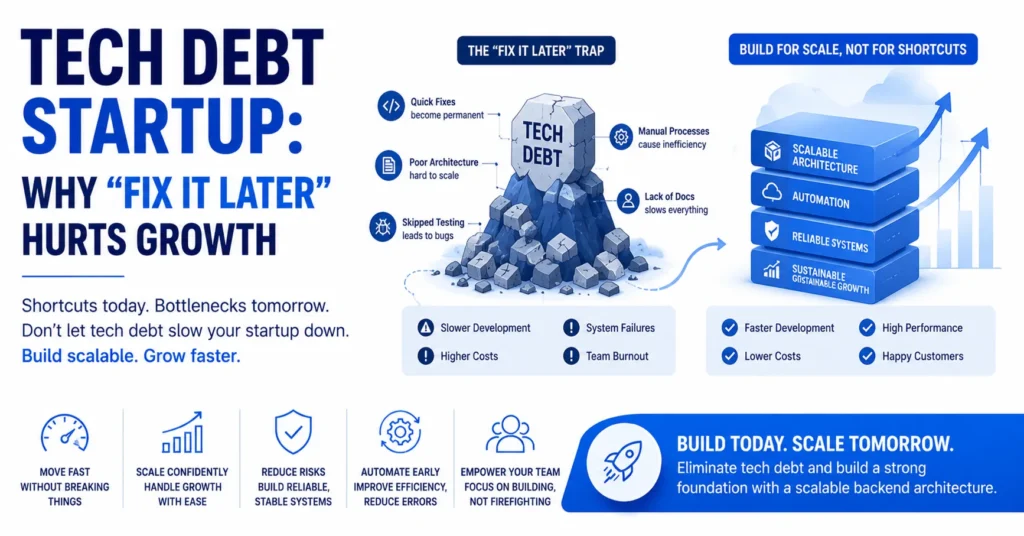
“We’ll fix it later” is one of the most common—and costly—phrases in early-stage companies. It sounds practical when speed matters and resources are tight. Founders want to validate quickly, ship features, and capture early traction, so technical shortcuts feel justified. But this mindset quietly accumulates risk. What you’re really building isn’t just a product—it’s a growing pile of tech debt startups must eventually pay. And without a scalable backend architecture, that bill compounds faster than your growth.
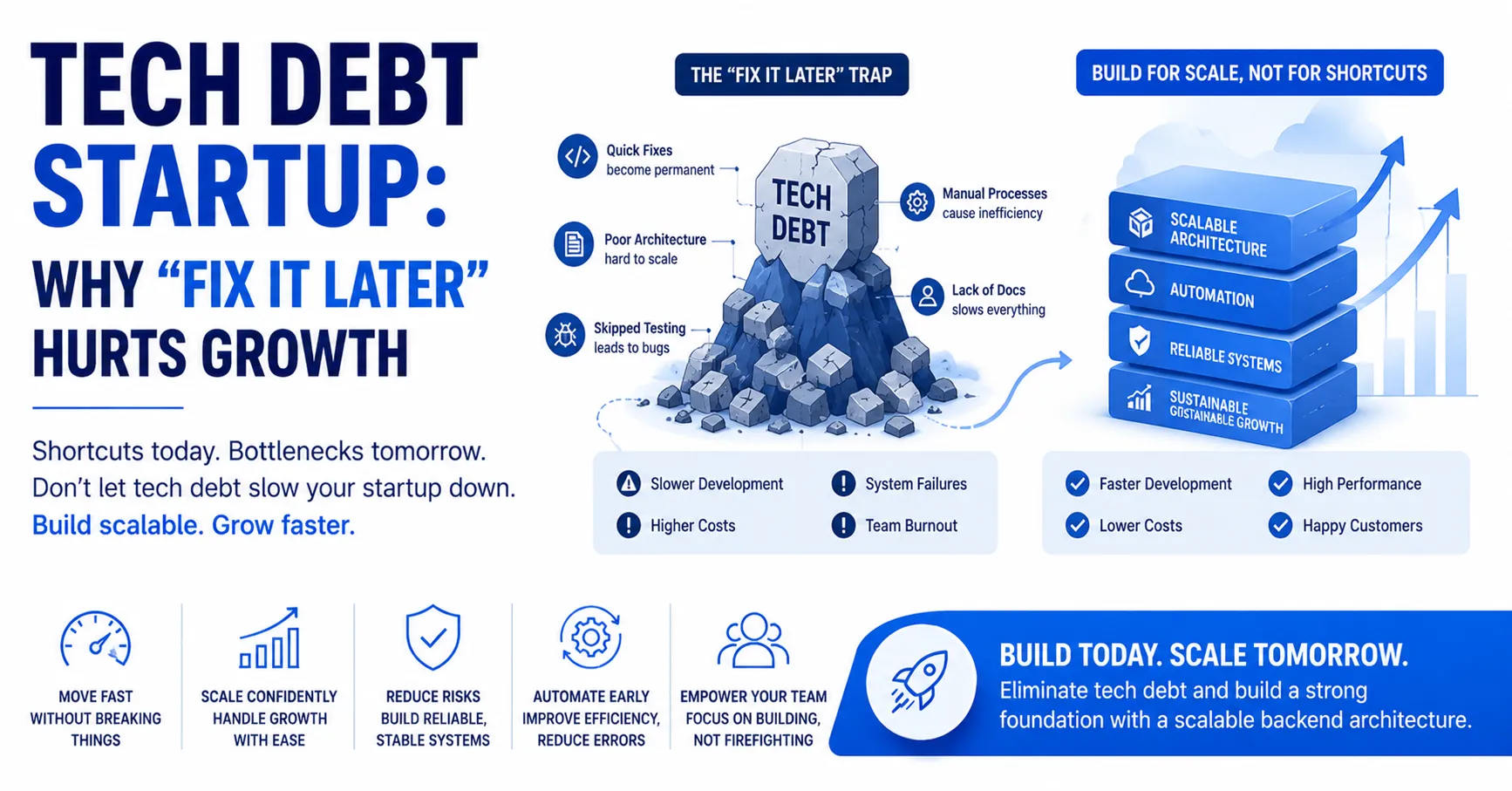
Why “Fix It Later” Feels Like the Right Decision
In the early days, constraints drive decisions. Limited time, limited capital, and pressure to launch push teams toward quick fixes. Writing temporary code, skipping proper architecture, or delaying optimization can feel like smart trade-offs when you’re racing to market. After all, if the product works and users are signing up, why slow down?
The problem is that “later” rarely comes in a clean, controlled way. It arrives during growth—when traffic spikes, users demand reliability, and your team needs to move faster than ever. At that exact moment, the shortcuts you took earlier start pushing back. Instead of building, your team begins firefighting. Instead of scaling, you stall.
What Tech Debt Really Means for Startups
Tech debt isn’t just messy code. It’s the cumulative effect of decisions that prioritize short-term speed over long-term stability. It includes rushed architecture, lack of testing, manual processes, and fragmented systems. Individually, each decision might seem harmless. Together, they create a system that becomes harder to maintain, extend, and scale.
Common Sources of Tech Debt
| Source | What It Looks Like | Long-Term Impact |
|---|---|---|
| Quick Fixes | Temporary patches become permanent | Increased complexity |
| Poor Architecture | No clear structure or modularity | Hard to scale features |
| Lack of Documentation | Knowledge trapped in individuals | Slower onboarding |
| Manual Processes | Repetitive tasks done by hand | Inefficiency and errors |
| Skipped Testing | Bugs discovered late | Unstable releases |
For tech debt startups, the real cost isn’t just technical—it’s operational. It slows everything down, from development cycles to customer support.
Why “Later” Becomes the Worst Time to Fix Things
There’s a hidden irony in the “fix it later” mindset. The longer you wait, the harder and more expensive it becomes to fix. Early on, your system is small and changes are easy. Later, your system is larger, more complex, and actively serving users. Every change carries risk.
When you try to fix foundational issues during growth, you face trade-offs: pause feature development to refactor, or continue shipping and let problems grow. Either choice has consequences. This is why startups that delay investing in a scalable backend architecture often hit a wall just when momentum matters most.
How Tech Debt Slows Down Everything
Tech debt doesn’t always show up as a dramatic failure. More often, it creeps in as friction. Tasks take longer. Bugs appear more frequently. Releases become stressful. Over time, these small inefficiencies compound into major slowdowns.
Impact of Tech Debt on Execution
| Area | Without Tech Debt | With Tech Debt |
|---|---|---|
| Feature Development | Fast and predictable | Slow and inconsistent |
| Bug Fixing | Occasional | Frequent and time-consuming |
| Deployment | Smooth | Error-prone |
| Team Productivity | High | Reduced |
| Scalability | Easy | Difficult |
For tech debt startups, this means losing their biggest advantage: speed. And in competitive markets, speed is often the difference between winning and fading out.
The Role of Scalable Backend Architecture
A scalable backend architecture is the antidote to uncontrolled tech debt. It doesn’t eliminate trade-offs—you will still make decisions under pressure—but it ensures those decisions are made within a structured system that can handle growth.
Instead of building a fragile foundation, you create a flexible one. Your backend is modular, your workflows are standardized, and your infrastructure is designed to scale. This allows you to move fast without breaking things—and more importantly, without accumulating debt that slows you down later.
Why Founders Underestimate the Risk
Many founders underestimate tech debt because its impact is delayed. Early success can mask underlying issues. When users are few and traffic is low, the system appears stable. This creates a false sense of security.
The problem surfaces only when growth accelerates. Suddenly, the same system that worked before starts failing under pressure. By then, the cost of fixing it is much higher. This is why understanding tech debt startups face early is critical—it’s not about avoiding mistakes, but about avoiding compounding ones.
The Real Cost of “Fix It Later”
The cost of delaying technical improvements goes far beyond engineering effort. It affects your entire business.
Hidden Costs
- Lost Revenue: Downtime and poor performance reduce conversions
- Missed Opportunities: Slow development delays new features
- Higher Costs: Emergency fixes and rework increase expenses
- Team Burnout: Constant firefighting drains energy
- Reputation Damage: Unreliable systems erode trust
These costs often remain invisible until they become significant. By then, they’re much harder to reverse.
How to Avoid the “Fix It Later” Trap
Avoiding this trap doesn’t mean over-engineering from day one. It means making intentional decisions that balance speed with sustainability.
Practical Steps
- Build for Change, Not Perfection
Focus on creating systems that can evolve, rather than trying to get everything right immediately. - Prioritize Core Architecture
Invest time in designing a backend that supports growth. - Automate Early
Reduce manual processes to improve efficiency and consistency. - Refactor Regularly
Address small issues before they become major problems. - Adopt Scalable Systems
Use tools and infrastructure that can grow with your business.
By following these steps, tech debt startups can maintain speed without sacrificing long-term stability.
The Mindset Shift: From Shortcuts to Systems
The biggest change founders need to make is mental. Instead of viewing tech decisions as temporary, they need to see them as foundational. Every shortcut has a cost, and every system has a benefit.
A scalable backend architecture is not about slowing down—it’s about enabling sustainable speed. It allows you to build quickly today without compromising your ability to grow tomorrow.
Why This Matters More Than Ever
In today’s competitive landscape, startups don’t just compete on ideas—they compete on execution. The ability to ship quickly, adapt to change, and maintain reliability is what sets successful companies apart.
Ignoring tech debt may help you move fast initially, but it slows you down when it matters most. Investing in the right systems early gives you a long-term advantage that compounds over time.
Conclusion: There Is No “Later”
The idea of fixing tech later is a myth. There is no clean, convenient moment when everything pauses and you can rebuild your foundation. Growth doesn’t wait, and neither do your users.
For tech debt startups, the choice is simple: address issues early or pay a much higher price later. By investing in a scalable backend architecture, you can avoid the trap of accumulating debt and build a system that supports your vision.
Ready to Build Without Bottlenecks?
If you’re relying on “fix it later” as a strategy, now is the time to rethink. A strong backend can transform how your business operates, making growth smoother and execution faster.
👉 Get a backend audit and discover how to eliminate tech debt, optimize your systems, and build for scale from day one.