
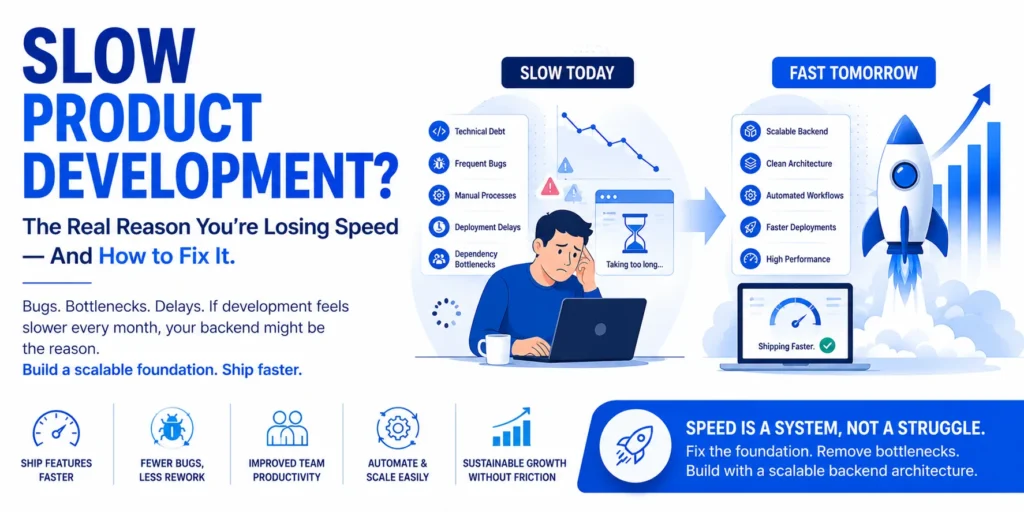
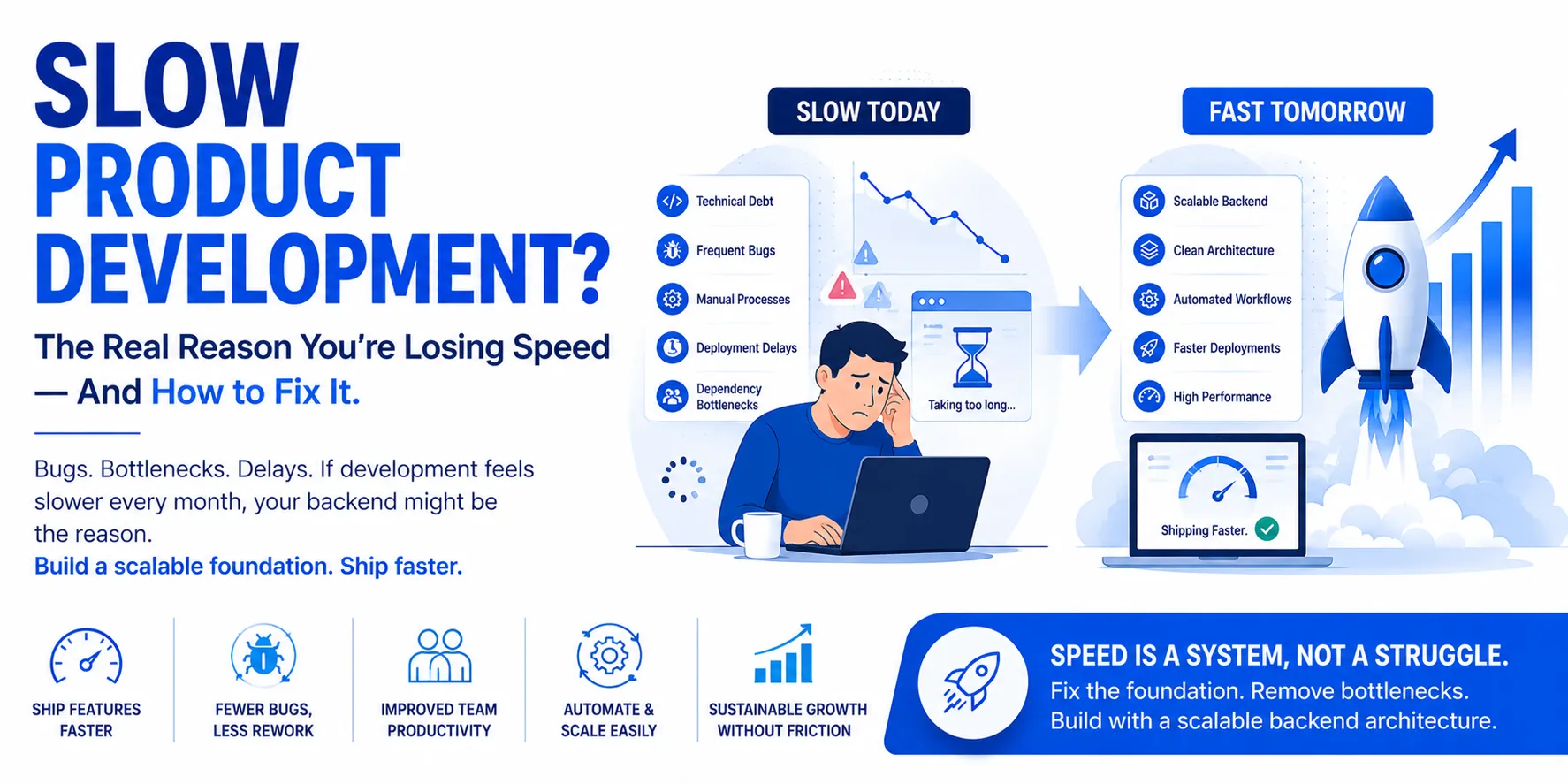
At the beginning, everything moves fast. Features are shipped in days, decisions are quick, and progress feels visible. But a few months in, something changes. Releases take longer, bugs increase, and your team seems busy all the time—but output slows down. This is one of the most frustrating phases for founders because it feels like momentum is slipping away without a clear reason. The truth is, slow product development is rarely about effort or talent. It’s almost always about systems—specifically, the lack of a scalable backend architecture that can support growth without creating friction.
Why Speed Declines as You Grow
In the early stages, your product operates in a low-pressure environment. Fewer users, fewer features, and a smaller codebase make it easier to move quickly. But as your startup grows, complexity increases. More users mean more edge cases, more data, and higher expectations. More features mean more dependencies and interactions between different parts of your system.
Without a strong foundation, this complexity slows everything down. What once took hours now takes days, and what took days now takes weeks. This is how slow product development begins—gradually, then suddenly.
The Hidden Causes of Slow Product Development
Most founders assume that slowdowns are caused by team inefficiency or lack of resources. While those can be factors, the real causes are usually deeper and more structural.
Common Causes
| Cause | What It Looks Like | Impact on Speed |
|---|---|---|
| Technical Debt | Messy, outdated code | Slower development cycles |
| Poor Backend Design | Frequent bugs and crashes | Increased rework |
| Lack of Automation | Manual deployments | Delays and errors |
| Dependency Overload | Waiting on multiple people | Bottlenecks |
| Inefficient Workflows | Constant back-and-forth | Wasted time |
Each of these issues contributes to slow product development, and they all stem from one root problem: a system that wasn’t built to scale.
How Backend Architecture Impacts Speed
Your backend is the engine of your product. It handles data processing, business logic, and system interactions. When your backend is poorly structured, every change becomes harder to implement. Developers spend more time understanding the system, fixing bugs, and dealing with unexpected issues.
A scalable backend architecture eliminates these problems by creating a clear, modular structure. It allows different parts of the system to operate independently, making it easier to add features, fix issues, and deploy updates quickly.
The Compounding Effect of Small Inefficiencies
One of the reasons slow product development is so difficult to diagnose is that it doesn’t come from a single issue. It’s the result of many small inefficiencies that add up over time.
Example of Compounding Delays
- A small bug requires extra debugging time
- Debugging delays testing
- Delayed testing pushes back deployment
- Late deployment affects the next feature
Individually, these delays seem minor. Together, they create a system where everything takes longer than it should.
Why Hiring More Developers Doesn’t Fix It
When speed drops, the instinct is to hire more developers. But this often makes things worse. More developers mean more communication, more coordination, and more dependencies. Without fixing the underlying system, you’re adding pressure to an already strained process.
This is why companies with large teams can still struggle with slow product development. The issue is not the number of people—it’s the efficiency of the system they’re working within.
What Fast Teams Do Differently
High-performing teams don’t rely on brute force. They rely on systems that enable speed. Their workflows are streamlined, their processes are automated, and their backend is designed to support growth.
Characteristics of Fast Teams
| Factor | Slow Teams | Fast Teams |
|---|---|---|
| Architecture | Rigid and messy | Modular and scalable |
| Deployment | Manual | Automated |
| Communication | Fragmented | Centralized |
| Ownership | Unclear | Well-defined |
| Problem-Solving | Reactive | Proactive |
A scalable backend architecture is a key part of this equation, enabling teams to maintain speed even as complexity increases.
How to Fix Slow Product Development
Improving speed requires a shift from reactive fixes to proactive system design. Instead of addressing symptoms, you need to address the root causes.
Practical Steps
- Audit Your Current System
Identify bottlenecks, inefficiencies, and areas of friction. - Refactor Your Backend
Improve structure and reduce technical debt. - Implement Automation
Streamline deployment, testing, and monitoring. - Simplify Workflows
Reduce dependencies and clarify processes. - Invest in Scalable Architecture
Build a backend that can handle growth without slowing down.
These steps help eliminate the root causes of slow product development, allowing your team to regain momentum.
The Role of Scalable Backend Architecture
A scalable backend architecture is not just about handling more users—it’s about maintaining efficiency as your product grows. It ensures that your system remains stable, flexible, and easy to work with.
Benefits
- Faster Development: Easier to add and modify features
- Reduced Bugs: Cleaner, more reliable codebase
- Improved Performance: Better user experience
- Lower Costs: Less time spent on maintenance
- Sustainable Growth: Ability to scale without disruption
By investing in scalability, you create a system that supports speed rather than hindering it.
Why This Matters for Your Business
Speed is a competitive advantage. The faster you can ship features, respond to feedback, and adapt to market changes, the stronger your position becomes. When your product development slows down, you lose this advantage.
Slow product development doesn’t just affect your team—it affects your entire business. It delays growth, reduces customer satisfaction, and limits your ability to innovate. Fixing it is not just a technical priority; it’s a strategic one.
The Shift from Chaos to Clarity
The transition from slow to fast is not about working harder—it’s about working smarter. By focusing on systems, structure, and scalability, you can transform your development process.
A scalable backend architecture provides the clarity and stability needed to move quickly. It reduces friction, improves efficiency, and allows your team to focus on what matters most: building and improving your product.
Conclusion: Speed Is Built, Not Forced
If your startup feels slower every month, it’s not because your team is losing momentum—it’s because your system is creating friction. The solution is not to push harder or hire more people, but to build a foundation that supports speed.
By addressing the root causes of slow product development and investing in a scalable backend architecture, you can regain control, accelerate execution, and create a system that grows with your business.
Ready to Move Faster Again?
If your product development feels stuck, it’s time to fix the system behind it. A structured, scalable backend can transform how your team works and how your business grows.
👉 Get a backend audit and discover how to eliminate bottlenecks, improve efficiency, and start shipping faster again.