
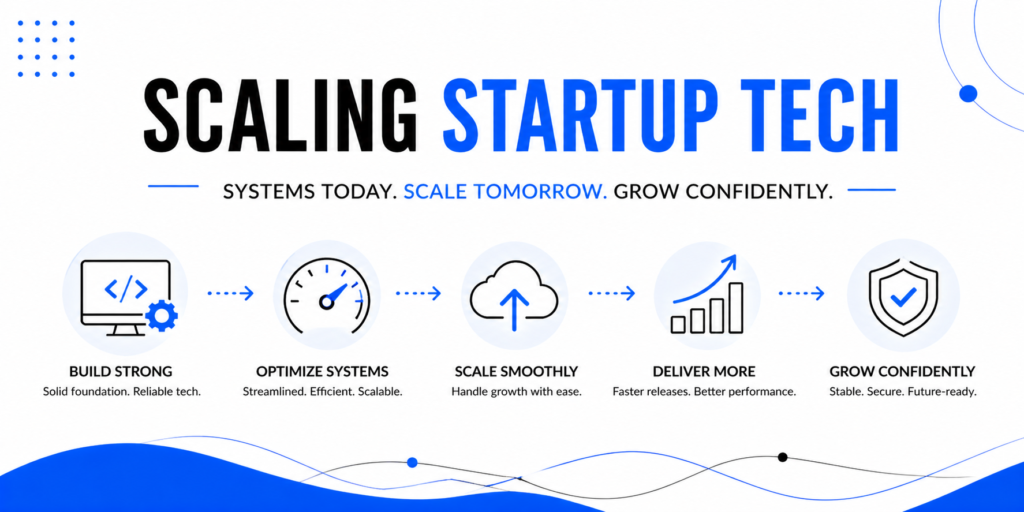
Growth is supposed to feel exciting. Revenue increases, users sign up, and your product gains traction. On paper, everything points to success. But behind the scenes, many founders experience something very different—delays, bugs, constant firefighting, and a growing sense of losing control. This is the hidden reality of scaling startup tech. Growth without the right systems doesn’t feel like progress—it feels like chaos.
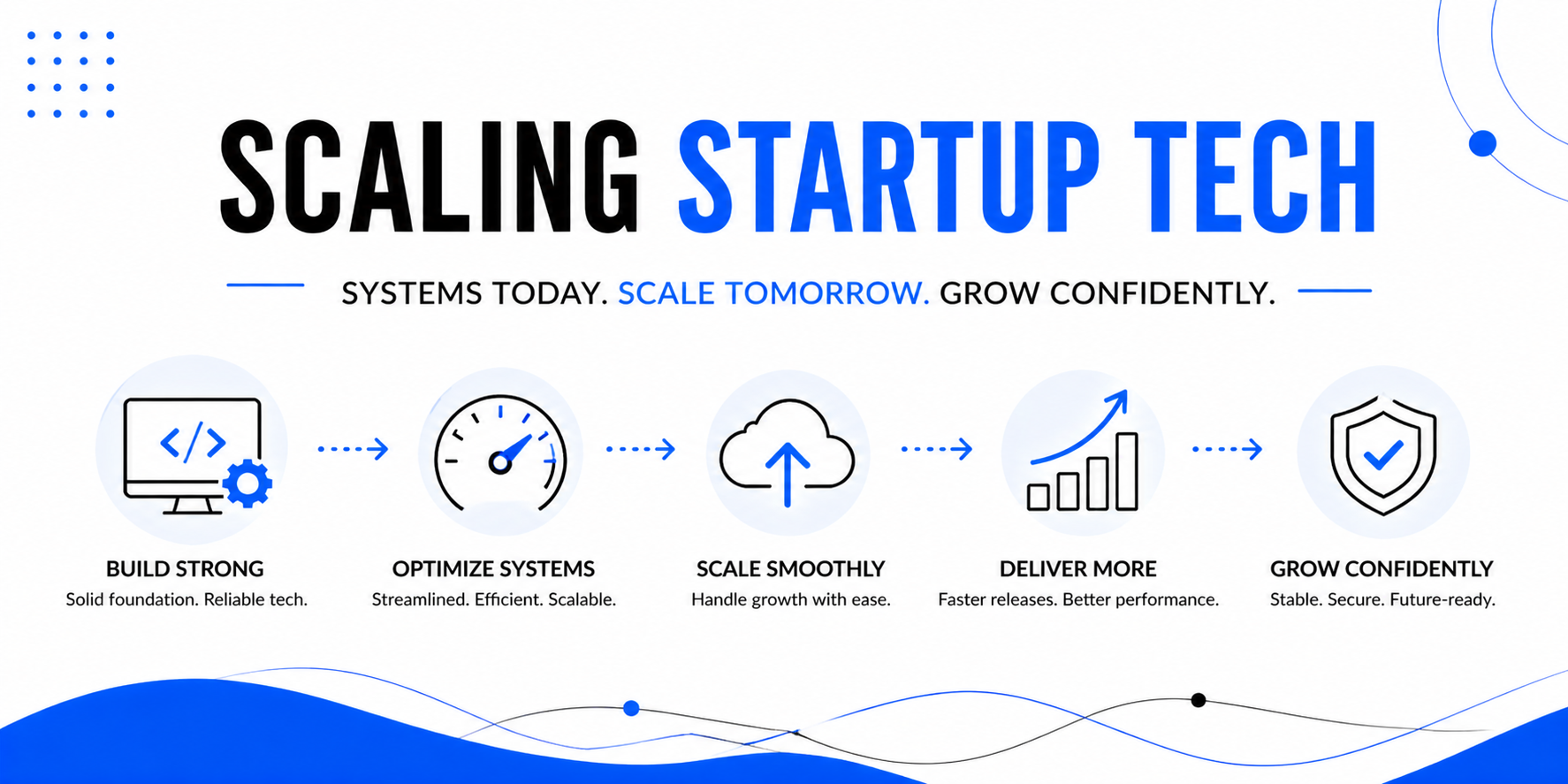
The Hidden Truth About Scaling Startup Tech
Scaling is often misunderstood as doing more of what already works. More users, more features, more revenue.
But growth doesn’t just amplify success—it amplifies weaknesses.
- A slightly inefficient backend becomes a major bottleneck
- Minor bugs turn into recurring failures
- Small delays become long release cycles
What worked at 100 users often breaks at 1,000. And what worked with a team of 3 becomes inefficient at 10.
Scaling startup tech isn’t about doing more—it’s about evolving your systems to handle complexity.
Why Growth Creates Chaos Instead of Clarity
As your startup grows, complexity increases exponentially—not linearly.
Every new addition creates dependencies:
- New features interact with existing systems
- New hires require coordination and communication
- New users increase load and expectations
Without structured systems, this complexity creates friction.
Instead of smooth execution, your team operates reactively:
- Fixing issues after they occur
- Managing unexpected failures
- Constantly switching priorities
This is why scaling startup tech often feels overwhelming—it’s not growth itself, it’s unstructured growth.
Common Signs You’re Scaling Into Chaos
Most founders don’t recognize the problem until it starts affecting performance. Here are the key signals:
Indicators of Chaotic Scaling
| Symptom | What It Looks Like | Impact |
|---|---|---|
| Slower Releases | Features take weeks instead of days | Lost momentum |
| Frequent Bugs | Issues reappear after fixes | Poor user trust |
| Backend Strain | Slow performance or crashes | User churn |
| Team Confusion | Unclear roles and ownership | Low productivity |
| Constant Firefighting | Always fixing instead of building | Burnout |
These issues are interconnected. One problem triggers another, creating a cycle that slows down growth.
The Core Problem: Scaling Without Systems
At the heart of chaotic growth is a lack of systems.
Early-stage startups rely on speed and flexibility. That works initially. But as complexity increases, the absence of structure becomes a major liability.
Scaling startup tech requires:
- Defined workflows
- Clear ownership
- Stable infrastructure
- Predictable execution
Without these, your team spends more time managing problems than creating value.
Where Most Startups Go Wrong
When chaos begins, founders often respond incorrectly.
Instead of fixing systems, they try to compensate with more resources.
Common Mistakes
- Overhiring → More people, more coordination overhead
- Ignoring backend stability → Focusing only on frontend growth
- No process standardization → Every task handled differently
- Reactive decisions → Fixing problems instead of preventing them
- Tool overload → Too many disconnected systems
These decisions don’t solve the problem—they increase complexity.
What Structured Scaling Looks Like
Scaling startup tech doesn’t have to feel chaotic. With the right systems, growth becomes predictable and controlled.
Key Elements of Structured Scaling
| Element | Description | Benefit |
|---|---|---|
| Clear Workflows | Defined processes for execution | Faster delivery |
| Scalable Backend | Strong architecture | Reliable performance |
| Automation | Reduced manual work | Higher efficiency |
| Centralized Communication | Unified information flow | Better alignment |
| Monitoring Systems | Real-time tracking | Early issue detection |
When these elements are in place, growth becomes smooth instead of stressful.
The Role of Backend in Scaling Startup Tech
Your backend is the foundation of your product—and its importance increases as you scale.
A weak backend leads to:
- Slow response times
- System crashes
- Data inconsistencies
- Increased maintenance
A strong backend enables:
- Consistent performance
- Seamless scaling
- Faster development cycles
Scaling startup tech successfully requires investing in backend systems early—not fixing them later under pressure.
How to Transition from Chaos to Control
Moving from chaotic growth to structured scaling requires intentional changes. It’s not about slowing down—it’s about enabling speed through systems.
Practical Steps
1. Audit Your Systems
Identify bottlenecks in backend, workflows, and communication.
2. Standardize Workflows
Create repeatable processes for development, deployment, and operations.
3. Strengthen Backend Architecture
Ensure your system can handle increased load and complexity.
4. Automate Repetitive Tasks
Reduce manual work in testing, deployment, and monitoring.
5. Reduce Dependencies
Limit how many people are required to complete a task.
6. Adopt Managed Execution Models
Leverage structured external systems to reduce internal complexity.
These steps transform scaling startup tech from reactive chaos into controlled execution.
Why Scaling Feels Easier with the Right Systems
When systems are aligned with growth:
- Teams work with clarity instead of confusion
- Releases become faster and more predictable
- Issues are prevented instead of constantly fixed
- Developers focus on building, not firefighting
Scaling startup tech becomes a natural progression—not a struggle.
The Long-Term Impact of Structured Scaling
The way you scale determines your future.
Chaotic Scaling Leads To:
- Burnout
- Technical debt
- Slower growth
- Missed opportunities
Structured Scaling Leads To:
- Faster feature releases
- Consistent product quality
- Lower operational stress
- Scalable, resilient systems
The difference compounds over time.
Conclusion: Growth Should Feel Like Control, Not Chaos
If scaling your startup feels overwhelming, the problem isn’t growth—it’s the lack of systems supporting it.
Scaling startup tech is not about hiring more people or working harder. It’s about building structure, eliminating friction, and enabling consistent execution.
When your backend, workflows, and systems are aligned, growth stops feeling chaotic—and starts feeling powerful.
Ready to Scale Without Chaos?
If your startup is growing but your systems are struggling to keep up, it’s time to bring structure to your tech.
Get a system audit and discover how to optimize your backend, streamline workflows, and scale your startup tech with clarity and confidence.