
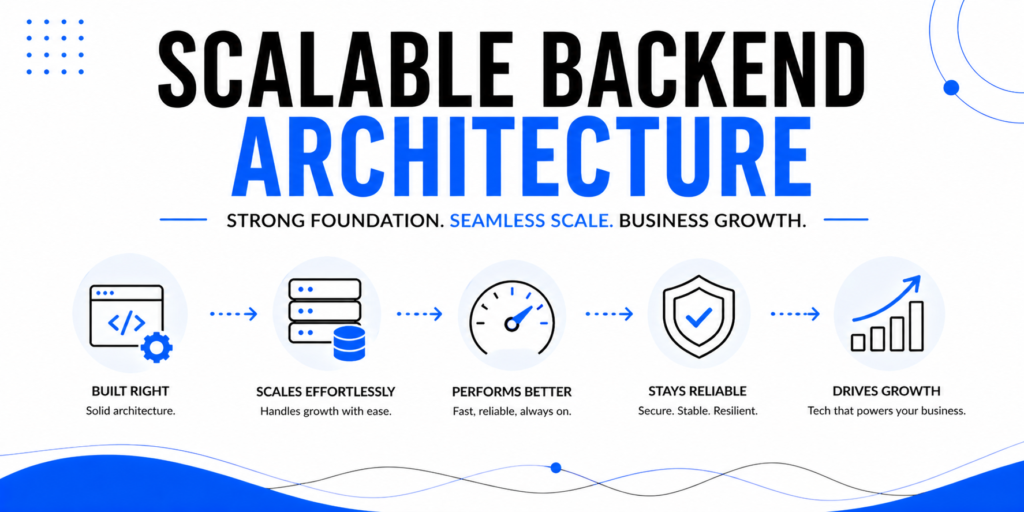
Most founders think of “tech” and “business” as separate worlds. Marketing drives growth, sales generate revenue, and technology quietly supports everything in the background. But in reality, there is no separation. Every technical decision directly impacts your business. When something breaks in your system, it doesn’t show up as a “backend issue”—it shows up as lost revenue, poor user experience, and missed opportunities. This is why scalable backend architecture is not just a technical investment—it’s a business strategy.
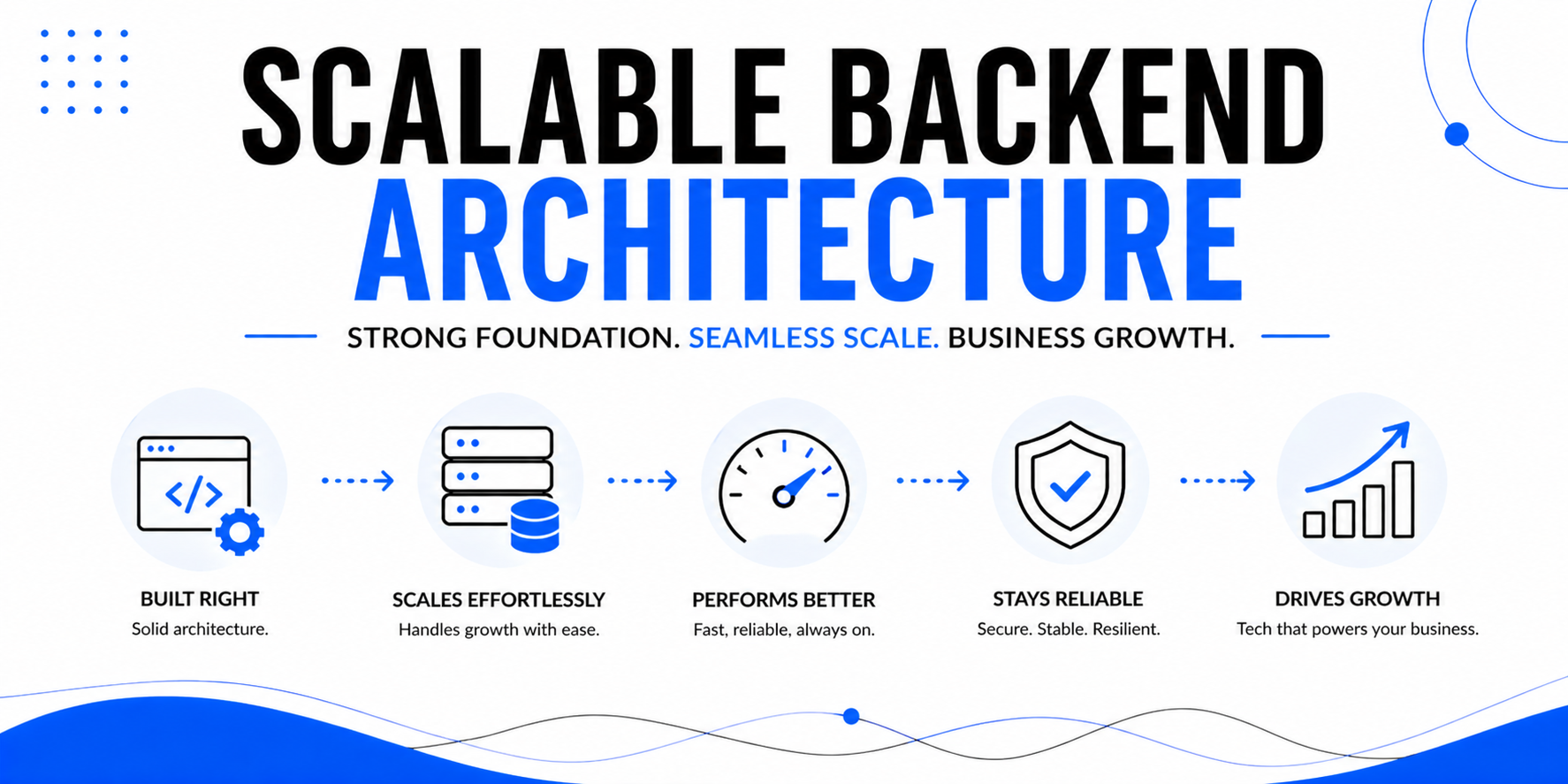
The Illusion That Tech and Business Are Separate
In the early stages, it’s easy to ignore backend systems. As long as your product works, your focus stays on growth—acquiring users, improving design, and building features.
At small scale, this works.
But as your product grows, the illusion starts to break.
- Small delays become noticeable
- Minor bugs become recurring issues
- Simple workflows become inefficient
What once felt like “just tech” begins to affect everything—from customer satisfaction to revenue.
This is where the absence of a scalable backend architecture becomes impossible to ignore.
How Technical Issues Become Business Problems
Backend problems rarely stay confined to engineering—they ripple across your entire business.
Tech-to-Business Impact
| Technical Issue | What Happens | Business Impact |
|---|---|---|
| Slow backend | Delayed responses | Lower retention |
| Downtime | System unavailable | Lost revenue |
| Poor architecture | Hard to scale features | Slower growth |
| Manual processes | Inefficiency | Higher costs |
| Technical debt | Complex codebase | Reduced innovation |
Every inefficiency in your backend eventually becomes a business limitation.
Why Founders Often Miss the Connection
The biggest reason founders overlook backend issues is timing.
The impact is rarely immediate.
- A slow system doesn’t cause instant churn—but gradually reduces engagement
- Technical debt doesn’t stop development—but slowly reduces speed
- Inefficiencies don’t break the product—but compound over time
Because the effects are delayed, they’re often blamed on external factors like marketing or competition.
In reality, the root cause is internal: a lack of scalable backend architecture.
The Backend Is Your Business Engine
Your backend is not just infrastructure—it’s the engine that powers your entire product.
Every action depends on it:
- User interactions
- Data processing
- Feature execution
- System reliability
When your backend is strong:
- Your product feels fast and reliable
- Your team moves quickly
- Your business scales smoothly
When it’s weak:
- Everything slows down
- Errors increase
- Growth becomes difficult
A scalable backend architecture ensures your system can grow without breaking under pressure.
Real-World Scenarios Where Backend Issues Hurt Growth
Backend problems often show up during critical business moments.
Scenario Breakdown
| Situation | Technical Problem | Business Outcome |
|---|---|---|
| Traffic spike | System overload | Lost conversions |
| Feature launch | Deployment issues | Delayed release |
| Customer support | Poor integration | Slow responses |
| Growth phase | Inefficient infrastructure | Rising costs |
These aren’t “technical failures”—they’re business disruptions caused by weak systems.
The Hidden Cost of Ignoring Backend Architecture
Ignoring backend issues doesn’t save time—it increases long-term costs.
Hidden Costs
- Revenue loss → Downtime and poor performance drive users away
- Higher expenses → Emergency fixes and patches
- Missed opportunities → Delayed launches and slow execution
- Team burnout → Constant firefighting
The longer you delay fixing your backend, the more expensive it becomes.
Investing in scalable backend architecture early prevents these cascading costs.
Why Scalability Is a Competitive Advantage
Scalability is not just about handling more users—it’s about enabling growth without friction.
Business Benefits of Scalable Backend Architecture
| Benefit | Impact |
|---|---|
| Faster growth | Handle demand seamlessly |
| Better user experience | Consistent performance |
| Lower costs | Efficient resource usage |
| Faster innovation | Quicker feature releases |
A scalable system allows your business to expand without constantly hitting technical limits.
Reactive vs Proactive Systems
Most startups operate reactively:
- Fix issues after they happen
- Respond to failures
- Patch problems repeatedly
This creates instability and slows growth.
A proactive approach focuses on building systems that prevent issues before they occur.
With scalable backend architecture, you move from:
- Chaos → Control
- Reaction → Planning
- Instability → Predictability
How to Build a Scalable Backend Architecture
Creating a scalable system doesn’t require perfection—it requires structure.
Practical Steps
1. Design for Scale Early
Even if your product is small, plan for growth in your architecture.
2. Use Modular Systems
Break your backend into components that can scale independently.
3. Automate Key Processes
Reduce manual work in deployment, testing, and monitoring.
4. Implement Monitoring
Track performance and detect issues before they escalate.
5. Reduce Technical Debt
Continuously clean and optimize your codebase.
6. Use Managed Infrastructure
Leverage external expertise to improve efficiency and scalability.
These steps create a backend that grows with your business instead of holding it back.
Why This Matters More as You Scale
The bigger your business becomes, the more critical your backend becomes.
- At small scale → inefficiencies are manageable
- At medium scale → inefficiencies slow growth
- At large scale → inefficiencies break the system
This is why scalable backend architecture becomes more important—not less—as you grow.
The Long-Term Impact of Strong Backend Systems
When your backend is designed for scale:
- Your team builds faster
- Your product performs consistently
- Your costs remain controlled
- Your growth becomes sustainable
Instead of reacting to problems, your business operates with clarity and confidence.
Conclusion: Tech Is Business
The idea that tech and business are separate is a myth.
Every backend decision affects:
- User experience
- Revenue
- Growth
- Efficiency
Technical problems don’t stay technical—they become business problems.
A scalable backend architecture ensures your systems support your growth instead of limiting it. It transforms your backend from a risk into a competitive advantage.
Ready to Build a Scalable Backend?
If your product is growing but your systems are struggling to keep up, it’s time to rethink your foundation.
Get a backend audit and discover how to build a scalable backend architecture that supports faster growth, better performance, and long-term success.