
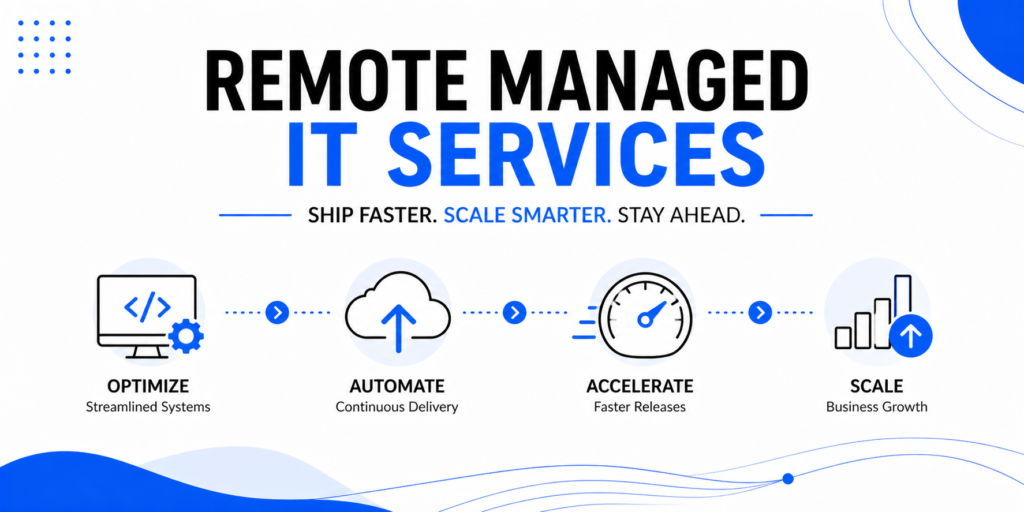
Speed is the hidden currency of modern businesses. It determines whether your product captures attention, gains market share, and scales efficiently—or falls behind while competitors move faster. Many founders assume that the only way to increase speed is to hire more developers. In reality, that approach often leads to bloated teams, rising costs, and slower execution. The truth is simpler and more powerful: Speed comes from systems, not headcount. This is where remote managed IT services become a game-changing advantage.
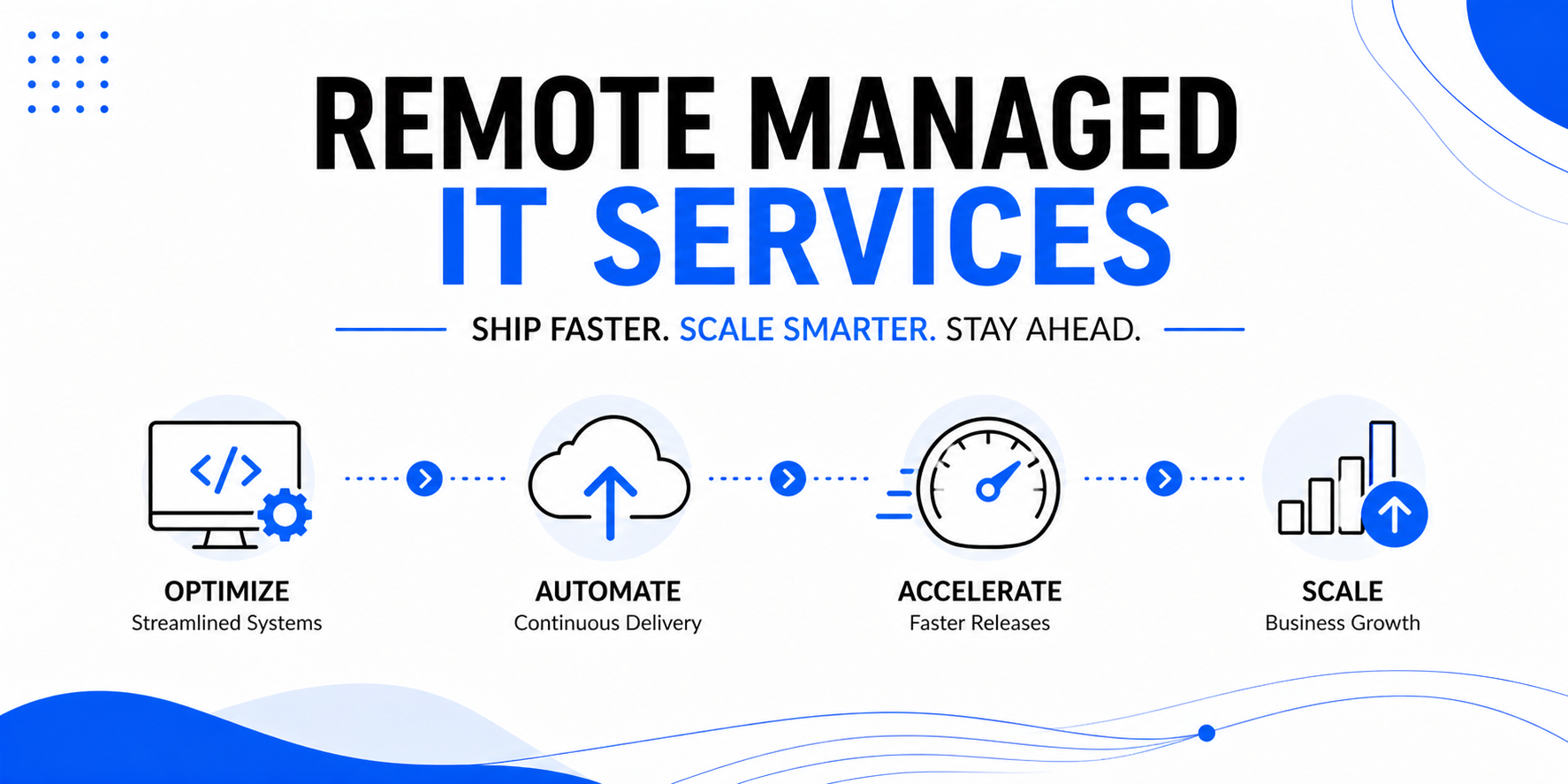
Why Hiring More Developers Doesn’t Solve the Problem
When delivery slows down, hiring more developers feels like the logical solution. But adding people introduces new layers of complexity.
What Actually Happens When You Scale Headcount
- More communication overhead
- Increased coordination time
- Dependency chains between developers
- Longer onboarding cycles
- Inconsistent coding standards
Instead of accelerating progress, teams often slow down.
As the team grows, even small changes require multiple approvals, reviews, and coordination steps. What once took a day now takes a week.
The issue is not a lack of talent—it’s a lack of structure.
This is why businesses are shifting toward remote managed IT services, where execution is driven by systems instead of individuals.
The Real Bottlenecks Slowing Down Your Product
If your team is struggling to ship quickly, the problem is usually hidden beneath the surface.
Common Bottlenecks
| Bottleneck | What It Looks Like | Impact |
|---|---|---|
| Poor Backend Structure | Frequent bugs, instability | Slows every release |
| Lack of DevOps | Manual deployments | Delays updates |
| Unclear Workflows | Constant back-and-forth | Wastes time |
| Technical Debt | Messy codebase | Slows development |
| Dependency Overload | Waiting on multiple people | Creates delays |
These issues compound over time. Adding more developers into this environment only increases friction.
What Actually Makes Teams Ship Faster
High-performing teams don’t rely on more people—they rely on better systems.
Key Drivers of Speed
- Automated deployment pipelines → Faster releases with fewer errors
- Clear ownership → No confusion or delays
- Optimized backend systems → Stability at scale
- Standardized workflows → Predictable execution
- Proactive monitoring → Issues resolved before impact
This is the foundation of remote managed IT services.
Instead of building these capabilities from scratch, businesses plug into a system that already works.
What Are Remote Managed IT Services?
Remote managed IT services provide a dedicated external team that handles backend development, infrastructure, DevOps, and system maintenance—using structured processes and proven workflows.
Rather than hiring individuals and building systems internally, you gain access to a fully operational execution engine.
How Remote Managed IT Services Accelerate Execution
The biggest advantage of remote managed IT services is instant operational maturity.
Traditional Team vs Remote Managed IT Services
| Capability | Traditional Team | Remote Managed IT Services |
|---|---|---|
| Setup Time | Months | Immediate |
| Process Maturity | Inconsistent | Pre-built systems |
| Deployment Speed | Slow | Automated & fast |
| Cost Structure | High overhead | Predictable |
| Scalability | Limited | Flexible |
Instead of spending months building infrastructure, you start executing immediately.
The Shift from Headcount to Systems
Most founders operate with a “more people = more output” mindset.
But high-growth companies operate differently.
They focus on:
- Systems over individuals
- Automation over manual effort
- Clarity over complexity
This shift is what makes remote managed IT services so powerful.
Instead of managing people, you rely on systems that deliver consistent results.
How Remote Managed IT Services Reduce Complexity
Building backend systems internally requires:
- Hiring multiple specialists
- Setting up infrastructure
- Creating DevOps pipelines
- Managing deployments
- Monitoring performance
Each of these adds operational complexity.
Remote managed IT services eliminate this burden by handling everything through a unified system.
What You Offload
- Backend architecture management
- Infrastructure scaling
- Deployment automation
- Monitoring and alerts
- Performance optimization
This allows your internal team to focus on product and growth.
Practical Steps to Start Shipping Faster
You don’t need a complete overhaul to improve speed.
1. Audit Your Workflow
Identify where delays occur:
- Approvals
- Testing
- Deployment
Clarity is the first step to improvement.
2. Automate Repetitive Tasks
Focus on:
- Automated testing
- Continuous integration
- Continuous deployment
Automation removes friction.
3. Reduce Dependencies
Minimize how many people are required for each task.
Fewer dependencies = faster execution.
4. Strengthen Backend Stability
A stable backend reduces:
- Bugs
- Rework
- Delays
This improves overall velocity.
5. Adopt Remote Managed IT Services
Instead of building everything internally, plug into a system designed for speed.
This is the fastest way to transform execution.
Why This Approach Scales Better
Speed is not just about short-term gains—it’s about sustaining momentum.
Many companies grow quickly but slow down later because their systems cannot scale.
Remote managed IT services solve this by:
- Maintaining consistent performance
- Handling increased load automatically
- Supporting continuous delivery
- Reducing operational bottlenecks
This creates a long-term advantage.
Impact on Team Productivity
When systems are inefficient, developers spend time:
- Fixing bugs
- Managing deployments
- Handling infrastructure issues
With remote managed IT services, this changes.
Before vs After
| Activity | Without Systems | With Managed Services |
|---|---|---|
| Development | Interrupted | Focused |
| Deployment | Manual | Automated |
| Debugging | Reactive | Proactive |
| Productivity | Low | High |
This shift unlocks real productivity.
Why Businesses Are Moving to Remote Managed IT Services
The trend is clear: companies are choosing structured execution over internal complexity.
Key Reasons
- Faster time to market
- Lower operational costs
- Access to specialized expertise
- Reduced management overhead
- Scalable infrastructure
This model allows businesses to stay lean while moving fast.
Common Mistakes to Avoid
Even with the right intent, mistakes can slow down progress.
Mistakes
- Hiring too quickly without systems
- Ignoring backend architecture
- Delaying automation
- Overcomplicating workflows
- Not monitoring performance
Avoiding these ensures faster execution.
Key Takeaways
- Speed comes from systems, not headcount
- Hiring more developers often increases complexity
- Automation and structure drive execution
- Remote managed IT services provide instant efficiency
- Scalable systems enable long-term growth
Conclusion: Replace Effort with Execution
If your goal is to ship faster, adding more developers is not the answer.
The real solution is removing friction, optimizing systems, and creating a predictable execution environment.
This is exactly what remote managed IT services deliver.
Instead of expanding your team, you upgrade how your system works.
And when your system works efficiently, speed becomes your default—not your struggle.
Ready to Ship Faster?
If your releases are slowing down and your team feels stretched, it’s time to rethink your approach.
With remote managed IT services, you can eliminate inefficiencies, streamline execution, and scale without complexity.
Start by identifying what’s slowing you down—and replace it with a system that delivers consistently.