
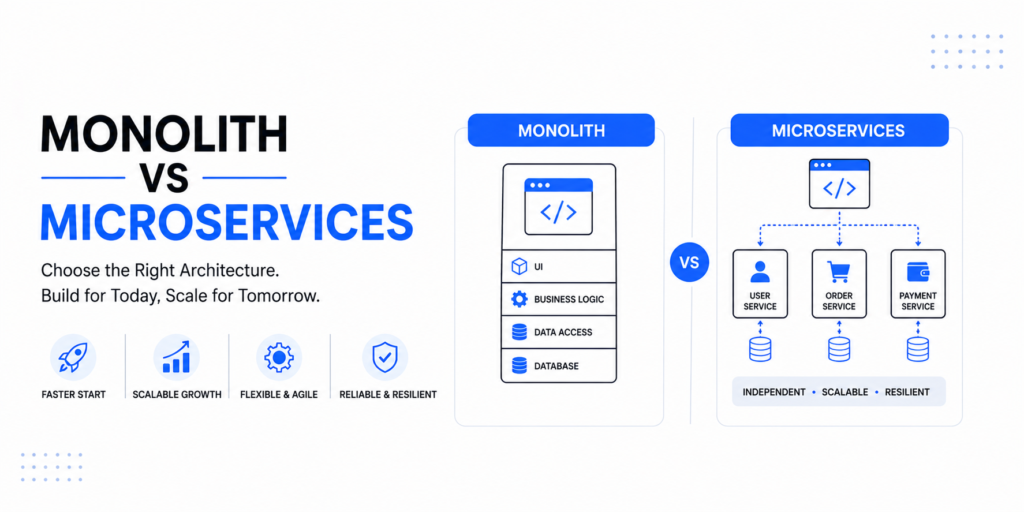
Choosing the right backend architecture is one of the most important technical decisions you’ll make. It shapes how your product evolves, how quickly your team can ship features, and how efficiently your system handles growth. The debate around monolith vs microservices is not just technical—it’s strategic. Each approach offers distinct advantages and trade-offs, and the right choice depends on your stage, goals, and resources.
Understanding the Basics
Before deciding what works best, it’s important to understand what each architecture actually means.
What Is a Monolith?
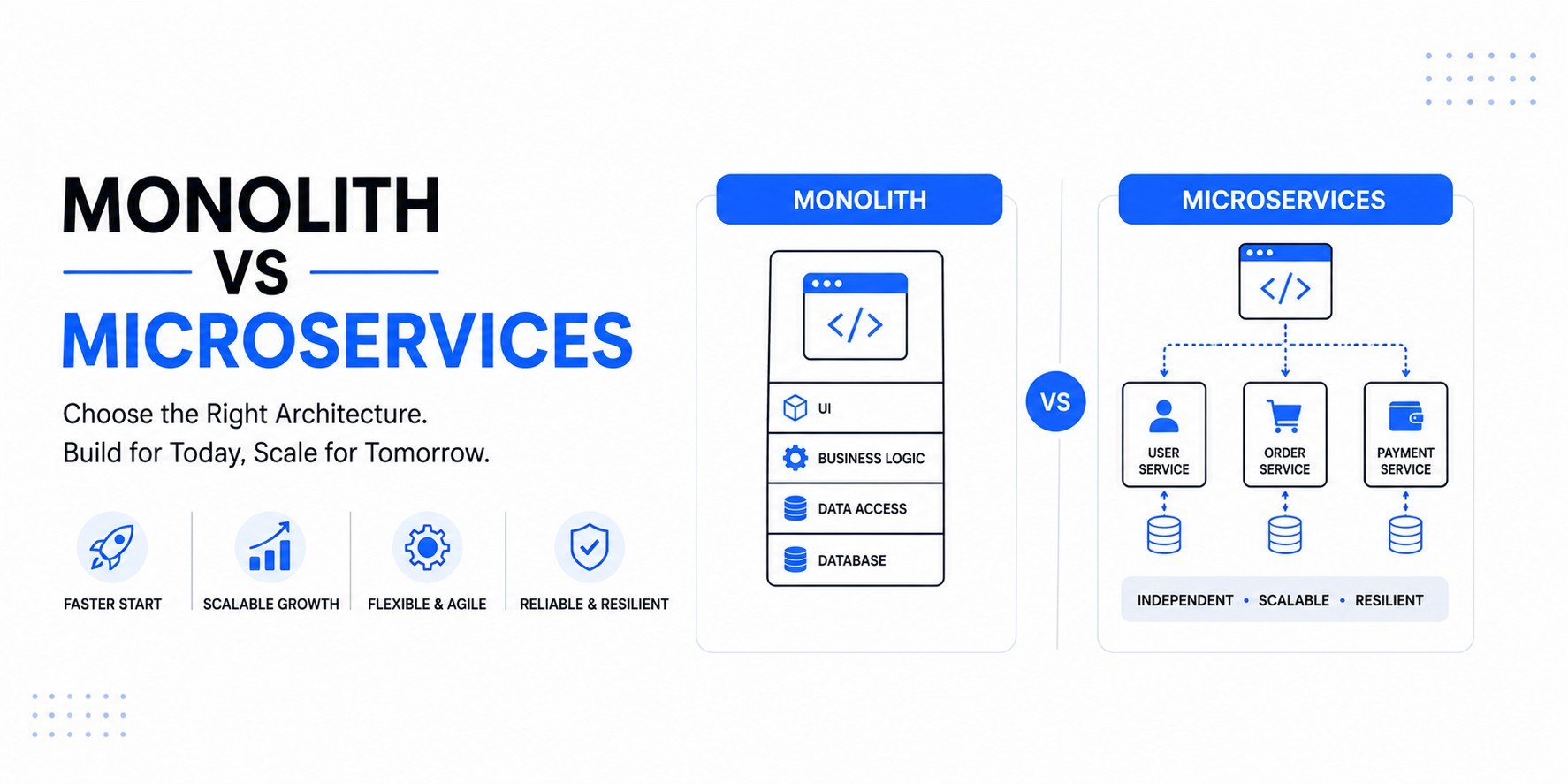
A monolithic architecture is a single, unified codebase where all components of the application are tightly integrated. Everything—business logic, APIs, and data handling—lives within one system.
What Are Microservices?
A microservices architecture breaks the application into smaller, independent services. Each service handles a specific function and communicates with others through APIs.
At its core, the monolith vs microservices debate comes down to:
- Simplicity vs flexibility
- Speed vs scalability
Why This Decision Matters
Your architecture directly impacts:
- Development speed
- System performance
- Scalability
- Maintenance effort
Choosing the wrong approach can lead to:
- Slower releases
- Increased bugs
- Higher operational costs
Choosing the right one creates a strong foundation for long-term growth.
Monolithic Architecture: Pros and Cons
Monoliths are often the default choice, especially in early-stage products.
Advantages of Monolith
| Benefit | Description |
|---|---|
| Simplicity | Easy to build and understand |
| Faster Initial Development | Quick to launch |
| Easier Debugging | Everything in one place |
| Lower Operational Overhead | Fewer moving parts |
This makes monoliths ideal for getting products off the ground quickly.
Challenges of Monolith
| Challenge | Impact |
|---|---|
| Limited Scalability | Hard to scale individual components |
| Tight Coupling | Changes affect the entire system |
| Slower Development Over Time | Complexity increases |
| Risky Deployments | Small changes can impact everything |
As systems grow, these limitations become more noticeable.
Microservices Architecture: Pros and Cons
Microservices are designed for scalability and flexibility, making them popular for larger systems.
Advantages of Microservices
| Benefit | Description |
|---|---|
| Scalability | Scale services independently |
| Flexibility | Use different technologies per service |
| Faster Development at Scale | Teams work independently |
| Fault Isolation | Failures don’t affect entire system |
Microservices allow systems to evolve without being constrained by a single codebase.
Challenges of Microservices
| Challenge | Impact |
|---|---|
| Complexity | More systems to manage |
| Higher Setup Cost | Requires infrastructure and expertise |
| Communication Overhead | Services must coordinate efficiently |
| Monitoring Difficulty | Harder to track issues |
While powerful, microservices require discipline and strong processes.
Monolith vs Microservices: Side-by-Side Comparison
| Factor | Monolith | Microservices |
|---|---|---|
| Development Speed (Early) | Fast | Slower |
| Development Speed (Scaling) | Slows down | Remains consistent |
| Scalability | Limited | High |
| Complexity | Low | High |
| Initial Cost | Low | Higher |
| Long-Term Cost | Can increase | More predictable |
This comparison highlights that the right choice depends on your stage—not just preferences.
When to Choose a Monolith
A monolithic architecture is best suited for early-stage products where speed and simplicity are critical.
Use a Monolith When:
- You’re building an MVP
- Your team is small
- Your product is still evolving
- You need to move quickly with minimal complexity
In these scenarios, the simplicity of a monolith allows you to focus on delivering value without being slowed down by infrastructure decisions.
When to Choose Microservices
Microservices become valuable as your system grows in complexity and scale.
Use Microservices When:
- Your user base is growing rapidly
- You need to scale specific features independently
- Your team is expanding
- Your system has become complex
At this stage, microservices help maintain performance and development speed.
The Hybrid Approach: A Practical Strategy
Most successful systems don’t stick to one model forever. Instead, they evolve.
Hybrid Approach
- Start with a monolith for speed
- Identify bottlenecks as the system grows
- Break out critical components into microservices
- Continue evolving architecture based on needs
This approach balances simplicity and scalability—making it one of the most practical outcomes of the monolith vs microservices decision.
Key Decision Factors
When evaluating monolith vs microservices, consider the following:
1. Scalability Needs
How quickly is your product growing?
2. Team Size
Do you have the resources to manage complexity?
3. Product Complexity
How many features and integrations exist?
4. Budget
Can you invest in infrastructure and tooling?
5. Operational Readiness
Do you have processes for monitoring and deployment?
These factors help determine the right architecture at any given stage.
Common Mistakes to Avoid
Many teams struggle not because of the architecture they choose, but how they implement it.
Key Mistakes
- Starting with microservices too early
- Sticking with a monolith for too long
- Ignoring team capabilities
- Overengineering for future scale
Avoiding these mistakes ensures that your architecture supports growth instead of slowing it down.
The Role of DevOps
Regardless of whether you choose a monolith or microservices, DevOps practices are essential.
Key Practices
- Continuous Integration (CI)
- Continuous Deployment (CD)
- Monitoring and observability
- Infrastructure automation
These practices ensure that your system remains efficient, reliable, and scalable.
Key Takeaways
- The monolith vs microservices decision depends on your stage
- Monoliths are best for speed and simplicity early on
- Microservices enable scalability and flexibility at scale
- A hybrid approach offers the best balance
- DevOps practices are critical for both architectures
Conclusion: Choose Based on Growth, Not Trends
The monolith vs microservices debate is not about which approach is better—it’s about which one fits your current needs and future goals.
A monolith gives you speed.
Microservices give you scalability.
The smartest strategy is not choosing one forever—it’s evolving your architecture as your product grows.
When done right, your backend becomes a system that:
- Supports growth
- Enables faster development
- Maintains performance under pressure
🚀 Ready to Choose the Right Architecture?
If you’re unsure which approach fits your product, the right strategy can make a significant difference.
Evaluate your current system, understand your growth stage, and use the monolith vs microservices framework to make a decision that supports both speed and scalability.