
As your product grows, the complexity behind it grows even faster.
What starts as a simple backend can quickly become a network of servers, databases, APIs, integrations, deployment pipelines, monitoring systems, and cloud infrastructure. In the early stages, handling everything internally may feel manageable. But over time, maintaining these systems becomes increasingly demanding.
This is where managed backend services become valuable—not just as operational support, but as a strategic advantage for startups that want to scale efficiently.
What Are Managed Backend Services?
Managed backend services refer to outsourcing the maintenance, monitoring, optimization, and management of backend systems to specialized teams.
Instead of hiring separate experts for infrastructure, DevOps, deployments, cloud management, and backend optimization, companies work with external specialists who manage these functions through structured systems and processes.
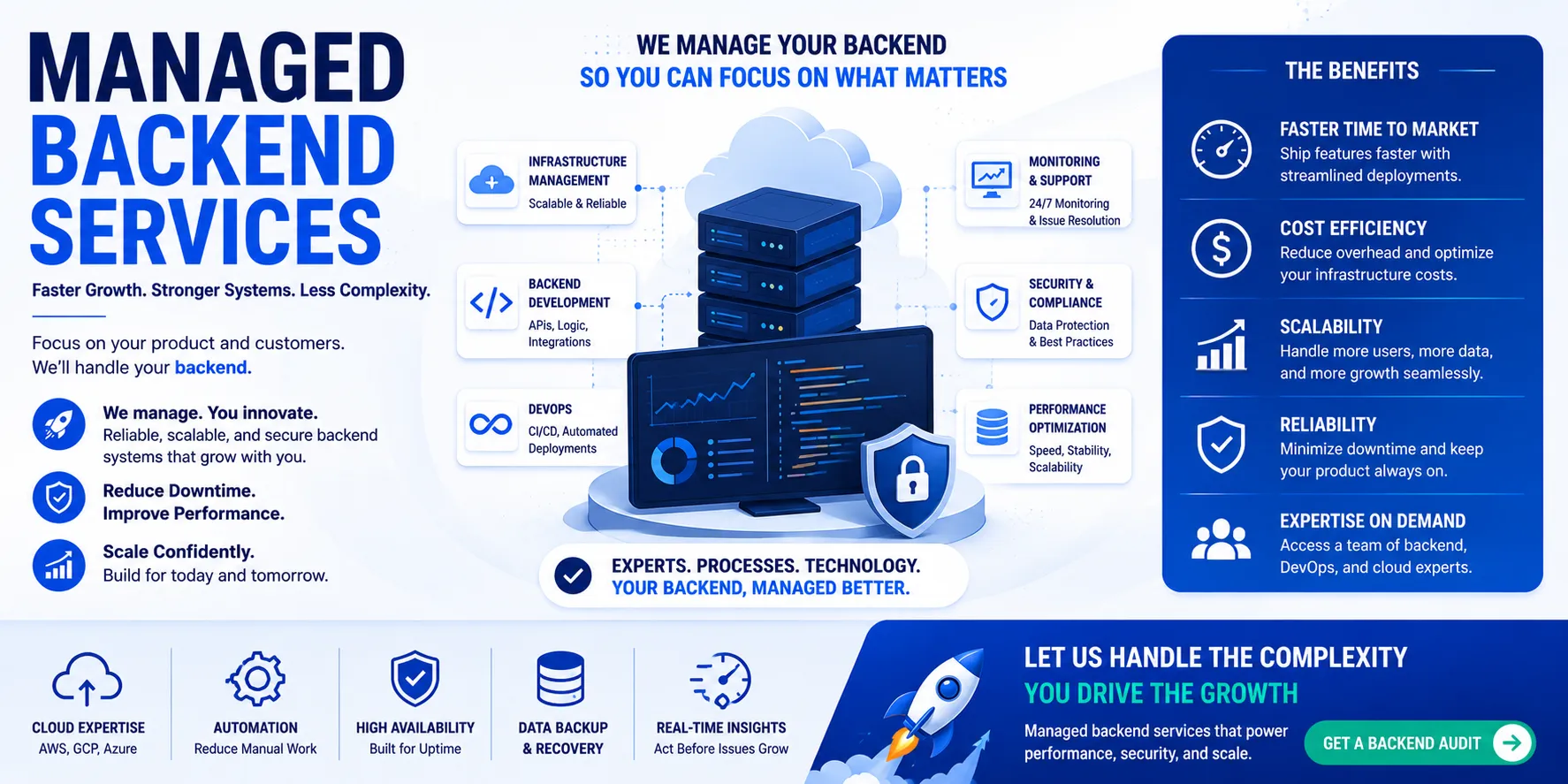
Managed backend services commonly include:
- Infrastructure management
- Backend optimization
- Cloud architecture support
- DevOps implementation
- Monitoring and incident response
- Deployment management
- Security practices
- Performance optimization
- Scalability planning
The goal is simple: reduce operational burden while improving system reliability and growth readiness.
Why Backend Complexity Grows Faster Than Teams
Most startups underestimate how quickly backend complexity compounds.
Initially, a few APIs, databases, and servers may be enough.
As products evolve, new demands emerge:
- More users
- More data processing
- More integrations
- More deployment requirements
- Increased security expectations
- Greater infrastructure demands
- Higher reliability requirements
Growth adds complexity faster than many internal teams can manage.
Eventually, developers spend more time maintaining systems than building products.
This is one of the biggest reasons companies adopt managed backend services.
What Managed Backend Services Usually Include
A strong managed backend approach supports the entire backend lifecycle.
| Service | What It Covers | Why It Matters |
|---|---|---|
| Infrastructure Management | Servers, cloud systems, scaling | Improves reliability |
| Backend Support | APIs, integrations, logic | Enables product growth |
| DevOps | CI/CD, deployments | Speeds releases |
| Monitoring | Alerts, uptime tracking | Reduces downtime |
| Security | Access control, protection | Reduces risk |
| Performance Optimization | Load management, tuning | Improves speed |
Managed services aim to prevent issues before they become operational problems.
How Managed Backend Services Work
Rather than building a large internal team immediately, businesses gain access to specialized expertise.
Managed teams often:
✓ Monitor backend performance continuously
✓ Handle deployments and updates
✓ Optimize infrastructure
✓ Detect bottlenecks early
✓ Improve scalability
✓ Reduce downtime risks
✓ Implement automation workflows
This allows internal teams to focus on:
- Product development
- Innovation
- User experience
- Business growth
Instead of spending excessive time maintaining systems.
Benefits of Managed Backend Services
The value extends beyond outsourcing.
Faster Execution
Teams spend less time fixing infrastructure problems and more time shipping improvements.
Improved Scalability
Backend systems are designed to handle increased demand more effectively.
Reduced Operational Costs
Hiring multiple specialists internally often costs significantly more than managed support.
Better Reliability
Continuous monitoring helps reduce unexpected disruptions.
Access to Expertise
Businesses gain knowledge across DevOps, cloud systems, backend optimization, and infrastructure.
Managed Services vs Building Everything In-House
Founders often struggle with this decision.
| Factor | In-House Team | Managed Backend Services |
|---|---|---|
| Cost | High fixed expense | More predictable |
| Hiring Speed | Slow | Immediate access |
| Expertise | Limited to hires | Multi-domain specialists |
| Scalability | Harder to adjust | Flexible support |
| Maintenance | Internal responsibility | Managed externally |
Neither approach is universally better.
The right choice depends on growth stage, complexity, and available resources.
Signs Your Startup May Need Managed Backend Services
You may need external backend support if:
- Releases keep slowing down
- Developers spend excessive time fixing issues
- Infrastructure feels difficult to maintain
- Downtime becomes more common
- Scaling systems creates stress
- Deployment processes remain manual
- DevOps expertise is missing internally
These are often indicators that systems need stronger support.
Why DevOps Matters in Managed Backend Services
DevOps connects development and operations into a streamlined workflow.
Managed backend teams often implement:
- Continuous Integration (CI)
- Continuous Deployment (CD)
- Automated testing
- Monitoring systems
- Infrastructure automation
These systems improve consistency while reducing manual effort.
Security and Reliability Become More Important as You Scale
As products grow, protecting systems becomes increasingly critical.
Managed backend services often include:
| Capability | Benefit |
|---|---|
| Encryption | Protects sensitive information |
| Access Controls | Limits unauthorized activity |
| Monitoring | Detects unusual behaviour early |
| Backup Systems | Improves recovery readiness |
| Security Practices | Reduces operational risk |
Reliable systems support long-term growth.
The Hidden Cost of Managing Everything Internally
Trying to handle all backend responsibilities internally may create hidden costs:
- Increased hiring expenses
- Slower development cycles
- Operational overload
- Higher maintenance effort
- Delayed feature delivery
- More firefighting during growth
These costs accumulate over time.
How to Start Using Managed Backend Services
Transitioning doesn’t require outsourcing everything immediately.
Many companies begin by:
1. Auditing Existing Systems
Identify bottlenecks and inefficiencies.
2. Outsourcing Specific Functions
Start with infrastructure, DevOps, or monitoring.
3. Improving Automation
Reduce manual processes.
4. Optimizing Architecture
Prepare systems for growth.
5. Expanding Support Gradually
Scale backend management alongside product growth.
Why Managed Backend Services Become a Competitive Advantage
The biggest advantage isn’t reduced workload.
It’s speed with stability.
Businesses with reliable systems can:
- Release improvements faster
- Handle growth more effectively
- Reduce downtime risks
- Improve operational efficiency
- Focus on innovation rather than maintenance
This creates compounding advantages over time.
Conclusion: Focus on Building, Not Constant Maintenance
Growth increases backend complexity whether you plan for it or not.
Managing everything internally may work early on, but eventually systems require specialized expertise.
Managed backend services help businesses reduce friction, improve reliability, and build infrastructure ready for long-term growth.
The goal isn’t simply outsourcing work.
The goal is creating systems that allow your team to move faster.
Ready to Simplify Your Backend Operations?
If infrastructure maintenance is slowing your team down, evaluating managed backend services could help reduce bottlenecks and improve scalability.
Explore your backend systems, identify inefficiencies, and build a stronger foundation for growth.