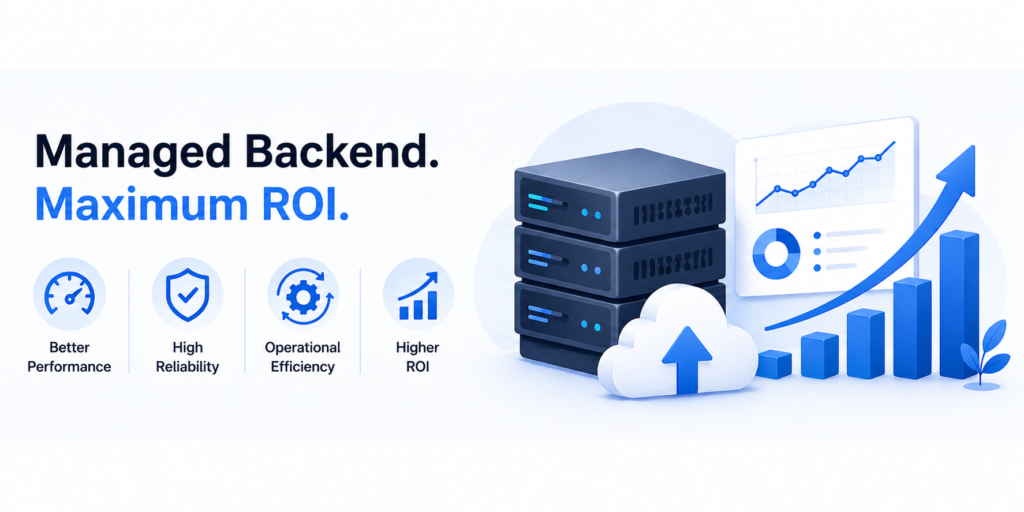
When businesses evaluate technical decisions, the conversation almost always starts with cost. How much will it take to build? How much will it take to maintain? How much can we reduce? But focusing only on cost is a mistake. What truly matters is return—the value your backend generates relative to what you spend. This is where managed backend ROI becomes the defining metric. It separates systems that quietly drain resources from those that actively drive growth.
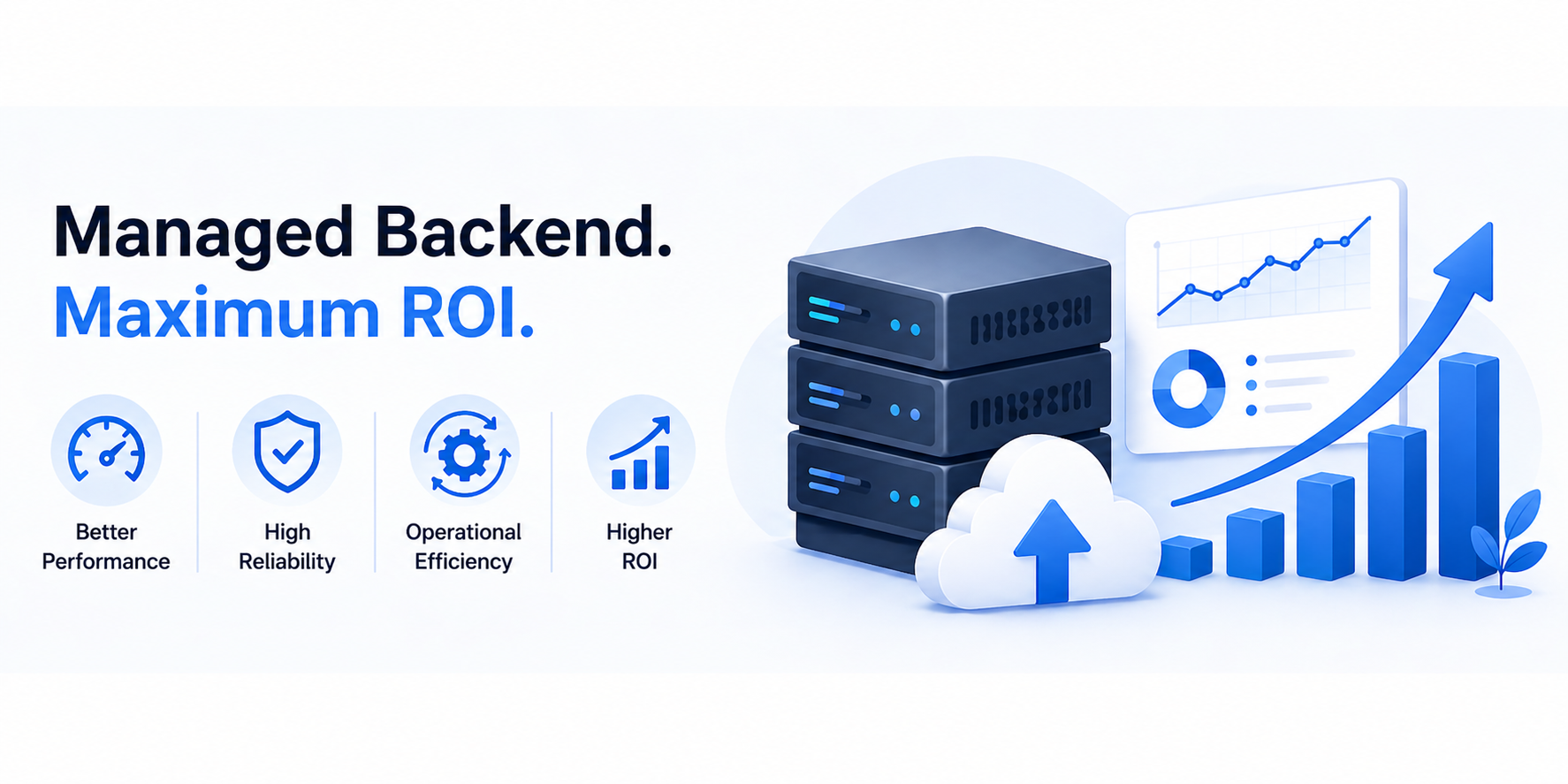
Your backend isn’t just infrastructure. When optimized correctly, it becomes a performance engine that directly impacts revenue, speed, and scalability.
What Is Managed Backend ROI?
Managed backend ROI refers to the measurable return you gain by outsourcing backend operations compared to managing them internally.
It goes beyond simple cost savings. It includes:
- Faster feature releases
- Improved system performance
- Reduced downtime
- Better resource utilization
- Increased revenue opportunities
ROI Formula (Simplified)
ROI = (Value Gained – Cost of Service) / Cost of Service
The challenge isn’t calculating ROI—it’s understanding what counts as “value gained.”
In most cases, value comes from a combination of efficiency, performance, and business outcomes.
The Hidden Cost of In-House Backend Management
Many teams start with an in-house backend setup. While this provides control, it often introduces inefficiencies that reduce overall ROI.
Typical Monthly Cost Breakdown (In-House)
| Category | Estimated Cost |
|---|---|
| Backend Developers (2–4) | High |
| DevOps Engineer | Medium–High |
| Cloud Infrastructure | Medium |
| Monitoring Tools | Medium |
| Total | Significant |
Common Challenges
- Underutilized developer capacity
- Slow deployment cycles
- High maintenance overhead
- Difficulty scaling infrastructure
- Increased risk of errors
These issues don’t always appear immediately. But over time, they reduce efficiency and increase operational costs—directly impacting managed backend ROI.
The Shift to Managed Backend Services
Switching to managed backend services changes how systems operate.
Instead of maintaining infrastructure and handling backend complexity internally, businesses rely on specialized providers who optimize and manage these systems.
What Changes Immediately?
- Lower operational overhead
- Streamlined processes
- Built-in automation
- Access to specialized expertise
Cost Structure (Managed Model)
| Category | Impact |
|---|---|
| Managed Service Fee | Predictable |
| Cloud Infrastructure | Optimized |
| Tools & Monitoring | Often included |
| Total Cost | Reduced and efficient |
While cost savings are important, they are only one part of the managed backend ROI equation.
Performance Gains: The Real ROI Multiplier
The biggest impact of managed backend services comes from performance improvements.
Key Performance Enhancements
| Metric | Before | After |
|---|---|---|
| Deployment Frequency | Infrequent | Frequent |
| Downtime | Higher | Minimal |
| Response Time | Slower | Faster |
| Bug Resolution | Delayed | Rapid |
These improvements directly influence user experience—and user experience drives business results.
How Performance Impacts Revenue
Performance is not just a technical metric—it’s a revenue driver.
Even small improvements can create measurable gains:
- Faster load times increase user retention
- Reduced downtime prevents revenue loss
- Faster releases introduce new monetization opportunities
- Better reliability builds trust and engagement
This is where managed backend ROI becomes powerful—it connects technical improvements directly to financial outcomes.
Productivity Gains: Doing More Without Hiring More
Another major advantage of managed backend services is improved team productivity.
How Work Distribution Changes
| Activity | In-House | Managed |
|---|---|---|
| Maintenance | High | Low |
| Feature Development | Limited | High |
| Deployment Effort | Complex | Minimal |
Instead of spending time fixing infrastructure issues, your internal team focuses on innovation and growth.
This shift increases output without increasing headcount—one of the most overlooked contributors to managed backend ROI.
Cost vs Value: Understanding True ROI
To evaluate ROI properly, you need to combine cost savings with value creation.
Annual Impact Breakdown (Illustrative)
| Component | Value |
|---|---|
| Cost Savings | High |
| Performance Gains | High |
| Productivity Gains | Equivalent to additional hires |
| Revenue Impact | Significant |
| Total Value | Substantial |
ROI Insight
Even if cost savings are moderate, the combined value from performance and productivity creates a strong positive return.
This is why managed backend ROI is often underestimated—it’s not just about saving money, it’s about generating more value.
Why Managed Backend Services Deliver High ROI
Several factors contribute to high ROI when backend systems are managed effectively.
Key Drivers
| Driver | Impact |
|---|---|
| Cost Efficiency | Reduced operational खर्च |
| Expertise | Better system design and optimization |
| Automation | Lower manual effort and errors |
| Scalability | Systems grow without friction |
| Reliability | Minimal downtime and disruptions |
These drivers work together, creating a compounding effect that strengthens managed backend ROI over time.
The Risk Reduction Advantage
One of the most underestimated aspects of ROI is risk reduction.
Backend failures can lead to:
- Revenue loss
- Customer churn
- Brand damage
Managed services reduce these risks through structured monitoring, automation, and proactive optimization.
Risk Comparison
| Factor | In-House | Managed |
|---|---|---|
| Downtime Risk | Medium | Low |
| Security Risk | Medium | Low |
| Scalability Risk | High | Low |
Lower risk translates directly into higher long-term ROI.
When Managed Backend ROI Is Highest
Not every business will experience the same level of ROI. The impact is highest in specific scenarios:
Ideal Situations
- Rapidly growing products
- Increasing infrastructure complexity
- Teams struggling with DevOps
- Frequent downtime or performance issues
- Need for faster product development
In these cases, managed services create immediate and compounding ROI.
Common Misconceptions About Managed Backend ROI
“It’s Just About Cutting Costs”
In reality, the biggest gains come from performance and productivity—not just savings.
“We Lose Control”
Structured systems often improve visibility and control through better monitoring and reporting.
“It’s Only for Large Companies”
Smaller teams benefit the most because they gain access to expertise without hiring extensively.
How to Measure Your Managed Backend ROI
To evaluate your ROI accurately, track these metrics:
- Monthly backend costs
- Deployment frequency
- Downtime duration
- System performance
- Team productivity
- Revenue impact
Compare these metrics before and after implementing managed services to get a clear picture of your managed backend ROI.
The Strategic Shift: Backend as an Investment
The biggest mindset shift is this:
Your backend is not an expense—it’s an investment.
When managed correctly, it:
- Accelerates growth
- Improves performance
- Enhances user experience
- Increases profitability
This is the true power of managed backend ROI—it transforms backend operations into a business advantage.
Conclusion: Build Systems That Generate Value
A backend that only functions is not enough. It needs to perform, scale, and contribute to business outcomes.
By focusing on managed backend ROI, you move from reactive cost management to proactive value creation.
The result is a system that:
- Supports growth effortlessly
- Enables faster innovation
- Maximizes return on every dollar spent
Ready to Maximize Your Managed Backend ROI?
If your backend feels expensive or inefficient, the solution isn’t just to cut costs—it’s to increase value.
A well-managed backend can unlock:
- Faster releases
- Better performance
- Higher scalability
Start by evaluating your current systems and take the first step toward building a backend that works as a profit driver, not just an operational layer.