
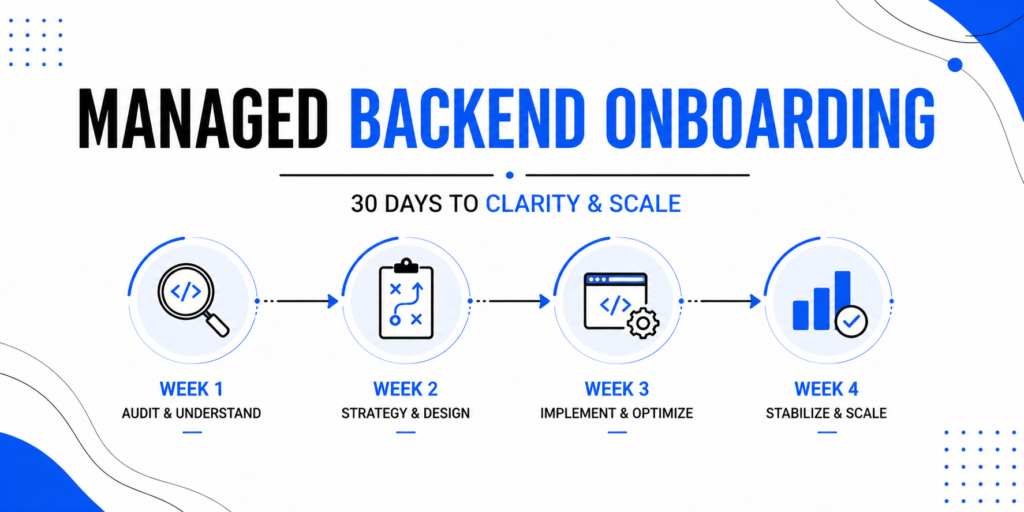
The first 30 days of any backend partnership determine everything—speed, clarity, and long-term success. This phase is not just about setup. It’s about transformation. A well-executed managed backend onboarding process replaces chaos with structure, uncertainty with clarity, and inefficiency with scalable systems. If done right, your backend stops being a bottleneck—and starts becoming a growth engine.
Why Managed Backend Onboarding Matters
Most backend issues don’t come from lack of effort—they come from lack of structure.
Without a proper onboarding process, teams:
- Jump into execution too quickly
- Apply temporary fixes
- Miss deeper architectural issues
This leads to:
- Recurring bugs
- Slower development
- Rising infrastructure costs
Managed backend onboarding solves this by introducing a structured approach from day one.
What Happens During Backend Onboarding?
A strong onboarding process focuses on four key outcomes:
- Understanding the current system
- Identifying inefficiencies
- Building a scalable foundation
- Establishing clear workflows
This ensures that every improvement is intentional and long-term.
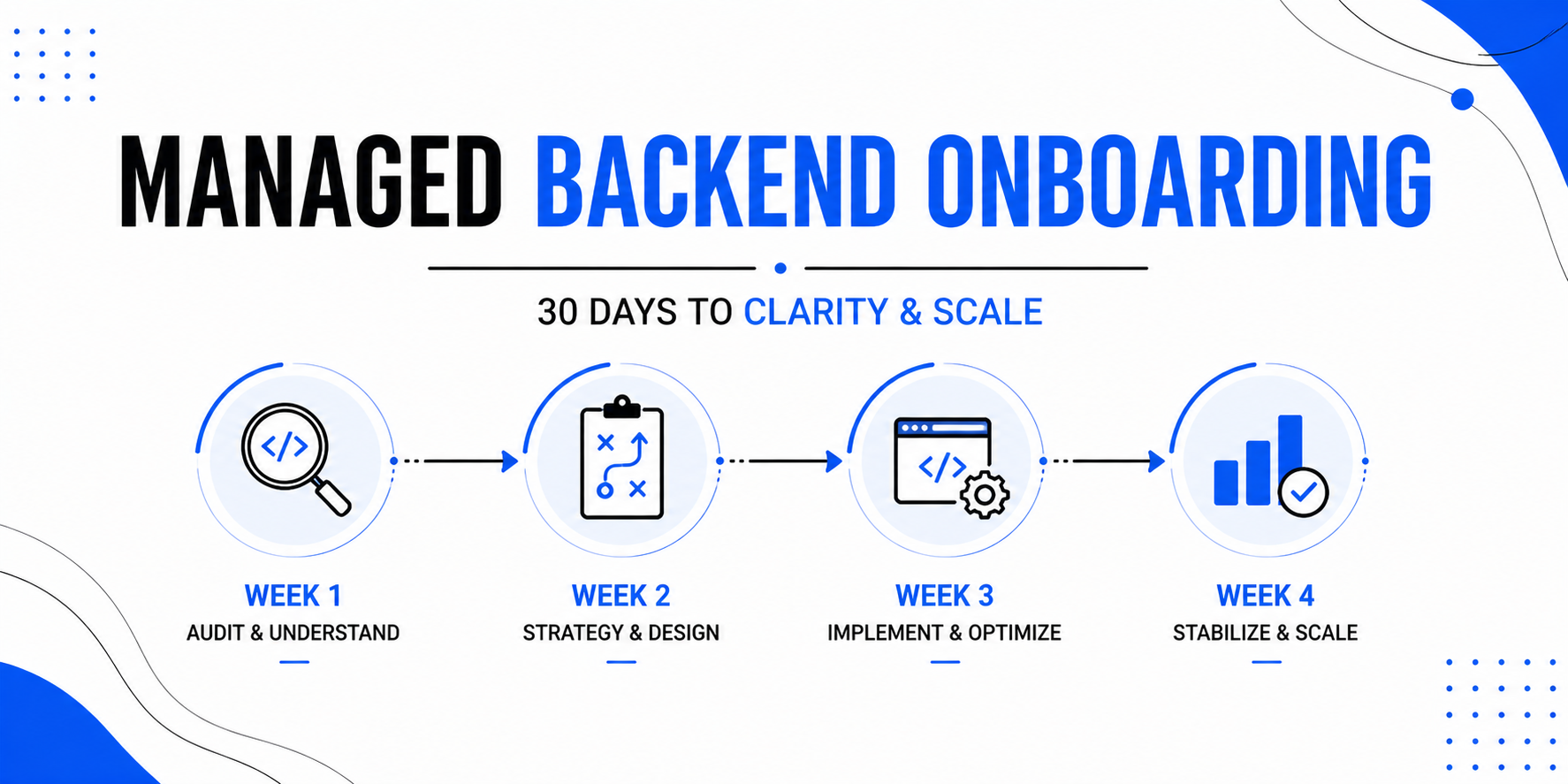
Week 1: Deep Audit and System Understanding
The first week is about gaining complete clarity.
Before making changes, the system must be understood in depth.
Key Activities
- Backend architecture review
- Database performance analysis
- Infrastructure and cloud audit
- Codebase evaluation
- Security assessment
Audit Insights
| Area | What’s Identified | Why It Matters |
|---|---|---|
| Architecture | Structural weaknesses | Affects scalability |
| Performance | Bottlenecks | Impacts speed |
| Costs | Inefficiencies | Increases expenses |
| Security | Vulnerabilities | Affects reliability |
This phase lays the foundation for successful managed backend onboarding.
Week 2: Strategy and System Design
Once the audit is complete, the next step is building a clear plan.
This is where clarity turns into direction.
Key Deliverables
- Backend architecture roadmap
- Performance optimization plan
- Cost optimization strategy
- DevOps and deployment framework
- Security checklist
Strategic Focus
| Focus Area | Goal |
|---|---|
| Scalability | Handle growth efficiently |
| Efficiency | Reduce resource waste |
| Reliability | Ensure system stability |
| Speed | Improve development cycles |
A strong strategy ensures that execution is structured—not reactive.
Week 3: Implementation and Optimization
With a clear plan in place, execution begins.
This is where the transformation becomes visible.
Key Improvements
- Refactoring backend architecture
- Optimizing database queries
- Implementing caching systems
- Setting up CI/CD pipelines
- Introducing monitoring tools
Before vs After
| Metric | Before | After |
|---|---|---|
| Response Time | Slow | Faster |
| Deployment | Manual | Automated |
| Errors | Frequent | Reduced |
| Visibility | Limited | Real-time |
This phase delivers immediate improvements while setting the stage for long-term efficiency.
Week 4: Stabilization and Workflow Setup
The final phase focuses on ensuring sustainability.
It’s not enough to fix systems—you need to maintain them effectively.
Key Activities
- Testing and validation
- Performance benchmarking
- Workflow standardization
- Documentation
- Monitoring setup
Workflow Systems Introduced
- Clear ownership of tasks
- Structured development cycles
- Automated deployments
- Real-time monitoring and alerts
This ensures that improvements are not temporary—they become part of the system.
What Changes After 30 Days?
After a successful managed backend onboarding, the backend transforms from a problem into an asset.
Key Outcomes
- Improved system performance
- Faster feature releases
- Reduced downtime and errors
- Lower infrastructure costs
- Higher team productivity
The system becomes predictable, scalable, and efficient.
Why Managed Backend Onboarding Works
The effectiveness of this approach comes from its structure.
Core Principles
| Principle | Impact |
|---|---|
| Clarity First | Understand before acting |
| Structured Execution | Avoid random fixes |
| Continuous Optimization | Improve over time |
| System Thinking | Focus on long-term scalability |
These principles ensure sustainable improvement—not temporary fixes.
Common Mistakes Without Proper Onboarding
Skipping structured onboarding often leads to recurring problems.
Common Mistakes
- Fixing symptoms instead of root causes
- Ignoring architecture issues
- Lack of monitoring and visibility
- Over-reliance on manual processes
- Poor communication across teams
These mistakes increase complexity and slow down growth.
How Backend Onboarding Impacts Business Growth
Backend improvements are not just technical—they directly affect business outcomes.
Business Benefits
| Area | Impact |
|---|---|
| User Experience | Faster, smoother interactions |
| Revenue | Fewer disruptions |
| Team Efficiency | More productive workflows |
| Scalability | Supports growth |
A strong backend foundation enables long-term success.
What Happens After Onboarding?
The first 30 days set the foundation—but optimization continues.
Ongoing Activities
- Monitoring system performance
- Optimizing costs and efficiency
- Scaling infrastructure
- Supporting development
Backend systems must evolve alongside the product.
When Do You Need Managed Backend Onboarding?
You should consider onboarding if:
- Your backend feels slow or unstable
- Your team spends more time fixing than building
- Scaling feels expensive or complex
- Your workflows lack structure
These are clear signals that your system needs transformation.
Key Takeaways
- Backend onboarding is a transformation phase—not just setup
- Structure and clarity are more important than quick fixes
- A 30-day process can significantly improve performance
- Automation and monitoring are critical
- Long-term success depends on scalable systems
Conclusion: The First 30 Days Define Everything
The first 30 days of backend onboarding set the tone for everything that follows.
A structured managed backend onboarding process ensures that:
- Systems are understood before being changed
- Improvements are intentional
- Growth is supported—not limited
It’s not about working harder—it’s about building smarter systems.
🚀 Ready to Transform Your Backend?
If your backend feels chaotic or inefficient, the right onboarding process can change everything.
With managed backend onboarding, you can:
- Improve performance
- Reduce costs
- Build scalable systems
Start by evaluating your current backend and take the first step toward clarity, efficiency, and growth.