
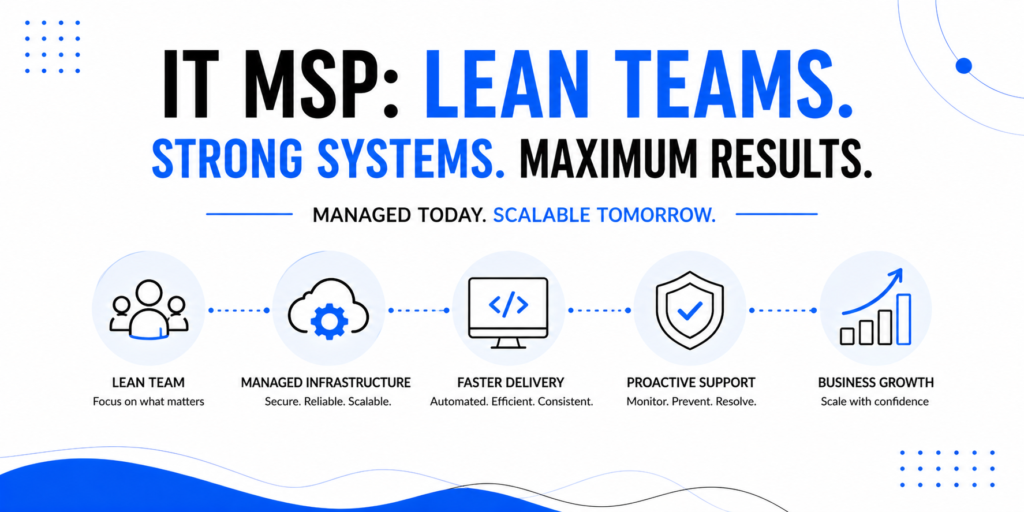
Most businesses don’t struggle because they lack talent—they struggle because their tech teams are structured inefficiently. When progress slows down, the default reaction is to hire more developers. It feels like the logical next step. But in reality, overhiring often creates more problems than it solves—introducing complexity, increasing costs, and slowing execution. The smarter approach is not to expand blindly, but to build a lean, high-performance system. This is where an IT MSP (Managed Service Provider) becomes a strategic advantage.
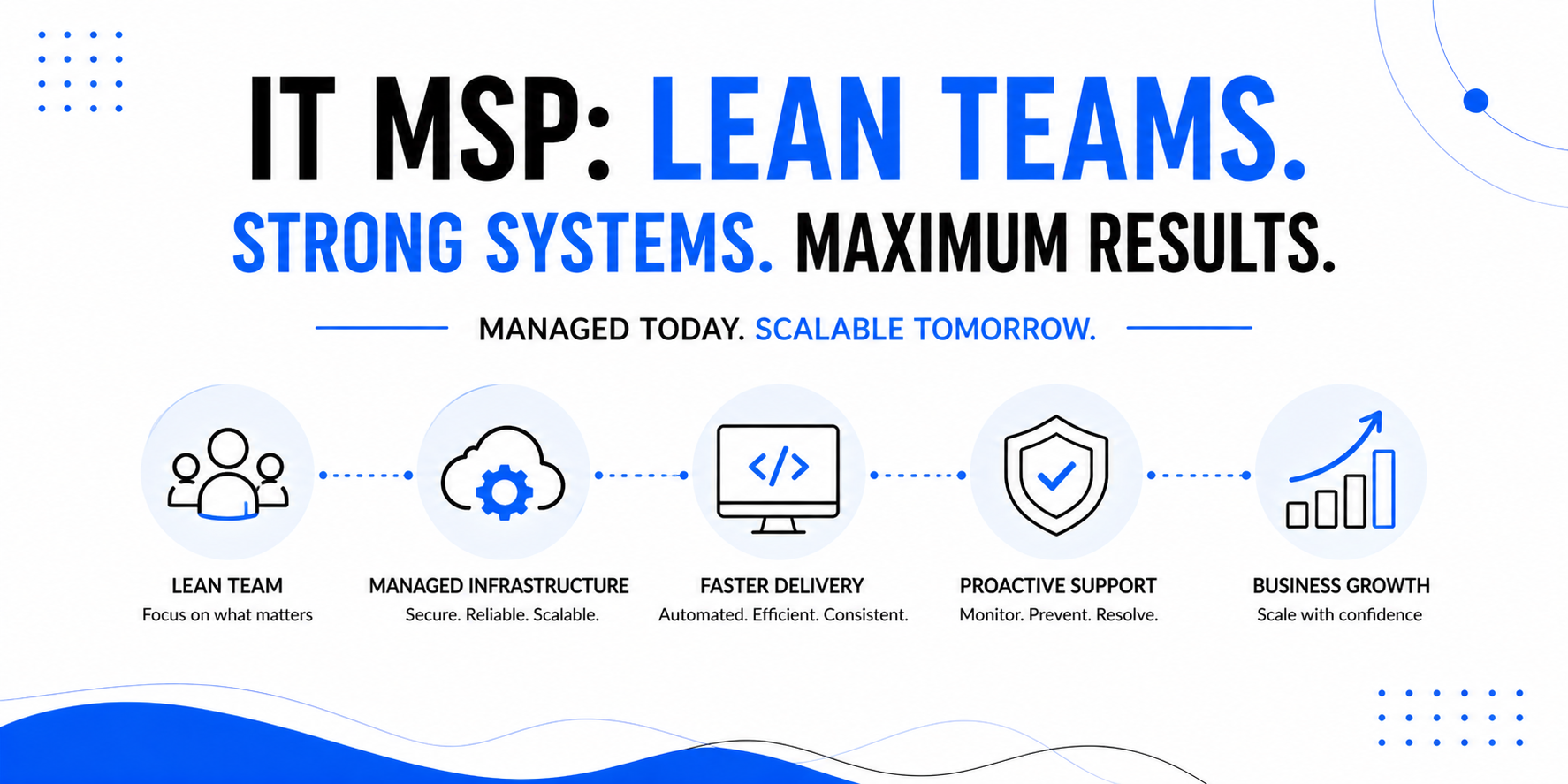
Why Overhiring Hurts More Than It Helps
Hiring gives the illusion of progress, but without structure, it creates friction.
What Happens When You Overhire
- Roles begin to overlap
- Ownership becomes unclear
- Decision-making slows down
- Communication overhead increases
- Dependencies multiply
Instead of speeding things up, execution becomes fragmented.
There’s also a financial impact:
- Salaries and benefits increase fixed costs
- Onboarding consumes time and resources
- Management overhead grows
Despite all this, many teams still struggle to deliver consistently.
That’s because speed doesn’t come from more people—it comes from better systems.
The Core Principle: Lean Teams, Strong Systems
High-performing tech teams are not the largest—they are the most structured.
A lean team with:
- Clear responsibilities
- Defined workflows
- Strong infrastructure
can outperform a much larger, unstructured team.
The goal is not to eliminate people—it’s to eliminate inefficiency.
This is where an IT MSP fits in perfectly.
What Is an IT MSP?
An IT MSP (Managed Service Provider) is an external team that manages your technical operations through structured systems and processes.
Instead of hiring multiple specialists internally, you gain access to:
- Backend developers
- DevOps engineers
- Infrastructure specialists
- Monitoring and support teams
—all working within an optimized execution framework.
The Ideal Tech Team Structure
A modern, efficient tech team is not fully in-house.
It combines strategic control with operational support.
Recommended Structure
| Function | In-House Role | IT MSP Role |
|---|---|---|
| Product Strategy | Product Manager | — |
| Core Development | Lead Developer | Support developers |
| Infrastructure | — | Cloud & DevOps |
| Maintenance | — | Backend support |
| Monitoring | — | Proactive tracking |
| Support | — | Issue resolution |
This structure ensures:
- Internal focus on strategy
- External handling of execution complexity
What an IT MSP Actually Handles
An IT MSP is not just a support layer—it’s a complete execution system.
Core Responsibilities
- Backend system management
- Infrastructure setup and scaling
- DevOps and deployment automation
- Monitoring and performance tracking
- Issue resolution and support
Instead of building these capabilities from scratch, you plug into an existing system.
Benefits of Using an IT MSP
1. Cost Efficiency
Hiring multiple specialists internally is expensive.
An IT MSP provides:
- A full team at a predictable cost
- Reduced hiring and onboarding expenses
- Lower operational overhead
2. Faster Execution
With pre-built systems and workflows:
- Deployment becomes automated
- Processes are standardized
- Delivery becomes predictable
3. Scalability
You can scale resources up or down without:
- Hiring delays
- Long-term commitments
4. Reduced Complexity
Managing fewer internal people means:
- Less coordination
- Fewer dependencies
- Clearer communication
5. Reliability
An IT MSP operates with:
- Proven processes
- Continuous monitoring
- Proactive issue resolution
The Shift from Hiring to Structuring
Most founders ask:
“Who should we hire next?”
The better question is:
“What system do we need to execute better?”
This shift changes everything.
When you focus on systems:
- Bottlenecks become visible
- Workflows become efficient
- Output increases without increasing headcount
An IT MSP helps you implement these systems quickly.
Common Mistakes in Tech Team Structuring
Even strong teams fall into these traps:
Mistakes to Avoid
- Hiring before defining roles
- Creating overlapping responsibilities
- Lack of clear ownership
- Relying on ad hoc workflows
- Ignoring infrastructure and DevOps
These issues compound over time and slow down growth.
An IT MSP helps eliminate these inefficiencies through structured execution.
How to Transition to a Leaner Team
If your team feels bloated or inefficient, you don’t need drastic changes—you need structured optimization.
Step 1: Audit Your Current Setup
Identify:
- Redundant roles
- Bottlenecks
- Workflow gaps
Step 2: Define Core Functions
Decide what must stay in-house:
- Product strategy
- Key decision-making
- Core development
Step 3: Streamline Workflows
Introduce:
- Standardized processes
- Clear ownership
- Automated systems
Step 4: Integrate an IT MSP
Offload:
- Infrastructure
- DevOps
- Monitoring
- Maintenance
Step 5: Continuously Optimize
Track:
- Output
- Speed
- Efficiency
Refine your structure over time.
Why This Model Works for Scaling Businesses
As your business grows, complexity increases.
Without structure:
- Development slows down
- Costs rise
- Systems become unstable
With an IT MSP:
- Systems scale smoothly
- Execution remains fast
- Costs stay predictable
This creates a strong foundation for growth.
Impact on Team Performance
Before vs After Using an IT MSP
| Area | Before | After |
|---|---|---|
| Development Speed | Slower | Faster |
| Deployment | Manual | Automated |
| Coordination | Complex | Streamlined |
| Productivity | Inconsistent | High |
The difference is not in talent—it’s in structure.
When Should You Consider an IT MSP?
You should consider this model if:
- Your team feels slow despite growth
- Costs are increasing without clear output
- Systems are unstable or inefficient
- Developers spend more time fixing than building
These are clear signs that your structure needs improvement.
Key Takeaways
Overhiring increases complexity and slows execution. Lean teams perform better with strong systems. IT MSPs provide structured, scalable execution. Systems matter more than headcount. Efficient structure enables sustainable growth
Conclusion: Build Systems, Not Just Teams
The most effective tech teams are not built by hiring more people—they are built by designing better systems.
An IT MSP allows you to:
- Reduce complexity
- Improve speed
- Scale efficiently
- Maintain high performance
Instead of expanding your team, you upgrade how your system works.
And when your system works efficiently, growth becomes easier, faster, and more sustainable.
🚀 Ready to Optimize Your Tech Team?
If your current setup feels inefficient or overly complex, it’s time to rethink your structure.
With the right systems—and the support of an IT MSP—you can achieve more with less.
Start by identifying what’s slowing you down and replace it with a system designed for execution.