Introduction
The history of data systems dates back to the 1950s when organizations first began storing structured information through punch cards and mainframes. By the 1970s and 1980s, database management systems transformed data into a vital organizational asset.
Fast forward to today — enterprises process petabytes of data daily, powered by AI development services, cloud computing, and data lake architectures. Yet, this abundance of tools has made data ecosystems more complex than ever.
While proprietary ETL (Extract, Transform, Load) solutions dominate the enterprise landscape, open-source ETL tools stand out for their flexibility, transparency, and strong community support. They empower teams to innovate without vendor constraints, ensuring scalability and long-term adaptability.
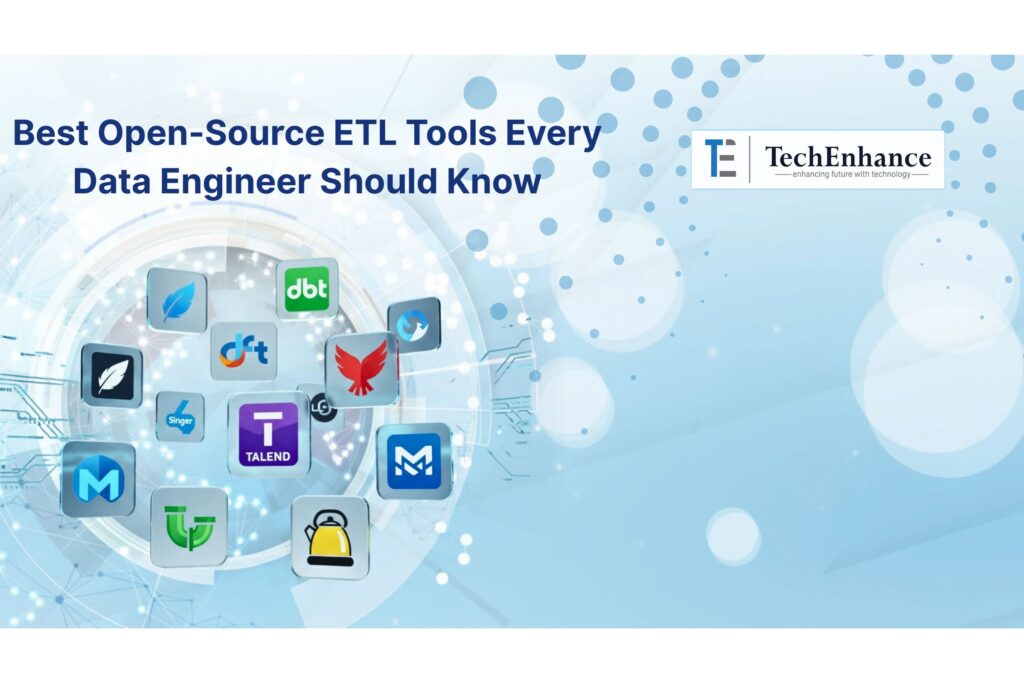
In this article, we’ll explore some of the most powerful open-source ETL tools that every data engineer should know — and why they matter for modern data infrastructure.
Why Do Data Engineers Need Open–Source ETL Tools?
Open-source ETL frameworks have reshaped modern data engineering pipelines. They are modular, extensible, and integrate seamlessly with cloud ecosystems. Unlike closed, monolithic systems, these tools allow organizations to:
- Customize workflows to meet specific business needs.
- Reduce costs associated with vendor licensing.
- Maintain transparency and control over data pipelines.
- Encourage community-driven innovation for faster evolution.
Best Open-Source ETL Tools:
Apache Airflow
Apache Airflow has become the industry standard for workflow orchestration. Built originally at Airbnb, it leverages Directed Acyclic Graphs (DAGs) to manage and monitor complex pipelines. Airflow’s prominence in Apache Airflow vs Prefect discussions stems from its maturity and wide adoption, though newer orchestration frameworks are challenging its dominance.
Characteristics:
- Clear DAG-based structure for transparency and debugging
- Strong integrations across data warehouses, cloud services, and machine learning platforms
- Integrations: Works seamlessly with Hadoop, Kubernetes, cloud storage services like AWS S3 and Azure Blob Storage, and orchestration tools like Airflow.
- Mature open-source ecosystem with plugins and connectors
Prefect
Prefect modernizes workflow orchestration with a developer-first mindset. Designed as a lighter, more dynamic successor to Airflow, Prefect offers both cloud and on-prem options.
Key Features:
- Python-native interface for ease of scripting.
- Built-in observability, retries, and error notifications.
- Great fit for agile data engineering teams using cloud-native architecture.
Explore how Prefect’s orchestration approach enhances data pipeline reliability and real-time monitoring.
DBT
DBT has become the go-to framework for analytics engineering. Instead of managing full ETL processes, DBT focuses purely on transformation inside data warehouses using modular SQL.
Key Features:
- Version-controlled SQL transformations.
- Automated testing and documentation.
- Integrations with Snowflake, BigQuery, and Redshift.
It bridges the gap between data engineers and analysts, fostering collaboration and data governance.
Talend Open Studio
Talend remains one of the more established open-source ETL platforms. It offers a graphical interface that allows drag-and-drop pipeline building, making it accessible to less technical teams while remaining powerful for engineers. While the community edition is limited compared to its enterprise suite, Talend Open Studio continues to be a reliable choice for smaller-scale ETL needs.
Characteristics:
- Wide range of connectors for structured and unstructured data
- Hybrid support for on-premise and cloud environments
- Proven track record with strong enterprise adoption
Apache NiFi
Developed by the NSA and later open-sourced by the Apache Foundation, NiFi specializes in real-time streaming and data flow automation. It’s especially useful in IoT and sensor-based systems.
Key Features:
- Flow-based visual interface.
- Real-time processing with built-in prioritization.
- Emphasis on security and compliance.
Singer – The Open Standard for Data Integration
Singer is less of a tool and more of a framework. It provides a standardized way to represent data extraction and loading through reusable “taps” and “targets.” Singer is ideal for teams that want modularity and aren’t afraid to work closer to the command line.
Characteristics:
- Lightweight and highly flexible
- Reusable components that reduce engineering overhead
- Strong community contributing connectors for diverse data sources
Luigi
Spotify’s Luigi remains a popular choice for building batch workflows. While it predates Airflow, it is still valued for its simplicity and Python-first design. Luigi is often used in academic, research, or smaller production contexts where agility matters more than enterprise-grade orchestration.
Characteristics:
- Lightweight compared to Airflow
- Excellent for dependency management in smaller pipelines
- Strong integration with Hadoop ecosystems
Meltano
Meltano is a new player conceived with modularity at its core. Built on top of Singer, it accentuates extensibility and modern developer workflows. Meltano is gaining recognition among startups and cloud-first organizations seeking end-to-end data integration solutions.
Characteristics:
- CLI-based, Git-integrated workflows.
- Plugins for orchestration, transformation, and data quality
- Active open-source development with a fast-growing community
Pentaho Data Integration (Kettle)
Pentaho, now part of Hitachi Vantara, still offers its community edition as a robust open-source ETL solution. Pentaho continues to hold relevance in organizations, balancing legacy and modern systems.
Characteristics:
- Rich GUI for building complex pipelines without extensive coding
- Mature support for diverse data sources
- Large, active user base with extensive documentation
Apache Beam
Apache Beam equips a programming model that works across multiple porters, including Apache Spark, Flink, and Google Cloud Dataflow. Beam’s inference allows you to avoid being locked into a single execution environment.
Characteristics:
- Unified API for batch and streaming workloads
- Portability across multiple execution engines
- Growing ecosystem for AI development companies in India
How to choose the right tool?
It’s not about adopting a single tool. Modern data stacks combine several, each optimized for different layers of the pipeline. Let’s look at some of the strategic considerations and organizational priorities you must consider before picking the right tool.
Characteristics:
- Scalability Needs: Airflow, Beam, and Spark are preferred for enterprise-grade pipelines.
- Ease of Use: Nifi, Talend, and Pentaho offer more user-friendly interfaces.
- Developer Experience: dbt, Prefect, and Meltano focus on agility and collaboration.
- Streaming vs Batch: Beam, Kafka Spring Boot (from your keyword list), and Luigi represent the spectrum.
The Future of ETL Engineering
Organizations are transitioning from traditional ETL to ELT (Extract, Load, Transform). In this scenario, tools that prioritize transformation within the warehouse, like dbt data build tool, will continue to expand in influence. Meanwhile, orchestration platforms will ripen toward automation, observability, and AI-driven optimization.
Conclusion
Open-source ETL tools are reshaping how organizations design, manage, and scale their data pipelines. From Airflow’s orchestration power to DBT’s transformation-first philosophy, each tool brings unique strengths that data engineers can leverage for efficiency and innovation.
Data is now the most valuable asset a company owns. Harnessing it effectively through the right ETL frameworks — powered by modern cloud data engineering — ensures organizations stay agile, intelligent, and competitive in a data-driven world.