
Introduction
In today’s data-driven world, businesses generate more data in a single day than they did in an entire year a decade ago. Managing, transforming, and analyzing this massive volume manually is nearly impossible.
Data Engineering Automation helps organizations turn raw data into actionable insights efficiently, accurately, and reliably, reducing human effort and accelerating business decisions.
Automation is not just about speeding up processes — it’s about reinventing data workflows to be smarter, adaptive, and resilient, enabling companies to scale without compromising quality.
From Manual Labor to Intelligent Automation
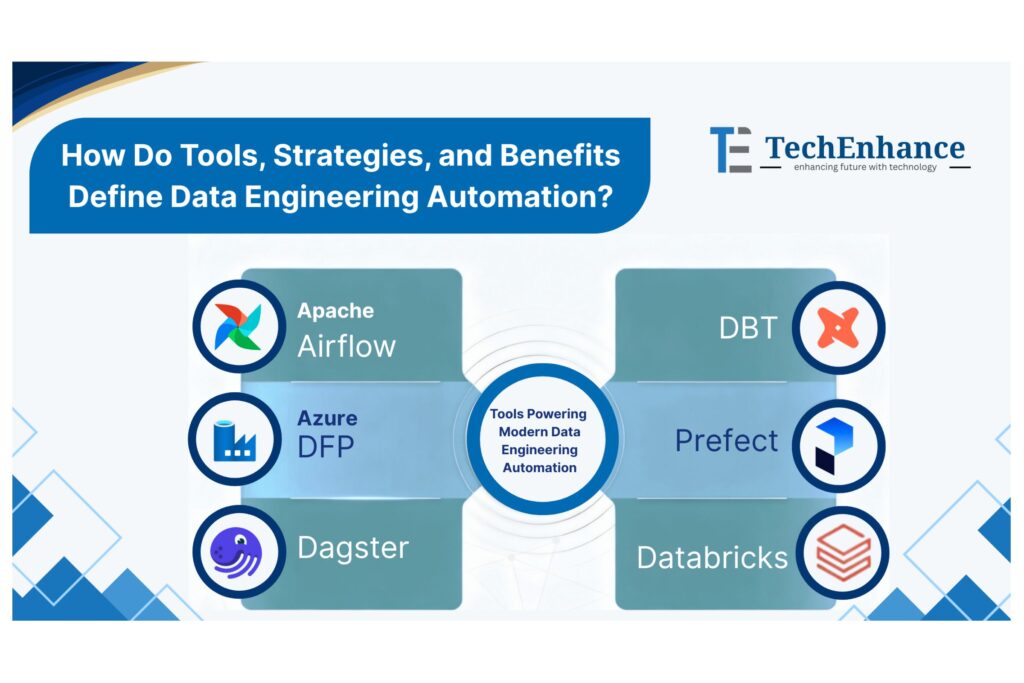
Modern automation tools empower engineers to focus on innovation rather than repetitive tasks. Here are some of the key platforms shaping today’s data engineering landscape:
Apache Airflow
An open-source workflow orchestrator that allows engineers to schedule, monitor, and visualize complex pipelines. Its “DAG” (Directed Acyclic Graph) system gives complete control over task dependencies and execution.
dbt (Data Build Tool)
This revolutionary transformation tool empowers data teams to turn raw data into analytics-ready models using SQL. It integrates version control and testing directly into workflows, ensuring consistency, transparency, and accuracy. Many companies pair dbt with Azure Data Factory pipelines for seamless orchestration and cloud scalability.
Azure Data Factory Pipeline
Microsoft’s Azure Data Factory is a fully managed, cloud-based data integration service that automates the movement and transformation of data across systems. By connecting to hundreds of on-premise and cloud data sources, it simplifies ETL operations and enhances data flow automation — making it an essential tool for modern enterprises.
Databricks Workflow
Databricks unifies data engineering, analytics, and AI. Its integration with Apache Spark architecture enables high-speed processing, smart cluster management, and automated workflow execution.
Prefect & Dagster
Modern orchestration tools emphasizing reliability, observability, and developer experience, Prefect and Dagster simplify automation across teams while maintaining transparency and maintainability.
These platforms empower engineers rather than replace them, allowing scalable and smarter data pipelines.
Learn more about Microsoft Azure Data Factory for scalable data automation.)
Crafting Effective Automation Strategies
Having powerful tools is only half the story. The real success of automation lies in how it’s implemented. Below are proven strategies that ensure long-term results and smooth adoption:
Start Small, Scale Gradually
Instead of automating your entire infrastructure at once, begin with a single pipeline or process. Learn from its performance, identify pain points, and then expand. This iterative approach minimizes risk.
Design Modular Pipelines
Break your data workflow into independent, reusable modules. It improves flexibility and allows quick updates without affecting the whole system.
Monitor Continuously
Automation doesn’t mean “set and forget.” Implement monitoring dashboards and alert systems to track data flow, detect anomalies, and prevent downtime.
Integrate with DevOps Practices
Blend data engineering automation with CI/CD pipelines. It ensures every change—whether in code or data model—is tested, validated, and deployed efficiently.
Prioritize Data Governance
Even the most advanced automation can produce garbage if data quality and compliance aren’t maintained. Automate validation checks, schema enforcement, and security audits to keep data trustworthy.
These strategies turn automation from a convenience into a competitive advantage.
Real-World Benefits Beyond Efficiency
While faster workflows and fewer errors are obvious perks, the true impact of automation goes deeper — touching every part of the data value chain.
Fresh and Reliable Data
Automated pipelines keep data up-to-date, ensuring business dashboards and analytics are based on the latest information. Real-time synchronization means decisions are made on current, not outdated, insights.
Scalability Without Headaches
As data grows, automation ensures that pipelines adjust automatically. No need to manually configure systems or add resources — cloud platforms manage scaling seamlessly.
Enhanced Accuracy and Quality
Machine-led validation minimizes human errors, guaranteeing cleaner datasets and more accurate analytics outputs.
Cost Optimization
Automation eliminates repetitive manual tasks and prevents unnecessary cloud resource consumption. The result? Lower operational costs and a more sustainable infrastructure.
Empowered Teams
Instead of spending time fixing pipelines or writing scripts, engineers can focus on innovation, strategy, and business insights — activities that drive growth.
When implemented right, automation transforms data engineering from a maintenance task into a value creation engine.
The Future: Self-Driving Data Systems
We’re standing at the edge of an exciting future where AI and automation converge.
Imagine a system that predicts data bottlenecks, optimizes its own performance, and repairs broken pipelines — all without human input.
That’s the next evolution: self-driving data operations (DataOps). With predictive analytics, machine learning, and Apache Spark architecture as the backbone, future data systems will operate like autonomous vehicles — safe, efficient, and continuously improving.
Organizations that adopt these advancements early will gain a significant lead in speed, insight accuracy, and cost efficiency.
Wrapping It Up
Data Engineering Automation is not merely a technology trend — it is a strategic advantage for organizations drowning in data. By combining intelligent tools like dbt, Azure Data Factory, and Databricks with thoughtful strategies, companies can create smarter, faster, and more reliable data pipelines.
Even small teams can empower their data engineers and deliver accurate insights consistently. Learn how data engineering automation can transform your workflows and help your organization turn data into actionable business value.