
Introduction
Data is the heart and brain of any business. In today’s digital era, companies rely on data engineering tools and technologies to ensure that success depends not only on collecting data but also on how efficiently it is processed. From deriving customer insights, detecting oddities, to real-time personalizations, the architecture of data plays a crucial role in determining an organization’s response to challenges.
Now we have hands-on access to multiple tools. However, the challenge remains in selecting an approach that is both robust and adaptive. Batch pipelines offer the scalability required for large datasets. Real-time pipelines provide the responsiveness needed for high-stakes environments.
In this article, let’s look at the difference between batch and real-time pipelines, the tools and technologies that support them, and practical use cases.
What are Batch and Real-Time Data Pipelines?
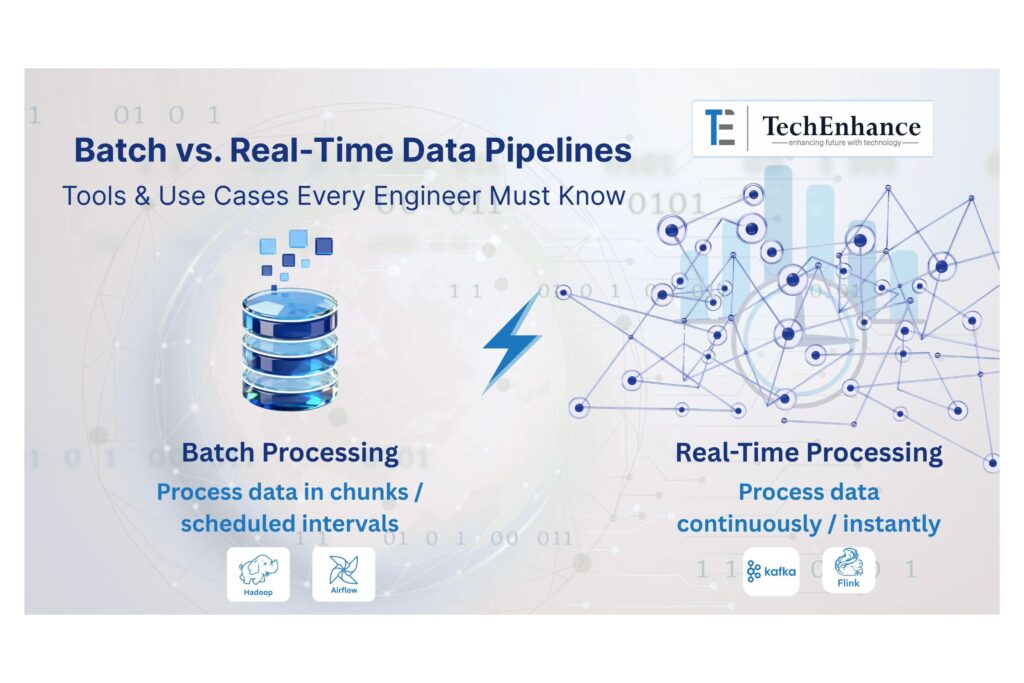
Batch pipelines process data in fixed intervals. Hourly, daily, or weekly. They group large volumes of information before applying transformation or analytics. This method is ideal when immediate results are not important. Efficiency in handling massive datasets is prioritized.
For example, a retail company might use batch pipelines to analyze weekly sales trends, customer demographics, and inventory levels. Since real-time intervention is required, grouping data allows for optimized storage and processing.
Characteristics:
- High throughput
- Lower complexity in data handling
- Efficient resource utilization
- Suitable for offline processing, reporting, and trend analysis
Tools and Technologies:
Customers are more willing to engage when they feel their information is safe. But GenAI relies on massive amounts of customer data. Any misuse or breach corrodes trust. Indian enterprises must comply with the new Digital Personal Data Protection Act (DPDPA) and global standards, or risk losing customer confidence.
Apache Hadoop
Apache Hadoop is a pioneer in batch data processing, offering distributed storage (HDFS) and computation across clusters of machines. It’s widely used in data warehousing, large-scale analytics, and ETL workflows.
Apache Spark Architecture
Apache Spark has revolutionized batch processing by leveraging in-memory computation for faster data transformations. It supports advanced analytics, machine learning, and graph processing, making it a go-to framework for engineers needing high-performance batch pipelines
Apache Airflow
Apache Airflow is used for staging workflows, scheduling batch jobs, and managing dependencies. It ensures pipelines run reliably and allows engineers to visualize task flows, monitor jobs, and automate retries in case of failures.
Batch Pipeline Use Cases
1. Business Reporting and Analytics
Retail or finance firms use batch pipelines for weekly or monthly reporting and forecasting — optimizing performance through cloud data engineering solutions
2. Machine Learning Model Training
ML models rely on historical data for training. Batch pipelines ensure clean, structured inputs for AI-driven analytics
3.Data Warehousing and ArchivalLarge
enterprises and government bodies use data lake architecture for centralized, compliant storage of massive datasets.
4.Customer Segmentation and Personalization
Businesses analyze customer behavior patterns over time to group them for targeted marketing.
5.Financial Reconciliation
Batch pipelines are often used to crystallize and cross-check large datasets to ensure accuracy.
Real-Time Pipelines:
Real-time pipelines process data as it arrives. It enables organizations to gain insights within milliseconds or seconds of an event occurring. These pipelines are important when latency can cost revenue, reputation, or operational efficiency.
For example, a financial institution uses real-time pipelines to monitor transactions for fraud, flagging suspicious activity instantly to prevent loss.
Characteristics:
- Low latency
- Even-driven architecture
- Immediate data ingestion and processing
- Supports streaming analytics, fraud detection, and live dashboards.
Tools & Technologies:
Real-time pipelines require systems that handle event streams, fast data ingestion, and low-latency processing. The tools below are designed to process data continuously while ensuring fault tolerance and scalability.
Apache Kafka
Apache Kafka is a broadcast event streaming platform widely used for real-time data pipelines. It handles large volumes of events with low latency and supports multiple consumers reading data streams in parallel.
Apache Flink / Spark Streaming
For streaming analytics, frameworks like Apache Flink and Spark Streaming provide real-time computation with state management, windowing, and fault tolerance. They allow engineers to apply transformations, filters, and aggregations on live data streams.
Managed Cloud Solutions
Cloud providers offer services that abstract away infrastructure complexities while providing scalable, serverless solutions:
- Google Dataflow – A fully managed stream and batch processing service.
- AWS Kinesis – A platform for streaming data ingestion and analytics with flexible processing pipelines.
These solutions are perfect for engineers looking to deploy real-time pipelines quickly without worrying about scaling and resource management.
How Data Lake Architecture Supports Both Pipelines
A data lake architecture functions as a centralized depository for storing structured, semi-structured, and unstructured data. Unlike traditional data warehouses, data lakes offer flexibility in how data is stored and accessed, making them suitable for both batch and real-time pipelines.
Key features of data lakes:
- Storage of raw, unprocessed data
- Support for schema-on-read, allowing flexibility in query design
- Integration with distributed processing frameworks like Hadoop and Spark
- Metadata cataloging for easier data governance
Real-Time Pipeline Use Cases
- Integration with distributed processing frameworks like Hadoop and Spark
- Metadata cataloging for easier data governance
1.Fraud Detection and Risk Monitoring
Financial fraud can occur within winks, making real-time analysis critical. A payment gateway processes thousands of transactions per second, using streaming analytics to flag suspicious patterns like duplicate payments or unusual transaction amounts before they are completed.
2. Live Customer Support
Businesses need to respond quickly to customer inquiries or issues to enhance satisfaction. A telecom provider uses real-time data from customer devices to detect service disruptions and automatically reroute traffic or inform users via alerts.
3. IoT Monitoring and Predictive Maintenance
Connected devices generate vast amounts of data that must be acted upon immediately to prevent downtime. A manufacturing plant uses sensor data from machines to detect anomalies like overheating or vibration patterns, triggering alerts for maintenance before a failure occurs.
4.Personalized Recommendations
Streaming analytics enable businesses to serve tailored content to users based on their immediate behavior. A streaming platform analyzes a viewer’s current activity and suggests new shows or videos in real time, improving user engagement.
5.Supply Chain Optimization
Real-time data helps logistics companies track shipments, inventory, and demand fluctuations as they occur. A courier service uses GPS data streams to monitor vehicle locations, optimizing routes dynamically and ensuring faster delivery times.
6.Social Media Monitoring
Brands and organizations track public sentiment and trends as they happen to respond proactively. A marketing team analyzes live social media feeds to understand customer reactions to a new product launch, adjusting advertising strategies on the fly.
Choosing Between Batch and Real-Time Pipelines
Picking the right pipeline depends on your business plans, data elements, and operational restraints. Both batch and real-time pipelines come with special advantages, but using them requires understanding where they fit in your organization’s workflows.
Here are key factors and considerations that can guide engineers and architects in making informed decisions:
- Is immediate insight necessary, or can analysis be shelved?
- How large is the dataset, and how often is it updated?
- What level of infrastructure intricacy can your team support?
- How urgent is system availability, defect tolerance, and data accuracy?
Mixed systems are becoming prevalent. Many firms process raw data in real time for monitoring goals while using batch pipelines for deeper analytics and historical reporting.
Conclusion
For a modern data-driven enterprise, data processing helps in providing the infrastructure to ingest, process, and analyze data at scale. Whether you choose batch pipelines for their efficiency or real-time pipelines for immediacy, understanding the nuances between them is essential for engineers tasked with designing data-driven systems.
With refinements in distributed computing, streaming frameworks, and especially cloud data engineering services, organizations no longer face the daunting challenges of managing large datasets. Instead, they can focus on unlocking insights, automating processes, and delivering better experiences.
The choice between batch and real-time is not an either-or proposition. It’s about aligning data processing strategies with business outcomes, latency essentials, and infrastructure abilities. By carefully deciding the right tools and designing architectures that support growth, data engineers can ensure their pipelines not only meet present demands but also scale for the future.