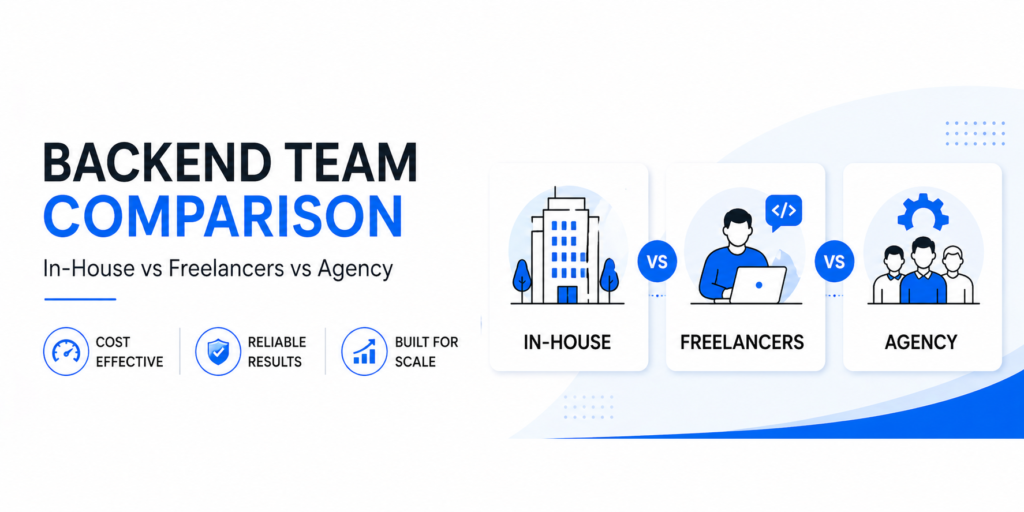
Choosing how to build and manage your backend team is one of the most critical decisions you’ll make as a business owner. It directly impacts your development speed, operational costs, product quality, and ability to scale. The three most common approaches—in-house teams, freelancers, and agencies—each offer unique advantages and trade-offs. This backend team comparison breaks down how each model performs in real-world scenarios, when to use them, and how to structure your team for long-term success.
Why Backend Team Structure Matters
Your backend is the core engine of your product. It manages data, processes logic, ensures performance, and maintains reliability.
A strong backend team enables:
- Faster feature releases
- Stable system performance
- Scalable infrastructure
- Better user experience
A weak structure leads to delays, bugs, and rising costs. That’s why this backend team comparison is not just a hiring decision—it’s a strategic one.
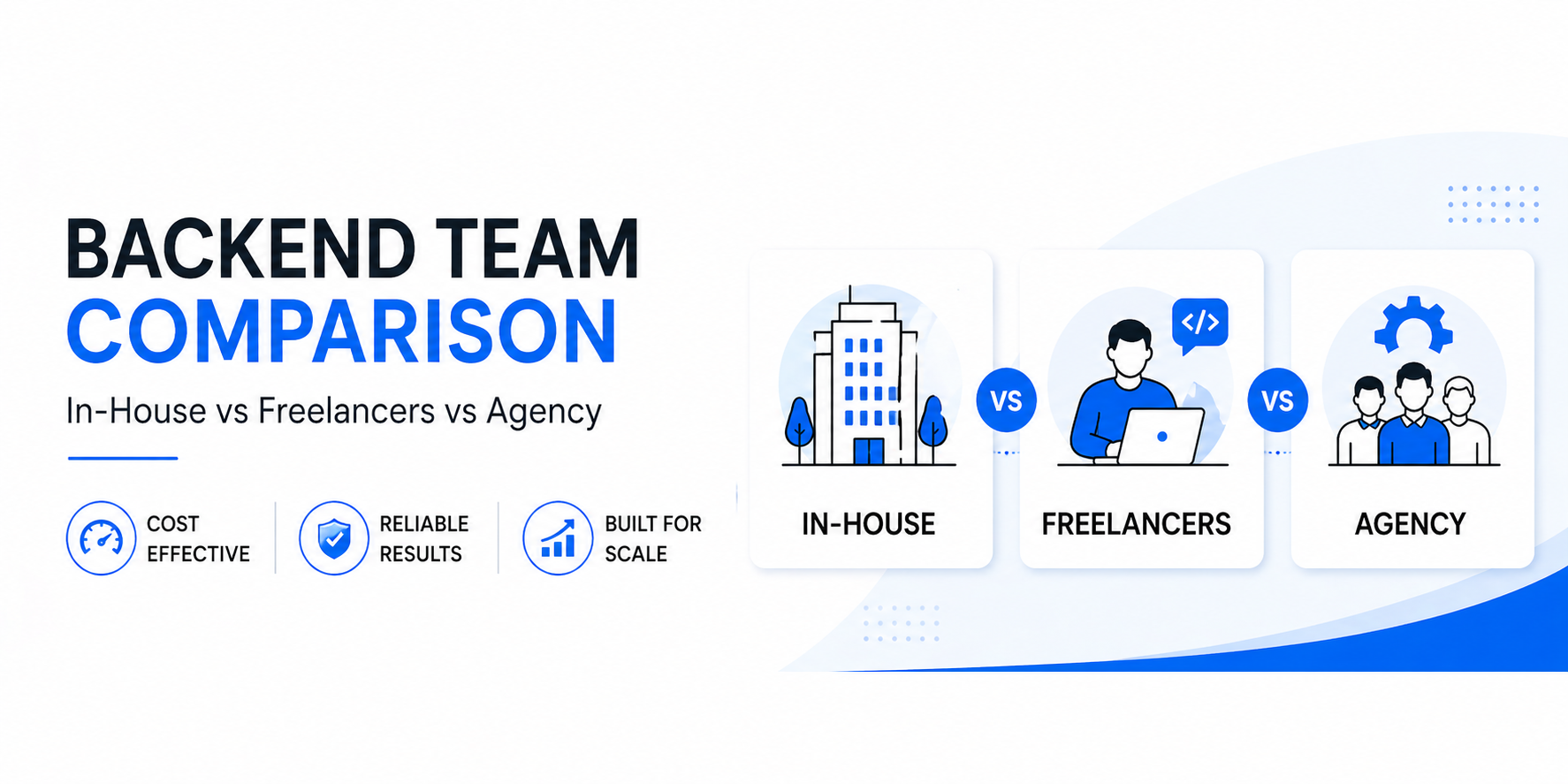
The Three Backend Team Models
Before comparing them, let’s define each model clearly.
1. In-House Team
A full-time internal team dedicated exclusively to your product.
2. Freelancers
Independent developers hired for specific tasks or short-term projects.
3. Agency
An external, structured team providing end-to-end backend and infrastructure services.
Each model serves a different purpose depending on your stage and needs.
Backend Team Comparison: Quick Overview
| Factor | In-House Team | Freelancers | Agency |
|---|---|---|---|
| Cost | High fixed cost | Low to medium | Predictable |
| Speed | Moderate | Fast (small tasks) | Fast (structured) |
| Scalability | Limited | Difficult | High |
| Reliability | High (if managed well) | Variable | High |
| Expertise | Depends on hires | Limited | Diverse |
| Management Effort | High | Moderate | Low |
This table gives a high-level view, but the real differences appear when you go deeper.
In-House Teams: Control with Commitment
In-house teams offer the highest level of control. They work closely with your product and align deeply with your business goals.
Advantages
- Full ownership of development
- Strong product understanding
- Seamless communication
- Long-term consistency
This makes in-house teams ideal for companies that require continuous development and deep system knowledge.
Challenges
| Challenge | Impact |
|---|---|
| High Costs | Salaries, benefits, infrastructure |
| Slow Hiring | Time-consuming recruitment |
| Management Overhead | Requires leadership and processes |
| Limited Flexibility | Hard to scale quickly |
In early stages, these challenges can slow momentum. That’s why many businesses delay building a full in-house backend team.
Freelancers: Flexibility with Risk
Freelancers are often the fastest way to get started. They provide flexibility and require minimal long-term commitment.
Advantages
- Quick onboarding
- Lower upfront costs
- Flexible engagement
They are particularly useful for:
- Small features
- Bug fixes
- Short-term projects
Challenges
| Challenge | Impact |
|---|---|
| Inconsistent Quality | Depends on individual skill |
| Limited Accountability | No long-term ownership |
| Communication Gaps | Time zone and availability issues |
| Scaling Difficulty | Hard to coordinate multiple freelancers |
Freelancers can work well in isolation, but they often struggle with complex backend systems. This is a key takeaway in any backend team comparison.
Agencies: Structure with Scalability
Agencies provide a complete backend solution with a team of specialists. They combine structured processes with diverse expertise.
Advantages
- Access to multiple specialists (backend, DevOps, cloud)
- Faster execution through established workflows
- Scalable resources on demand
- Reduced management effort
Agencies are particularly effective when:
- Systems are complex
- Speed is critical
- Scalability is required
Challenges
| Challenge | Impact |
|---|---|
| Less Direct Control | Compared to in-house teams |
| Dependency | Reliance on external partner |
| Initial Alignment | Requires clear communication |
Despite these trade-offs, agencies often provide the most balanced solution in this backend team comparison.
What Works Best at Different Stages?
The right model depends heavily on your stage of growth.
Stage-Based Backend Team Comparison
| Stage | Best Option | Why |
|---|---|---|
| Early Stage (MVP) | Freelancers / Agency | Fast and flexible |
| Growth Stage | Agency | Scalable and structured |
| Mature Stage | In-House + Agency | Control + efficiency |
This progression allows you to optimize for speed early and stability later.
Cost Perspective: What You’re Really Paying
Cost is often the deciding factor, but it’s important to understand how each model behaves over time.
Cost Breakdown
| Model | Cost Type | Predictability |
|---|---|---|
| In-House | Fixed (high) | Medium |
| Freelancers | Variable | Low |
| Agency | Subscription / project | High |
While freelancers appear cheaper initially, costs can increase due to inefficiencies. Agencies often provide better predictability, which improves planning and ROI.
Speed and Execution
Speed is critical, especially in competitive markets.
Execution Comparison
| Model | Speed | Why |
|---|---|---|
| In-House | Moderate | Depends on team size |
| Freelancers | Fast (small tasks) | Limited scope |
| Agency | Fast (complex systems) | Structured workflows |
Agencies typically deliver consistent speed across larger systems, making them a strong choice for scaling products.
Reliability and Risk
Backend reliability directly impacts user experience and business performance.
Reliability Comparison
| Model | Reliability | Risk Level |
|---|---|---|
| In-House | High | Medium |
| Freelancers | Variable | High |
| Agency | High | Low |
Agencies reduce risk through standardized processes and team redundancy, making them more reliable for critical systems.
The Hybrid Model: Best of All Worlds
The most effective approach is often a combination of all three models.
Hybrid Backend Strategy
| Function | Best Model |
|---|---|
| Product Strategy | In-House |
| Core Backend | In-House / Agency |
| Infrastructure & DevOps | Agency |
| Short-Term Tasks | Freelancers |
This hybrid structure balances:
- Control (in-house)
- Speed (freelancers)
- Scalability (agency)
It’s the most practical outcome of a well-thought-out backend team comparison.
Common Mistakes to Avoid
Many teams struggle not because of the model they choose, but how they use it.
Key Mistakes
- Hiring in-house too early
- Over-relying on freelancers for complex systems
- Choosing agencies without proper alignment
- Ignoring long-term scalability
Avoiding these mistakes can significantly improve your backend efficiency.
Key Takeaways from This Backend Team Comparison
- No single model is perfect
- The right choice depends on your growth stage
- Agencies offer the best balance for scaling
- In-house teams provide long-term control
- Freelancers are ideal for short-term needs
The most successful teams don’t choose one—they combine them strategically.
Conclusion: Build for Strategy, Not Convenience
Choosing between in-house teams, freelancers, and agencies is not about preference—it’s about alignment with your goals.
This backend team comparison shows that the smartest approach evolves over time. Start lean, scale with structure, and build control gradually.
When your backend team is structured correctly, you gain:
- Faster execution
- Better reliability
- Scalable growth
🚀 Ready to Build the Right Backend Team?
If you’re unsure which model fits your business, the right strategy can unlock speed, efficiency, and growth.
Start by evaluating your current setup and use this backend team comparison to design a structure that supports your next stage of scale.