
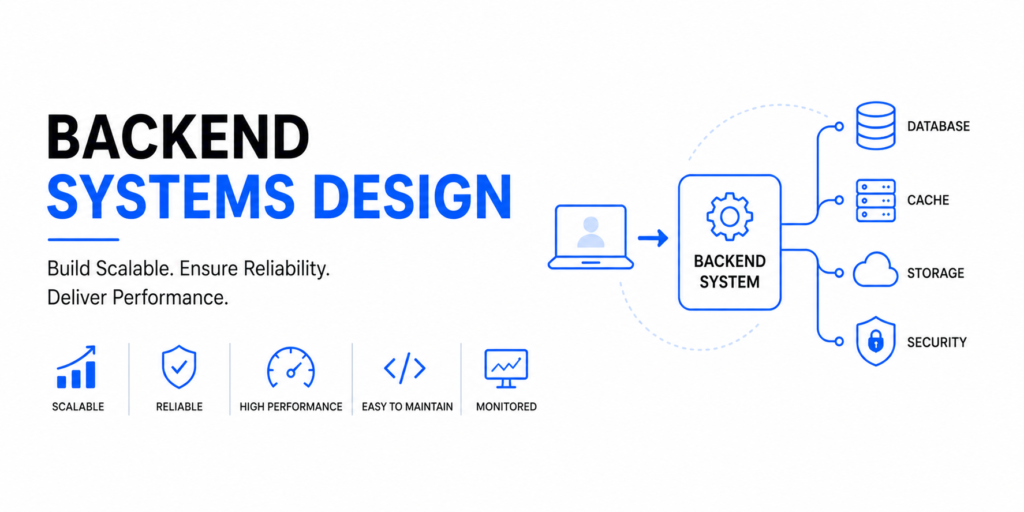
Every fast-scaling product shares one core trait: a system that doesn’t just function—it performs under pressure. Users experience speed, reliability, and consistency even as traffic increases and complexity grows. Behind this experience lies thoughtful backend systems design. It’s not just about writing code—it’s about creating a system that can scale, adapt, and deliver consistent performance over time.
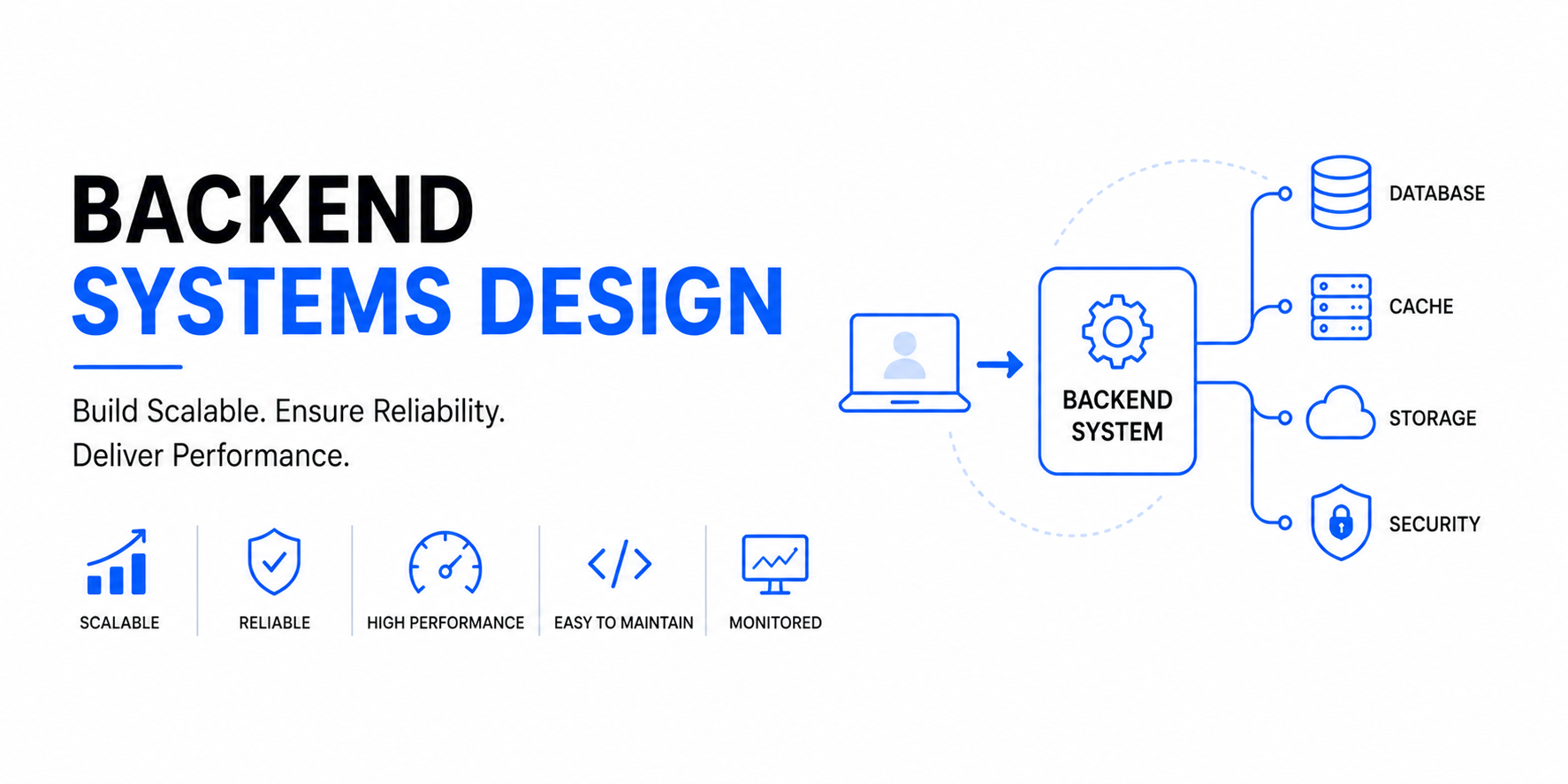
What Is Backend Systems Design?
Backend systems design refers to how the internal structure of your application is planned and organized. It defines how different components interact, how data flows, and how the system handles growth.
A well-designed backend system:
- Processes requests efficiently
- Handles traffic spikes without failure
- Supports rapid feature development
- Maintains stability under load
It’s the invisible layer that determines how well your product performs in real-world conditions.
Why Backend Systems Design Matters
Many teams focus heavily on frontend experience and user acquisition. While these are important, the backend determines how far your product can scale.
Poor backend systems design leads to:
- Slow performance
- Frequent bugs
- Difficulty scaling
- Increased operational complexity
Strong backend systems design enables:
- Faster development cycles
- Reliable performance
- Seamless scalability
- Reduced risk
In short, your backend defines your product’s limits—or removes them entirely.
Core Components of Backend Systems Design
A high-performing system is built on several interconnected components. Each plays a critical role in ensuring performance and reliability.
Core Components
| Component | Role | Impact |
|---|---|---|
| Architecture | Defines structure | Enables scalability |
| Infrastructure | Provides resources | Ensures performance |
| Data Management | Handles storage and retrieval | Improves efficiency |
| Automation | Streamlines workflows | Reduces errors |
| Monitoring | Tracks system health | Prevents failures |
When these elements are aligned, your system becomes both efficient and resilient.
1. Scalable Architecture
Architecture is the foundation of backend systems design.
A scalable architecture allows:
- Independent scaling of components
- Efficient handling of increased traffic
- Flexible feature development
Best Practices
- Use modular design
- Separate concerns across components
- Avoid tight coupling
- Plan for growth early
Choosing between monolithic and microservices architectures depends on your stage and complexity, but scalability should always be a priority.
2. Reliable Infrastructure
Infrastructure is where your system runs. Without reliable infrastructure, even the best design will fail under pressure.
Infrastructure Best Practices
- Use cloud-based systems for flexibility
- Implement load balancing to distribute traffic
- Ensure redundancy to prevent failures
- Optimize resource allocation
Reliable infrastructure ensures your system remains stable and responsive at all times.
3. Efficient Data Management
Data is central to backend systems design. Efficient handling of data ensures both speed and accuracy.
Key Strategies
| Strategy | Benefit |
|---|---|
| Optimized Queries | Faster data retrieval |
| Data Partitioning | Improved scalability |
| Caching | Reduced database load |
| Backup Systems | Data protection |
A strong data strategy ensures your system can handle large volumes without slowing down.
4. Automation and DevOps
Automation is what transforms a functional system into a high-performing one.
Key Areas of Automation
- Continuous Integration (CI)
- Continuous Deployment (CD)
- Automated testing
- Infrastructure as Code
Benefits
- Faster releases
- Reduced human error
- Consistent processes
- Improved efficiency
Automation ensures that backend systems design remains scalable and reliable as complexity grows.
5. Monitoring and Observability
A high-performing system requires visibility.
Monitoring allows you to:
- Detect issues early
- Understand system behavior
- Optimize performance
Key Metrics
| Metric | Importance |
|---|---|
| Response Time | User experience |
| Error Rate | System reliability |
| Throughput | Handling capacity |
| Resource Usage | Efficiency |
Effective monitoring ensures that problems are resolved before they impact users.
6. Security as a Core Layer
Security is not optional—it’s built into backend systems design from the start.
Security Best Practices
- Data encryption
- Secure authentication
- Role-based access control
- Regular security audits
A secure backend protects both your system and your users, ensuring long-term trust.
How These Components Work Together
A strong backend is not just a collection of parts—it’s an integrated system.
Example Flow
- A user sends a request
- The backend processes it using business logic
- Data is retrieved or updated
- The system responds quickly
- Monitoring tools track performance
Each component plays a role in ensuring this flow is efficient and reliable.
Common Mistakes in Backend Systems Design
Even well-built systems can fail due to poor decisions.
Mistakes to Avoid
- Overcomplicating architecture too early
- Ignoring scalability requirements
- Delaying automation
- Lack of monitoring
- Weak security implementation
Avoiding these mistakes is essential for maintaining a high-performing system.
How Backend Systems Design Impacts Growth
Backend systems design is not just a technical concern—it directly affects business outcomes.
Business Impact
| Benefit | Outcome |
|---|---|
| Faster Releases | Increased innovation |
| Better Performance | Higher user satisfaction |
| Reduced Downtime | Increased reliability |
| Scalability | Supports growth |
A well-designed backend enables your product to grow without friction.
How to Build a Strong Backend System
Creating a high-performing backend requires a structured approach.
Step-by-Step Approach
1. Define Requirements
Understand your system’s needs and goals
2. Design Scalable Architecture
Plan for growth from the beginning
3. Implement Reliable Infrastructure
Ensure stability and performance
4. Automate Processes
Reduce manual effort and errors
5. Monitor Continuously
Track performance and optimize
This approach ensures your backend evolves with your product.
Key Takeaways
- Backend systems design determines performance and scalability
- A strong architecture enables faster development
- Infrastructure and data management are critical
- Automation improves efficiency and reliability
- Monitoring ensures long-term stability
Conclusion: Performance Is Designed, Not Accidental
High-performing systems are not built by chance. They are the result of thoughtful planning, strong architecture, and continuous optimization.
By focusing on backend systems design, you create a system that:
- Handles growth effortlessly
- Maintains reliability under pressure
- Enables faster innovation
Your backend is not just support—it’s the engine that drives your product forward.
🚀 Ready to Improve Your Backend Systems Design?
If your system feels slow, unstable, or difficult to scale, it’s time to rethink your backend.
With the right backend systems design, you can:
- Improve performance
- Scale efficiently
- Build a system ready for long-term growth
Start by evaluating your current architecture and take the first step toward building a backend that performs at every stage.