
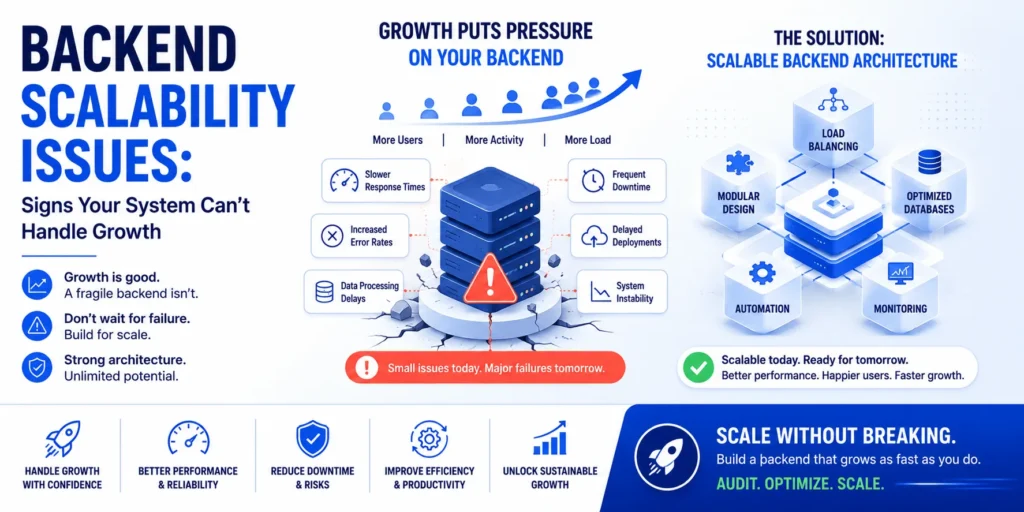
Growth is the goal of every startup. More users, more transactions, and more activity signal that your product is gaining traction. But growth also puts pressure on your systems—especially your backend. When that pressure exceeds what your system can handle, things start to break. What begins as small delays can quickly turn into major disruptions. These are classic backend scalability issues, and they almost always point to one root problem: the absence of a scalable backend architecture.
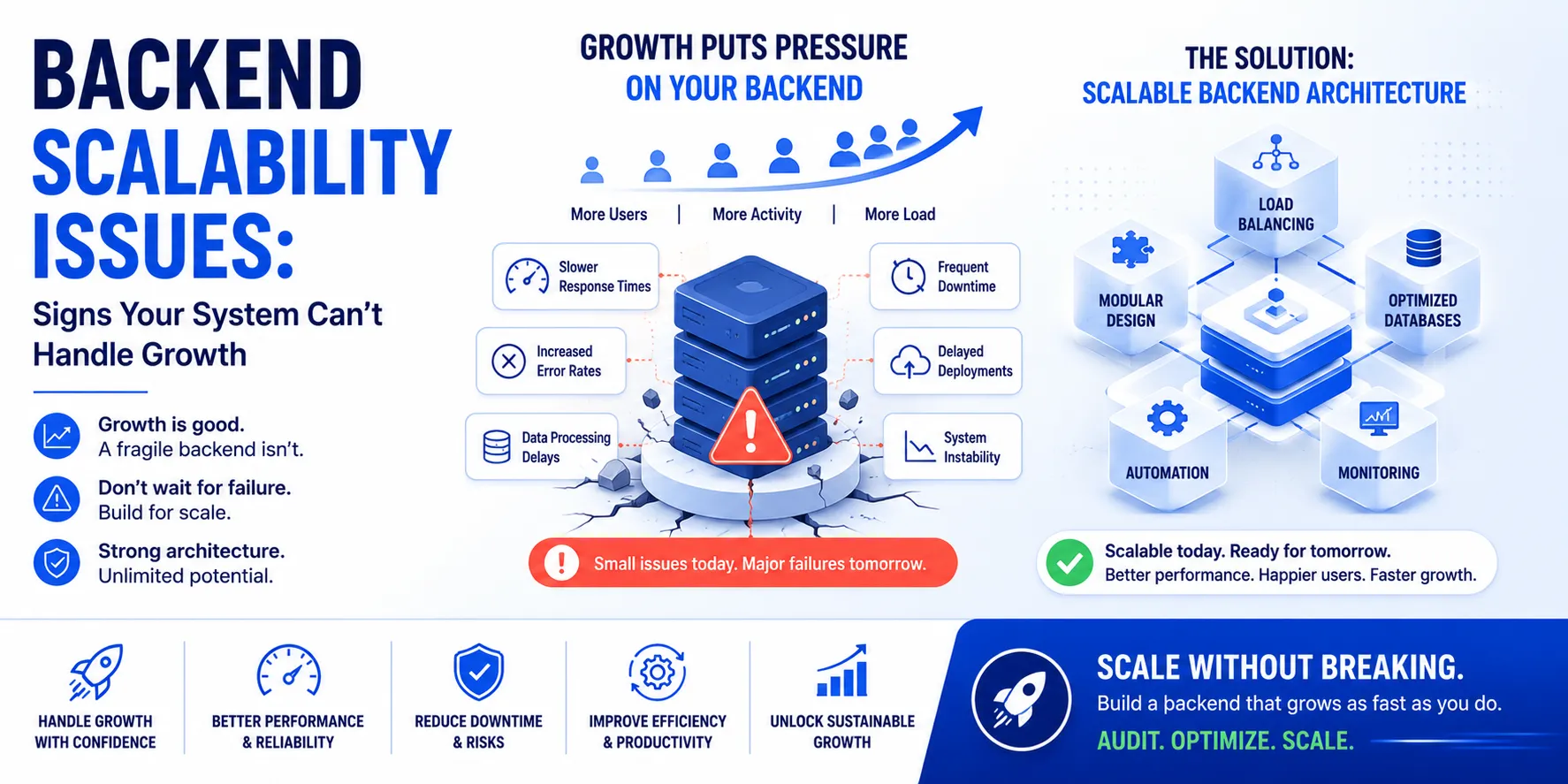
Growth Is a Stress Test for Your System
Your backend might perform perfectly when your user base is small. Requests are processed quickly, data flows smoothly, and everything appears stable. But as your product grows, the load increases. More users mean more concurrent requests, more data processing, and more complexity.
This is where hidden weaknesses begin to surface. Systems that were never designed for scale start to struggle under pressure. The result is a gradual decline in performance, followed by sudden failures. This is how backend scalability issues typically emerge—not as isolated incidents, but as a natural consequence of growth without preparation.
The Early Warning Signs of Backend Failure
Backend failures rarely happen overnight. They start with subtle signs that are easy to ignore, especially when your focus is on growth.
Common Warning Signs
| Symptom | What It Looks Like | Business Impact |
|---|---|---|
| Slower Response Times | Pages take longer to load | Frustrated users |
| Increased Error Rates | More failed requests | Reduced reliability |
| Frequent Downtime | System crashes during peak usage | Lost revenue |
| Delayed Deployments | Releases take longer | Slower innovation |
| Data Processing Delays | Lag in updates or transactions | Poor user experience |
These symptoms are indicators of deeper backend scalability issues that need to be addressed before they escalate.
What Actually Breaks When the Backend Fails
When your backend can’t handle growth, multiple components of your system start failing simultaneously. This creates a cascading effect that impacts both your product and your business.
Breakdown of Failures
- Server Overload: Too many requests overwhelm your servers
- Database Bottlenecks: Slow queries and delayed responses
- API Failures: Inconsistent communication between services
- Deployment Issues: Increased risk of errors during updates
- System Instability: Frequent crashes and unpredictable behavior
Each of these failures is a direct result of not having a scalable backend architecture in place.
The Domino Effect on Your Business
Technical failures don’t stay confined to your engineering team—they ripple across your entire organization. When your backend struggles, your business feels the impact immediately.
Business Impact of Backend Failures
| Area | Impact |
|---|---|
| User Experience | Slower performance and errors |
| Revenue | Lost transactions and conversions |
| Customer Trust | Reduced confidence in your product |
| Team Productivity | Increased firefighting |
| Growth | Slower scaling and missed opportunities |
This domino effect shows why backend scalability issues are not just technical problems—they are critical business challenges.
Why Scaling Without Preparation Is Risky
Many startups focus on growth without preparing their systems to handle it. This approach works in the short term but creates long-term risks. When your backend is not designed for scale, every new user adds strain to your system.
The problem is that scaling amplifies everything. If your system has inefficiencies, they become more pronounced. If your architecture is weak, it becomes a bottleneck. This is why investing in a scalable backend architecture is essential before you reach critical growth stages.
Why Adding More Servers Isn’t Enough
A common misconception is that backend issues can be solved by simply adding more servers or increasing resources. While this can provide temporary relief, it doesn’t address the underlying problem.
If your architecture is not designed to scale, adding resources only delays the inevitable. Inefficient code, poor data handling, and lack of modularity will continue to create bottlenecks. True scalability comes from structure, not just capacity.
What a Scalable Backend Architecture Looks Like
A scalable backend architecture is designed to handle growth efficiently. It ensures that your system can process increasing loads without compromising performance or reliability.
Key Characteristics
| Feature | Description | Benefit |
|---|---|---|
| Modular Design | Independent components | Easier scaling |
| Load Balancing | Distributes traffic across servers | Better performance |
| Efficient Databases | Optimized queries and storage | Faster responses |
| Automation | Streamlined processes | Reduced errors |
| Monitoring | Real-time tracking | Early issue detection |
These elements work together to create a system that can grow with your business.
How to Fix Backend Scalability Issues
Addressing backend scalability issues requires a strategic approach. It’s not just about fixing current problems—it’s about building a system that can handle future growth.
Steps to Improve Scalability
- Conduct a Backend Audit
Identify bottlenecks, inefficiencies, and areas of risk. - Optimize Architecture
Refactor your system to improve scalability and performance. - Implement Load Management
Use techniques like load balancing and caching. - Automate Processes
Streamline deployment, testing, and monitoring. - Upgrade Infrastructure
Move to cloud-based solutions that support scaling.
These steps help transform your backend into a system that supports growth rather than limiting it.
The Cost of Ignoring Scalability
Ignoring scalability issues doesn’t just slow you down—it can derail your entire business. The longer you wait, the more complex and expensive it becomes to fix.
Hidden Costs
- Emergency Fixes: Expensive and time-consuming
- Lost Customers: بسبب poor performance
- Reduced Efficiency: Teams spend more time fixing issues
- Missed Opportunities: Inability to handle growth
Investing in a scalable backend architecture early can prevent these costs and ensure smoother operations.
Why Proactive Scaling Wins
The most successful companies don’t wait for problems to arise—they plan for growth in advance. By building scalable systems early, they avoid the chaos that comes with reactive fixes.
A proactive approach allows you to handle increased demand effortlessly, maintain a high-quality user experience, and focus on innovation. This is the true advantage of a scalable backend architecture.
Conclusion: Growth Requires Strong Foundations
Growth is a sign of success, but it also comes with challenges. When your backend can’t handle growth, those challenges quickly turn into problems that affect your entire business.
By addressing backend scalability issues and investing in a scalable backend architecture, you can ensure that your systems are ready for the next stage of growth. This not only improves performance but also gives you the confidence to scale without fear.
Ready to Scale Without Breaking?
If your backend is struggling to keep up with growth, now is the time to act. A scalable system can transform your business and unlock new opportunities.
👉 Get a backend audit and discover how to eliminate bottlenecks, improve performance, and scale with confidence.