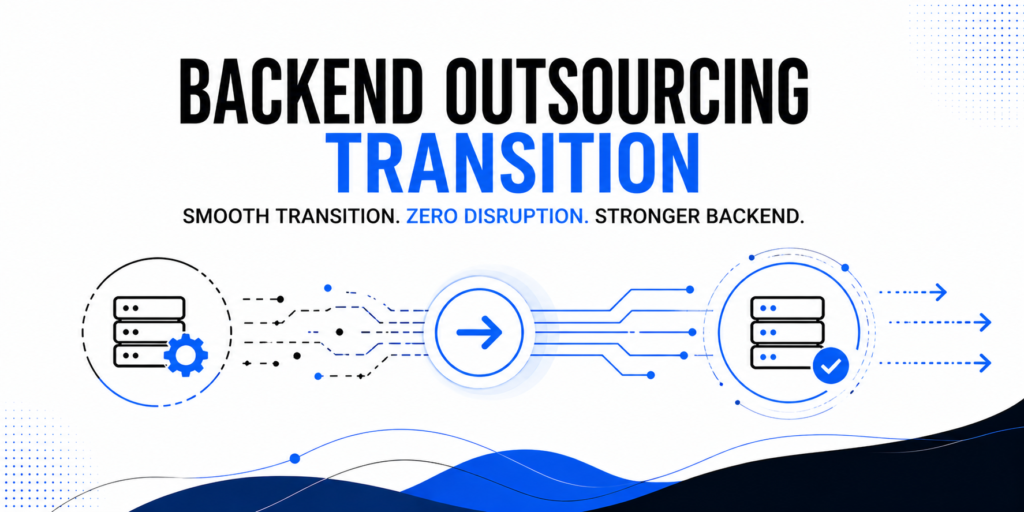
Replacing or restructuring your backend team can feel risky. Concerns about downtime, missed releases, knowledge loss, and user experience are completely valid—especially if the transition is rushed or unstructured. But with the right approach, a backend outsourcing transition can be smooth, controlled, and even performance-enhancing.
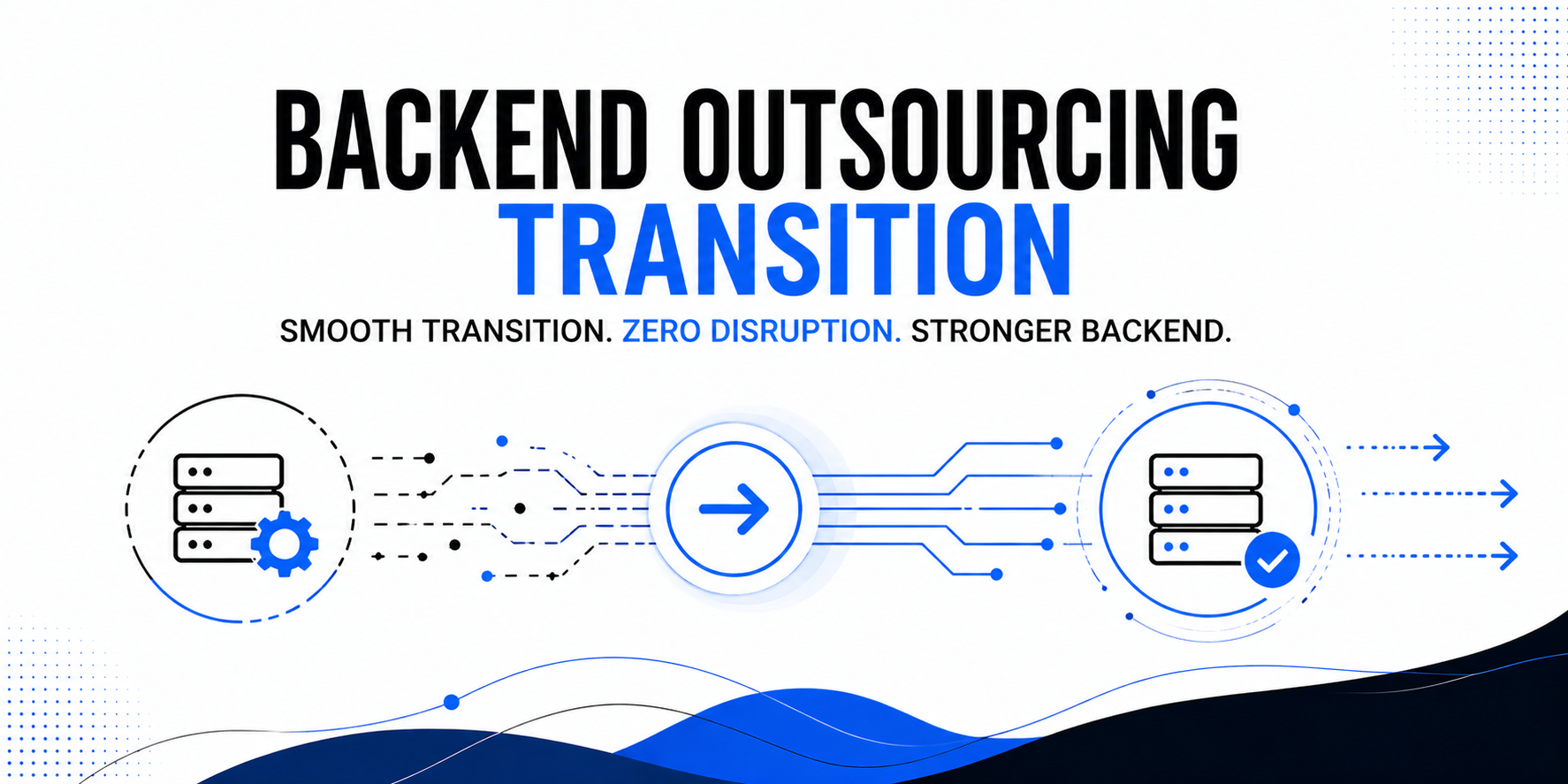
This guide breaks down how to execute a seamless transition without disrupting your product or slowing down growth.
Why Companies Consider a Backend Outsourcing Transition
Before understanding how to transition, it’s important to understand why companies make this move.
Common Triggers
- Rising costs without proportional output
- Slow feature releases
- Frequent bugs and system instability
- Lack of DevOps or infrastructure expertise
- Teams stuck in maintenance instead of innovation
As products grow, backend complexity increases. Without the right systems in place, teams struggle to keep up.
A backend outsourcing transition becomes a strategic decision to improve efficiency and scalability.
The Biggest Concern: Disruption
The primary fear during any transition is disruption.
Teams worry about:
- Systems breaking
- Delayed releases
- Confusion between teams
- Negative user impact
A successful backend outsourcing transition avoids all of this by focusing on parallel execution—not overnight replacement.
The goal is simple:
Improve the system without interrupting it.
Phase 1: Silent Audit (Clarity Before Change)
The transition begins without touching the live system.
Key Activities
- Backend architecture review
- Codebase and API analysis
- Infrastructure and cloud evaluation
- Database performance assessment
- Security checks
What This Reveals
| Area | Insight | Impact |
|---|---|---|
| Architecture | Structural gaps | Affects scalability |
| Performance | Bottlenecks | Slows system |
| Costs | Inefficiencies | Increases spending |
| Security | Risks | Affects reliability |
This phase ensures that your backend outsourcing transition starts with complete clarity.
Phase 2: Parallel Team Setup
Instead of replacing your existing team immediately, a new team is introduced in parallel.
Why This Works
- No disruption to ongoing work
- Existing team continues operations
- New team builds improvements in the background
Key Activities
- Setting up development environments
- Creating system documentation
- Establishing communication workflows
- Aligning with business goals
Parallel execution ensures a controlled and risk-free transition.
Phase 3: Knowledge Transfer Without Dependency
Knowledge loss is one of the biggest risks in any transition.
To prevent this, knowledge transfer must be structured and documented.
Knowledge Transfer Process
| Step | Action |
|---|---|
| Documentation | Record system architecture and workflows |
| Code Walkthroughs | Explain key components |
| Access Management | Secure transfer of credentials |
| Q&A Sessions | Clarify edge cases |
The goal is to move knowledge from individuals into systems.
A strong backend outsourcing transition eliminates dependency on specific people.
Phase 4: Controlled Implementation
Once the new team understands the system, improvements begin—carefully.
Implementation Strategy
- Start with non-critical components
- Gradually move to core systems
- Test every change thoroughly
- Maintain rollback options
Before vs After
| Metric | Before | After |
|---|---|---|
| Deployment | Risky | Controlled |
| Errors | Frequent | Reduced |
| Performance | Inconsistent | Stable |
Controlled implementation ensures stability throughout the transition.
Phase 5: Gradual Ownership Shift
Ownership should never be transferred abruptly.
Ownership Transition Model
| Stage | Responsibility |
|---|---|
| Stage 1 | Existing team leads, new team supports |
| Stage 2 | Shared responsibility |
| Stage 3 | New team leads, existing team supports |
| Stage 4 | Full ownership by new team |
This phased approach ensures continuity and minimizes risk.
Phase 6: Workflow and Process Integration
A backend outsourcing transition is not just about replacing people—it’s about improving systems.
Workflow Improvements
- Structured development cycles
- Automated CI/CD pipelines
- Real-time monitoring and alerts
- Clear task ownership
These changes improve efficiency and consistency across the system.
Phase 7: Performance and Stability Optimization
Once the transition is complete, the focus shifts to optimization.
Optimization Areas
- Database performance tuning
- Infrastructure cost reduction
- Load balancing and scaling
- Security improvements
Results
- Faster response times
- Lower infrastructure costs
- Reduced downtime
- Improved scalability
This is where the full value of a backend outsourcing transition becomes visible.
What Makes a Transition Disruption-Free?
The success of a backend outsourcing transition depends on following key principles.
Core Principles
| Principle | Impact |
|---|---|
| Parallel Execution | No downtime |
| Structured Handover | No knowledge loss |
| Gradual Transition | Smooth ownership shift |
| Continuous Testing | Reduced risk |
| Clear Communication | Team alignment |
These principles ensure a seamless experience for both users and teams.
Common Mistakes to Avoid
Even with a solid plan, mistakes can derail the transition.
Mistakes
- Rushing the replacement process
- Skipping documentation
- Poor communication between teams
- Lack of testing
- Ignoring security considerations
Avoiding these ensures a successful backend outsourcing transition.
Benefits of a Successful Transition
When executed properly, a backend outsourcing transition delivers measurable results.
Key Benefits
- Reduced backend costs
- Faster development cycles
- Improved system reliability
- Lower operational overhead
- Better scalability
The backend becomes an enabler of growth—not a limitation.
When Should You Consider a Backend Outsourcing Transition?
You should consider transitioning if:
- Your backend is slowing down development
- Costs are rising without clear value
- Systems feel unstable or difficult to manage
- Your team is overwhelmed with maintenance
These are clear signals that your backend needs restructuring.
Key Takeaways
- A backend outsourcing transition should be gradual, not abrupt
- Parallel execution eliminates disruption
- Knowledge transfer must be structured
- Automation and workflows are critical
- Optimization continues even after transition
Conclusion: Transition Without Chaos
Replacing your backend team doesn’t have to be risky.
With a structured backend outsourcing transition, you can:
- Improve performance
- Reduce costs
- Scale efficiently
- Maintain business continuity
The key is to focus on systems, not just people.
When architecture, workflows, and processes are aligned, the transition becomes an upgrade—not a disruption.
Ready to Upgrade Your Backend?
If your backend is holding you back, a structured transition can unlock new levels of efficiency and scalability.
A well-executed backend outsourcing transition ensures that your system evolves—without breaking along the way.
Start by evaluating your current backend and take the first step toward a smoother, smarter transition.