
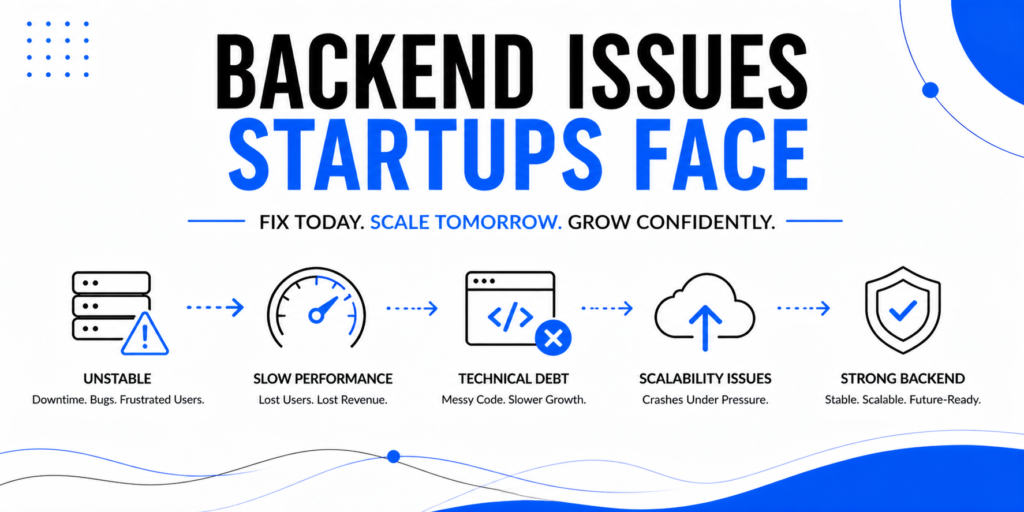
Startups rarely fail because of bad ideas—they fail because their systems can’t support growth. At first, everything looks promising. The product works, users start signing up, and momentum builds. But as traction increases, cracks begin to appear—slower performance, unexpected bugs, system crashes, and delayed releases. These are not random problems. They are the result of backend issues startups face when their systems are not built for scale.
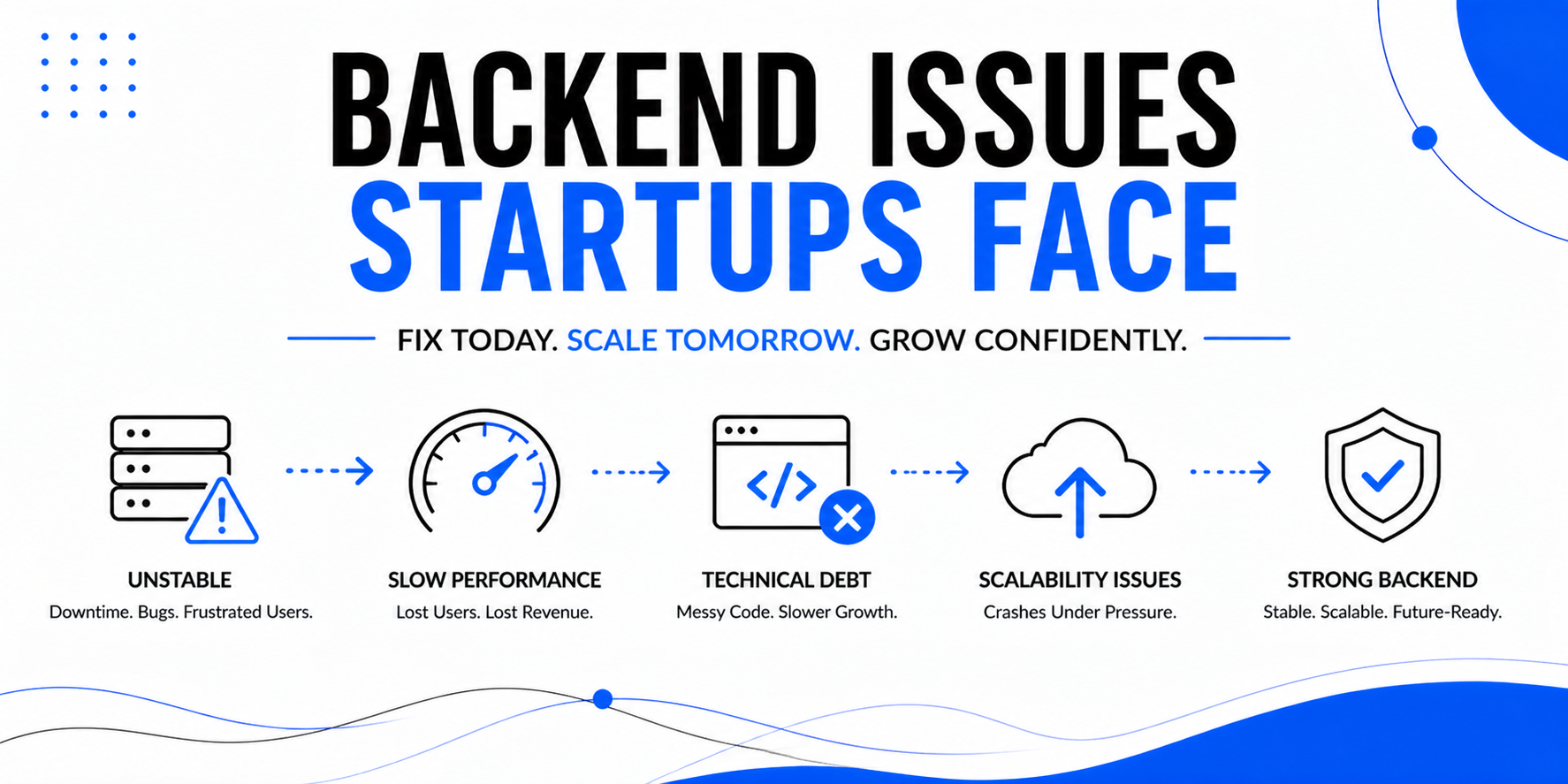
The Backend: Your Product’s Invisible Engine
The backend is the foundation of your product. It powers everything behind the scenes:
- Data processing
- Server communication
- Authentication
- Business logic
- System performance
Users never see it—but they experience it through speed, reliability, and consistency.
When your backend is strong, your product feels seamless.
When it’s weak, everything starts to break.
Why Backend Issues Startups Face Go Unnoticed Early
In the early stages, most startups prioritize speed over structure.
The focus is on:
- Launching quickly
- Validating the idea
- Acquiring users
To achieve this, teams often:
- Take shortcuts in architecture
- Skip optimization
- Delay scalability planning
This works initially because the system is under low load.
But as usage grows, these shortcuts turn into serious problems.
That’s when backend issues startups face become visible—and urgent.
The Most Common Backend Issues Startups Face
Backend problems rarely exist in isolation. They appear together and amplify each other.
Key Backend Challenges
| Issue | What It Looks Like | Impact |
|---|---|---|
| Poor Scalability | Crashes during traffic spikes | Lost users |
| Slow Performance | Long load times | Poor experience |
| Unstable Architecture | Frequent bugs | Reduced trust |
| Lack of Monitoring | Issues go unnoticed | Delayed fixes |
| Technical Debt | Messy codebase | Slower development |
Each of these issues slows your product—and your growth.
How Backend Issues Disrupt Growth
Growth is where backend problems become critical.
As your product scales:
- Traffic increases
- Data volume grows
- User expectations rise
If your backend can’t handle this, it becomes a bottleneck.
Business Impact of Backend Issues
- User Churn → Users leave due to poor experience
- Delayed Releases → Teams fix bugs instead of building
- Higher Costs → Emergency fixes and downtime recovery
- Reputation Damage → Loss of trust
Backend issues don’t just affect technology—they affect your entire business.
The Hidden Culprit: Technical Debt
One of the biggest reasons behind backend issues startups face is technical debt.
What Is Technical Debt?
It’s the result of:
- Quick fixes
- Temporary solutions
- Poor architectural decisions
These shortcuts save time early—but create long-term problems.
How Technical Debt Impacts You
- Makes code harder to maintain
- Increases bugs and errors
- Slows down development
- Limits scalability
Over time, even simple changes become complex.
This is when startups feel “stuck” despite having a good product.
Why Backend Problems Get Harder Over Time
Backend issues don’t stay small—they grow with your product.
As your system becomes more complex:
- Fixes become riskier
- Changes take longer
- Downtime becomes more costly
Making improvements in a live system requires:
- Careful planning
- Extensive testing
- Coordinated execution
That’s why early intervention is critical.
What a Strong Backend Looks Like
A well-built backend doesn’t just work—it scales.
Characteristics of a Strong Backend
- Scalable Architecture → Handles growth smoothly
- Efficient Data Handling → Fast and optimized
- High Reliability → Minimal downtime
- Automation → Reduced manual effort
- Continuous Monitoring → Issues detected early
With these in place, your system supports growth instead of resisting it.
How to Prevent Backend Issues Startups Face
The best way to solve backend problems is to prevent them.
1. Plan for Scalability Early
Even if your product is small, design your system with growth in mind.
2. Invest in DevOps
Automation helps with:
- Deployment
- Testing
- Monitoring
This reduces errors and improves speed.
3. Reduce Technical Debt
Regularly:
- Refactor code
- Remove outdated components
- Optimize performance
4. Use Scalable Infrastructure
Choose tools and platforms that can:
- Handle increased load
- Scale automatically
5. Implement Monitoring Systems
Track:
- Performance
- Errors
- Usage patterns
This allows you to fix issues before users notice them.
6. Consider Managed Backend Support
Instead of building everything internally, you can:
- Leverage external expertise
- Use proven systems
- Avoid costly mistakes
This accelerates stability and scalability.
The Advantage of Fixing Backend Early
Startups that address backend issues early gain a major advantage.
Benefits
- Faster scaling
- Better user experience
- Lower long-term costs
- More predictable performance
Instead of reacting to problems, they grow with confidence.
How Backend Impacts Your Team
Backend inefficiencies don’t just affect systems—they affect people.
Without a Strong Backend
- Developers spend time fixing bugs
- Releases become stressful
- Productivity drops
With a Strong Backend
- Development becomes smoother
- Teams focus on innovation
- Execution becomes consistent
This leads to better products and faster growth.
When Should You Fix Backend Issues?
Many founders wait too long.
You should act when:
- Performance starts slowing down
- Bugs become frequent
- Releases take longer
- Infrastructure costs increase
- Scaling feels difficult
These are early warning signs.
Key Takeaways
- Backend issues startups face are often hidden early
- Growth exposes weak systems
- Technical debt is a major cause
- Fixing issues early is easier and cheaper
- Strong backend systems enable scaling
Conclusion: Your Backend Determines Your Growth
Your backend is not just a technical layer—it’s the foundation of your business.
Ignoring it may help you move faster in the short term, but it creates risks that surface at the worst possible time.
The reality is simple:
Backend issues startups face are growth problems in disguise.
Fix the backend, and you unlock:
- Speed
- Stability
- Scalability
Ready to Strengthen Your Backend?
If your product is slowing down or struggling to scale, it’s time to address the root cause.
By fixing backend issues early, you can:
- Improve performance
- Reduce costs
- Scale confidently
Start by identifying what’s holding your system back—and build a backend that grows with your business.