
Every product reaches a point where things stop feeling smooth. Features take longer to ship, bugs appear more frequently, and performance starts to drop—especially under peak usage. At first, these issues seem manageable. A quick fix here, a patch there. But over time, they compound. What once worked efficiently becomes fragile and unpredictable. The real challenge isn’t fixing individual problems—it’s understanding whether your backend needs optimization or a complete rebuild. This is where a structured backend audit checklist becomes essential. It gives you clarity, helping you evaluate your system objectively before small issues turn into major failures.
Why Backend Health Matters
Your backend is the foundation of your product. It handles:
- Data processing
- Business logic
- Authentication
- System performance
When it works well, everything feels seamless. When it doesn’t, every part of your product suffers—from user experience to revenue.
Ignoring backend health often leads to:
- Slower performance
- Increased downtime
- Higher maintenance costs
- Reduced development speed
Using a backend audit checklist allows you to identify risks early and maintain system stability as you grow.
Optimization vs Rebuild: What’s the Difference?
Not every backend issue requires a rebuild.
Optimization
Involves improving existing systems:
- Refactoring code
- Optimizing queries
- Adding caching
- Fixing bottlenecks
Rebuild
Involves restructuring the system:
- Redesigning architecture
- Rewriting major components
- Replacing outdated systems
The key question is:
Is your foundation strong enough to support growth?
A backend audit checklist helps you answer this with clarity.
Key Signs Your Backend Needs a Rebuild
Some warning signs indicate deeper structural issues rather than surface-level problems.
Common Red Flags
| Sign | What It Looks Like | Impact |
|---|---|---|
| Slow Performance | Increasing response times | Poor user experience |
| Frequent Bugs | Recurring issues after fixes | Reduced reliability |
| Scaling Issues | System fails under load | Lost users or transactions |
| Complex Codebase | Difficult to understand or modify | Slower development |
| Deployment Failures | Errors during releases | Delayed updates |
If multiple issues appear consistently, your backend likely needs more than optimization.
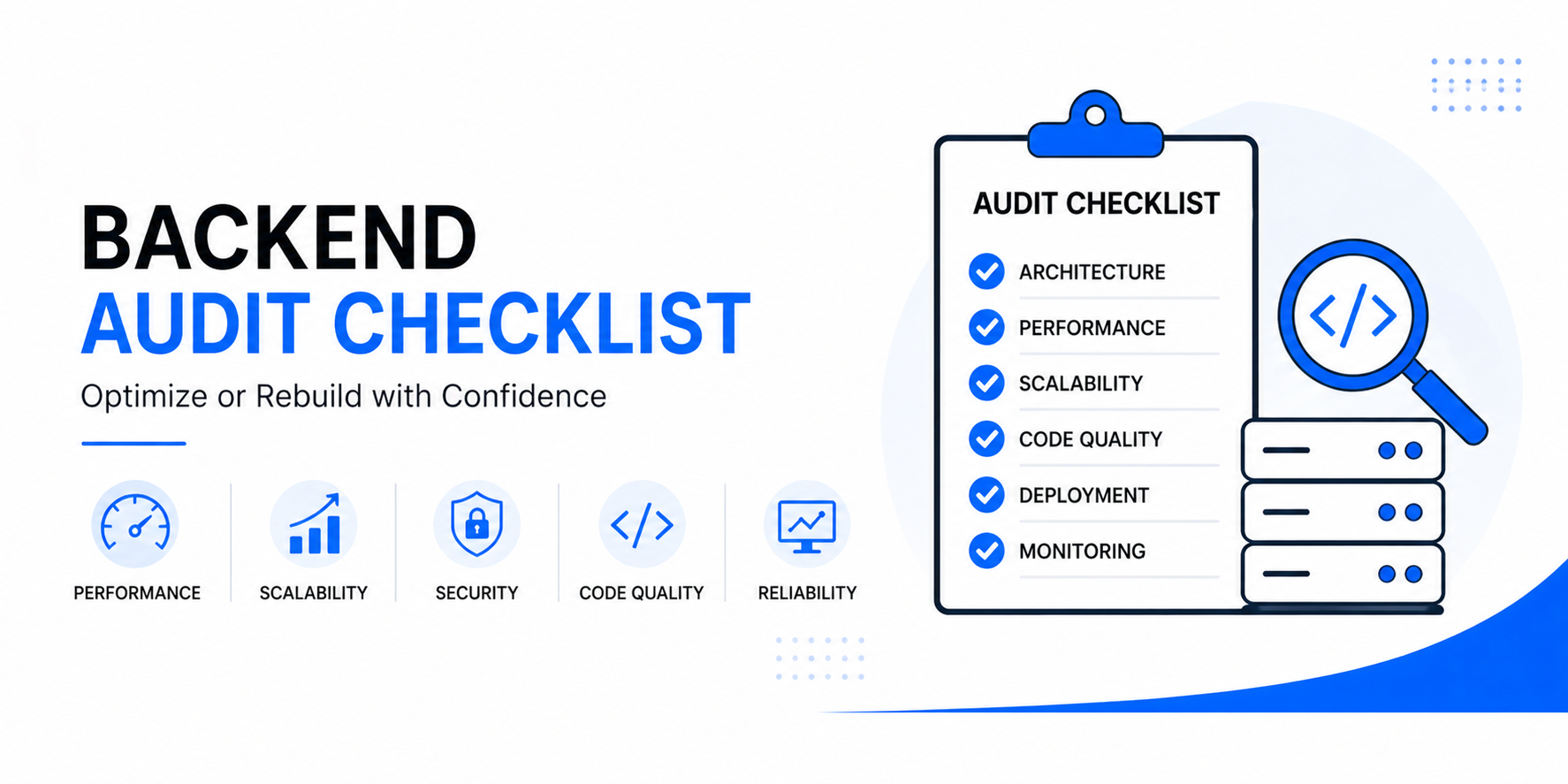
The Backend Audit Checklist (Core Areas)
A backend audit checklist provides a structured framework to evaluate your system thoroughly.
1. Architecture
Ask:
- Is your system modular or tightly coupled?
- Can components scale independently?
- Is your architecture aligned with future growth?
Healthy System: Flexible, modular, scalable
Warning Sign: Rigid, tightly connected components
2. Performance
Evaluate:
- Response times under normal and peak load
- Database query efficiency
- Presence of bottlenecks
Healthy System: Consistent performance
Warning Sign: Slowdowns as usage increases
3. Scalability
Check:
- Can your system handle traffic spikes?
- Is scaling automatic or manual?
- Are there single points of failure?
Healthy System: Handles growth seamlessly
Warning Sign: Requires constant manual intervention
4. Code Quality
Review:
- Code readability and structure
- Documentation quality
- Presence of redundant or outdated code
Healthy System: Clean, maintainable codebase
Warning Sign: Messy, hard-to-navigate code
5. Deployment and DevOps
Analyze:
- Deployment frequency and reliability
- Presence of CI/CD pipelines
- Failure rates during releases
Healthy System: Automated, predictable deployments
Warning Sign: Frequent errors and delays
6. Monitoring and Reliability
Assess:
- Real-time monitoring capabilities
- Alert systems for failures
- Incident response time
Healthy System: Proactive monitoring
Warning Sign: Reactive problem detection
Backend Audit Summary Table
| Area | Healthy System | Needs Attention |
|---|---|---|
| Architecture | Modular and flexible | Rigid and tightly coupled |
| Performance | Stable under load | Degrades with usage |
| Scalability | Automatic scaling | Manual intervention needed |
| Codebase | Clean and structured | Complex and messy |
| Deployment | Automated and reliable | Error-prone |
| Monitoring | Real-time visibility | Limited or reactive |
This table simplifies your backend audit checklist, helping you quickly identify critical gaps.
The Hidden Cost of Ignoring Backend Issues
Delaying backend improvements often seems like the easier choice. But the long-term cost is significantly higher.
Hidden Costs
- Increased Maintenance
Constant fixes consume time and resources - Slower Development
New features take longer to build - Higher Risk
System failures become more frequent - Lost Revenue
Downtime and poor performance impact users
A backend audit checklist helps you uncover these risks before they escalate.
When Optimization Is Enough
Not every system needs a rebuild.
Signs Optimization Will Work
- Issues are isolated, not systemic
- Architecture is still scalable
- Codebase is manageable
- Deployment processes are stable
In these cases, targeted improvements can restore performance effectively.
When a Rebuild Is the Right Move
A rebuild becomes necessary when:
- Architecture cannot support scaling
- Fixes create new issues repeatedly
- Development speed continues to decline
- System complexity is unmanageable
A backend audit checklist helps you recognize this turning point with confidence.
How to Approach a Backend Rebuild
If your audit indicates a rebuild, take a structured approach.
Rebuild Strategy
1. Define Clear Goals
What should the new system achieve?
2. Design Scalable Architecture
Focus on modularity and flexibility
3. Migrate Gradually
Avoid replacing everything at once
4. Implement DevOps Practices
Automate deployment and monitoring
5. Test Thoroughly
Ensure stability before full rollout
This approach minimizes risk and ensures a smooth transition.
Best Practices for Ongoing Backend Health
A backend audit should not be a one-time activity.
Ongoing Practices
- Conduct regular audits
- Monitor performance continuously
- Refactor code proactively
- Maintain clear documentation
- Invest in automation
Using a backend audit checklist regularly ensures your system stays healthy as it grows.
Key Takeaways
- Backend issues often signal deeper structural problems
- Optimization works for surface-level issues
- Rebuilds are necessary when foundations are weak
- A structured audit removes guesswork
- Proactive evaluation prevents costly failures
Conclusion: Clarity Before Action
Deciding whether to optimize or rebuild your backend is a critical decision. Acting too early wastes resources. Acting too late slows growth and increases risk.
A backend audit checklist gives you the clarity to make the right decision at the right time.
It helps you:
- Understand your system’s strengths
- Identify hidden weaknesses
- Plan your next steps with confidence
🚀 Ready to Evaluate Your Backend?
If your system feels slow, unstable, or difficult to scale, now is the time to assess it.
A structured backend audit checklist can help you:
- Identify bottlenecks
- Improve performance
- Decide between optimization and rebuild
Start with a clear evaluation—and build a backend that supports your growth instead of holding it back.