
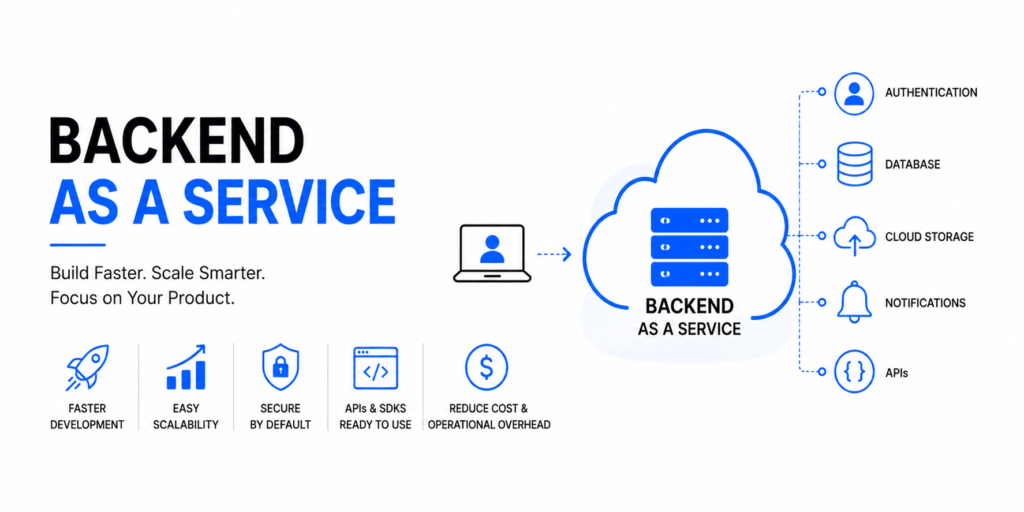
As products grow, backend complexity grows even faster. What starts as a simple setup quickly evolves into a network of servers, databases, APIs, authentication systems, and deployment pipelines. Managing all of this internally can slow down innovation and stretch your team thin. This is where backend as a service changes the game. Instead of building and maintaining your backend from scratch, you use a managed platform that provides ready-to-use infrastructure and services—allowing you to focus on building your product.
What Is Backend as a Service?
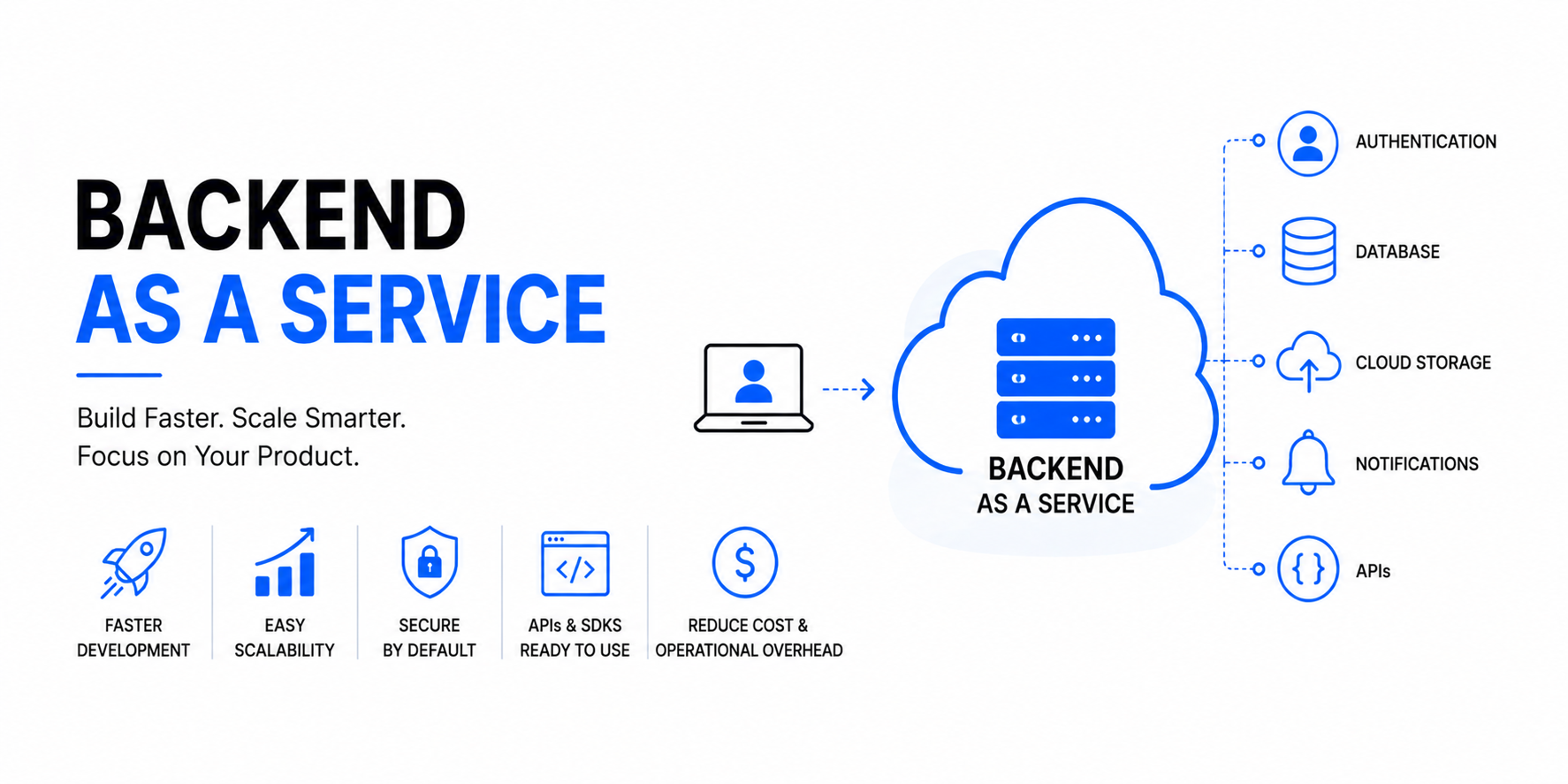
Backend as a service (BaaS) is a cloud-based model where backend infrastructure and common functionalities are provided by a third-party platform.
Instead of building everything yourself, you use pre-built services such as:
- Authentication
- Databases
- APIs
- Cloud storage
- Notifications
In simple terms, backend as a service allows you to “plug into” an existing backend rather than creating one from scratch.
Why Traditional Backend Models Slow You Down
Building a backend in-house requires:
- Setting up servers
- Managing databases
- Handling security
- Ensuring scalability
- Maintaining infrastructure
As your product grows, these responsibilities increase.
Common Challenges
- Slower development cycles
- Increased maintenance workload
- Higher operational costs
- Difficulty scaling systems
This often leads to a situation where your team spends more time managing infrastructure than building features.
How Backend as a Service Works
With backend as a service, your application connects to a provider through APIs and SDKs.
Typical Workflow
- User interacts with your application
- Request is sent to the BaaS platform
- Backend processes the request
- Data is stored or retrieved
- Response is sent back to the user
The provider handles infrastructure, scaling, and maintenance—so your team can focus on product development.
Key Features of Backend as a Service
BaaS platforms offer a wide range of built-in features that cover most backend requirements.
Core Features
| Feature | Description | Benefit |
|---|---|---|
| Authentication | User login and access control | Saves development time |
| Database | Managed data storage | Scalable and reliable |
| APIs | Pre-built endpoints | Faster integration |
| Cloud Storage | File and asset storage | Easy access and management |
| Notifications | Real-time updates | Improved user engagement |
These features make backend as a service a powerful solution for modern applications.
Backend as a Service vs Traditional Backend
Understanding the difference between these approaches highlights the value of BaaS.
Comparison
| Factor | Traditional Backend | Backend as a Service |
|---|---|---|
| Setup Time | Long | Quick |
| Cost | High upfront | Pay-as-you-go |
| Maintenance | Internal | Managed externally |
| Scalability | Complex | Automatic |
| Development Speed | Slower | Faster |
BaaS reduces complexity while improving speed and efficiency.
How BaaS Accelerates Development
One of the biggest advantages of backend as a service is speed.
Developers no longer need to:
- Build authentication systems
- Configure databases
- Set up infrastructure
Speed Benefits
- Faster product launches
- Reduced development time
- Quick feature deployment
- Less repetitive work
This allows teams to focus on what truly matters—building unique product features.
Scalability Without Complexity
Scaling traditional backend systems often requires:
- Manual infrastructure upgrades
- Performance tuning
- Resource allocation
BaaS platforms handle scaling automatically.
Scalability Benefits
- Automatic resource adjustment
- Consistent performance under load
- No manual intervention required
With backend as a service, your system grows seamlessly as demand increases.
Security and Compliance
Security is a critical part of any backend system.
BaaS providers implement advanced security measures, including:
Security Features
| Feature | Benefit |
|---|---|
| Data Encryption | Protects sensitive information |
| Access Control | Restricts unauthorized access |
| Monitoring | Detects threats early |
| Compliance Standards | Meets regulatory requirements |
This ensures that your application remains secure without building everything from scratch.
When Should You Use Backend as a Service?
BaaS is especially effective in specific scenarios.
Ideal Use Cases
- Building MVPs quickly
- Startups with limited backend resources
- Products requiring rapid scaling
- Teams focused on frontend and user experience
In these cases, backend as a service provides speed and efficiency.
Limitations of Backend as a Service
While BaaS offers many benefits, it’s important to understand its limitations.
Challenges
- Limited customization
- Dependency on the provider
- Potential cost increases at scale
- Less control over infrastructure
Being aware of these limitations helps you use BaaS strategically.
The Hybrid Approach: Best of Both Worlds
Many successful products combine BaaS with custom backend systems.
Hybrid Strategy
- Use BaaS for standard features (authentication, storage)
- Build custom backend for core functionality
- Transition gradually as complexity increases
This approach balances speed, flexibility, and control.
How to Get Started with Backend as a Service
Adopting backend as a service is straightforward with the right approach.
Step-by-Step Guide
1. Define Your Requirements
Identify what backend features you need
2. Choose a BaaS Provider
Select a platform that fits your use case
3. Integrate APIs and SDKs
Connect your application to the backend
4. Test Performance
Ensure everything works as expected
5. Monitor and Optimize
Continuously improve efficiency
This process allows for a smooth transition to a managed backend model.
Common Mistakes to Avoid
When adopting BaaS, avoid these pitfalls:
- Relying entirely on BaaS for complex core logic
- Ignoring long-term scalability needs
- Choosing providers without evaluating limitations
- Not planning for future migration
Avoiding these mistakes ensures that backend as a service works effectively for your product.
Why Backend as a Service Is the Future
The shift in technology is clear:
- From building infrastructure → to using managed services
- From complexity → to simplicity
- From maintenance → to innovation
Backend as a service aligns perfectly with this shift.
It allows teams to:
- Build faster
- Scale efficiently
- Focus on product development
Key Takeaways
- Backend as a service eliminates the need to build infrastructure from scratch
- It accelerates development and reduces operational overhead
- Scalability and security are handled by the provider
- A hybrid approach offers flexibility and control
- Strategic adoption ensures long-term success
Conclusion: Scale Smarter, Not Harder
Scaling a product is not just about adding users—it’s about building systems that can handle growth efficiently.
Traditional backend models often create bottlenecks.
Backend as a service removes them.
By leveraging BaaS, you can:
- Reduce complexity
- Improve speed
- Focus on innovation
Instead of managing infrastructure, you can focus on building a product that delivers real value.
🚀 Ready to Simplify Your Backend?
If your backend is slowing you down, it’s time to explore a better approach.
With backend as a service, you can:
- Build faster
- Scale seamlessly
- Reduce operational effort
Start by evaluating your current setup and take the first step toward a more efficient, scalable backend system.