
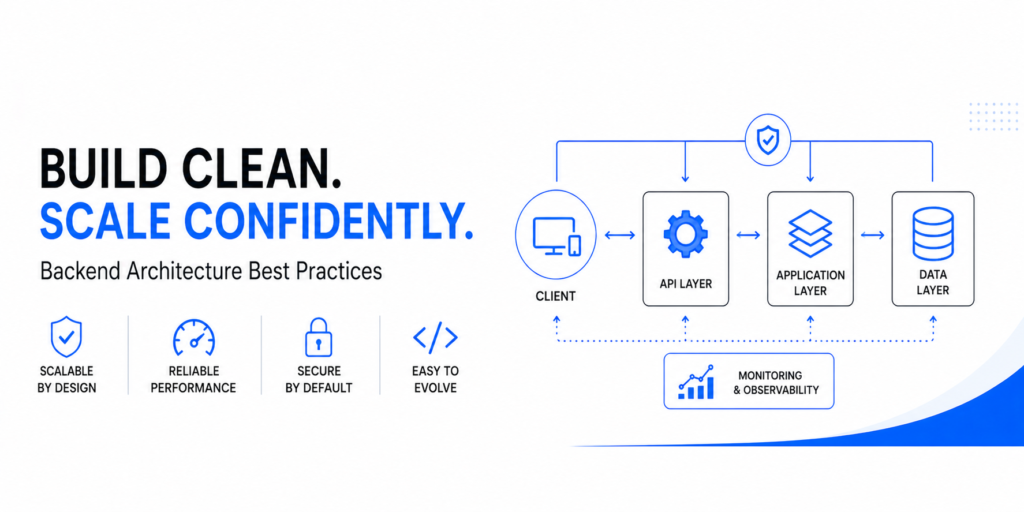
When a product scales smoothly, ships features quickly, and performs reliably under pressure, there’s usually one reason behind it: a clean backend. Users never see it, but your backend determines everything—from speed and stability to security and scalability. The difference between systems that struggle and systems that grow effortlessly comes down to one thing: how well the backend is structured. This is where backend architecture best practices become critical. They provide the foundation for building systems that are not only functional today but ready for tomorrow.
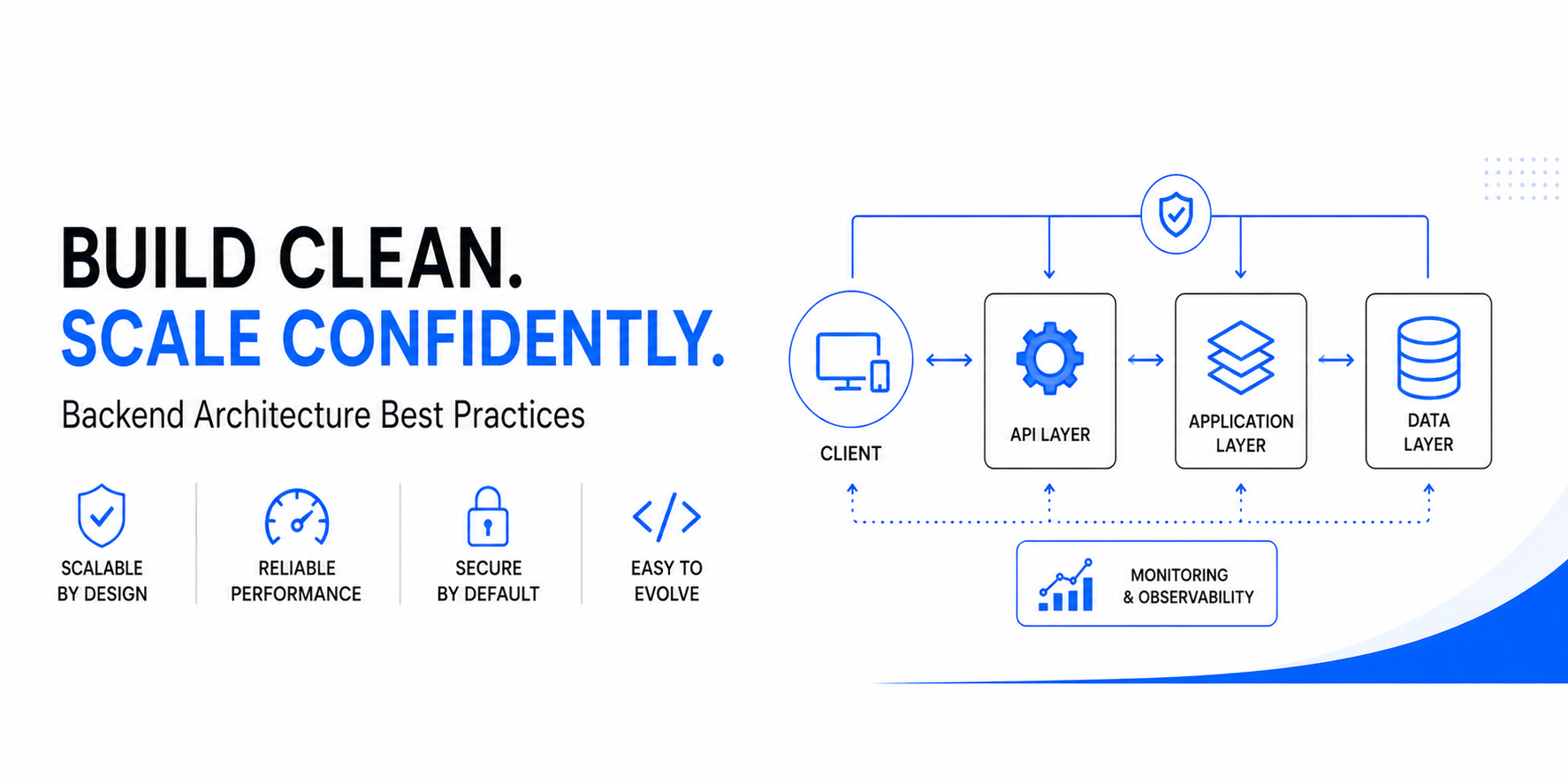
What Is a Clean Backend Architecture?
A clean backend architecture is a well-organized system where:
- Components have clearly defined responsibilities
- Workflows are predictable and efficient
- Dependencies are controlled and manageable
It is designed to evolve with your product. Instead of becoming more complex over time, it remains structured and adaptable.
Following backend architecture best practices ensures that your system:
- Handles increasing demand
- Supports rapid development
- Maintains reliability under pressure
Why Backend Architecture Matters More Than You Think
Many teams prioritize frontend experience and user acquisition early on. While this is important, backend issues often become the biggest bottleneck during growth.
A poorly structured backend leads to:
- Slower feature development
- Frequent bugs and failures
- Difficulty scaling infrastructure
A clean backend, on the other hand, enables:
- Faster releases
- Stable performance
- Efficient team collaboration
This is why backend architecture best practices are not optional—they are essential for long-term success.
Core Principles of Backend Architecture Best Practices
A strong backend is not about using the latest technologies. It’s about applying the right principles consistently.
Key Principles
| Principle | Description | Benefit |
|---|---|---|
| Separation of Concerns | Each component handles a specific function | Easier maintenance |
| Modularity | System divided into independent modules | Flexible scaling |
| Scalability | Designed to handle growth | Consistent performance |
| Reliability | Stable under load | Better user experience |
| Security | Protects sensitive data | Trust and compliance |
These principles form the backbone of backend architecture best practices.
The Building Blocks of a Clean Backend
A well-structured backend consists of multiple layers working together.
Key Components
- Application Layer
Handles business logic and core processing - Database Layer
Manages data storage and retrieval - API Layer
Connects frontend with backend systems - Infrastructure Layer
Handles servers, cloud services, and scaling - Monitoring Layer
Tracks performance and detects issues
When these layers are designed properly, they create a system that is both efficient and resilient.
Monolith vs Microservices: Making the Right Choice
One of the most important architectural decisions is choosing between a monolithic structure and microservices.
Comparison
| Approach | Advantages | Challenges |
|---|---|---|
| Monolith | Simple to build and deploy | Harder to scale |
| Microservices | Highly scalable and flexible | More complex to manage |
What to Choose?
- Start with a monolith for simplicity and speed
- Transition to microservices as complexity grows
Choosing the right approach at the right time is a key part of backend architecture best practices.
How Clean Architecture Improves Development Speed
A clean backend reduces friction in development.
When systems are well-organized:
- Developers understand code faster
- Changes are easier to implement
- Bugs are easier to fix
Impact on Development
| Factor | Poor Architecture | Clean Architecture |
|---|---|---|
| Feature Development | Slow | Fast |
| Bug Fixing | Complex | Simple |
| Deployment | Risky | Predictable |
| Collaboration | Difficult | Smooth |
By following backend architecture best practices, teams can maintain speed even as systems grow.
The Role of DevOps in Backend Architecture
Clean architecture is closely tied to DevOps practices. Together, they create systems that are both efficient and scalable.
Key DevOps Practices
- Continuous Integration (CI)
Automated testing and code merging - Continuous Deployment (CD)
Fast and reliable releases - Monitoring & Alerts
Real-time issue detection - Infrastructure as Code (IaC)
Consistent environment setup
These practices enhance backend performance and ensure that backend architecture best practices are executed effectively.
Security: A Core Pillar of Backend Architecture
Security is not an add-on—it’s built into the architecture.
Security Best Practices
| Area | Practice | Benefit |
|---|---|---|
| Data Protection | Encryption and secure storage | Prevents breaches |
| Access Control | Role-based permissions | Limits unauthorized access |
| Monitoring | Real-time threat detection | Faster response |
| Compliance | Regulatory alignment | Builds trust |
Integrating security into your architecture ensures long-term stability and reliability.
Common Mistakes to Avoid
Even well-intentioned teams can make decisions that hurt backend quality.
Key Mistakes
- Overcomplicating architecture too early
- Ignoring documentation
- Delaying refactoring
- Lack of monitoring systems
- Poor API design
Avoiding these mistakes is just as important as following backend architecture best practices.
How to Build a Clean Backend
Building a scalable backend doesn’t require perfection—it requires consistency.
Step-by-Step Approach
1. Define Architecture Early
Plan for scalability from the beginning.
2. Use Modular Design
Break systems into manageable components.
3. Implement DevOps Practices
Automate testing and deployment.
4. Prioritize Security
Protect data and systems at every level.
5. Continuously Optimize
Refactor and improve as your product grows.
This structured approach ensures that your backend remains efficient over time.
Why Clean Architecture Is a Competitive Advantage
In competitive environments, speed and reliability define success.
A clean backend enables:
- Faster feature releases
- Better system performance
- Seamless scalability
This creates a strong advantage over competitors struggling with inefficient systems.
By following backend architecture best practices, you position your product for sustainable growth.
Key Takeaways
- Backend architecture determines system performance and scalability
- Clean systems enable faster development and fewer errors
- Modularity and separation of concerns are essential
- DevOps and automation enhance backend efficiency
- Security must be built into the architecture
These principles ensure that your backend supports growth instead of limiting it.
Conclusion: Build Systems That Grow With You
A backend should not just work—it should scale, adapt, and support your vision.
By applying backend architecture best practices, you create systems that:
- Handle growth effortlessly
- Maintain stability under pressure
- Enable faster innovation
The strongest products are built on strong foundations—and that foundation is your backend.
🚀 Ready to Strengthen Your Backend Architecture?
If your backend feels complex, slow, or difficult to scale, it’s time to rethink your structure.
A clean architecture can unlock:
- Faster development
- Better performance
- Long-term scalability
Start by evaluating your current system and take the first step toward building a backend designed for growth.