
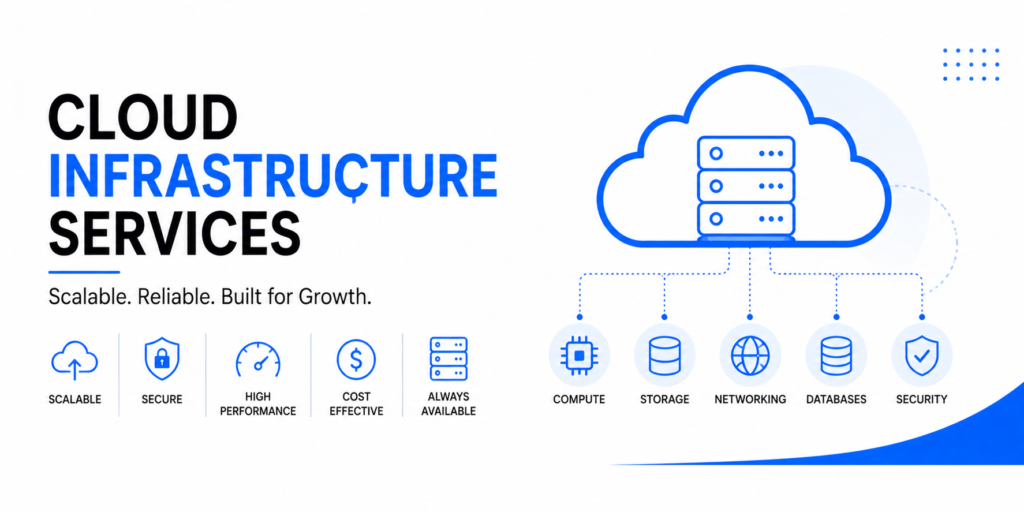
If you’re building or scaling a digital product, you’ve likely come across the term cloud infrastructure services. It’s often associated with speed, scalability, and reliability—but for many, it still feels abstract. In simple terms, cloud infrastructure services are the foundation that allows your product to run, scale, and operate efficiently without relying on physical servers. They enable modern applications to handle growth seamlessly while maintaining performance and stability.
Understanding Cloud Infrastructure in Simple Terms
Think of cloud infrastructure as renting powerful computers over the internet instead of owning them.
Instead of:
- Buying servers
- Maintaining hardware
- Managing physical data centers
You use remote servers provided by cloud providers. These servers handle:
- Running applications
- Storing data
- Managing network traffic
This approach removes the need for heavy upfront investment and gives you flexibility as your product grows.
Why Cloud Infrastructure Services Matter
In the early stages, it’s easy to focus only on building features. But as your product scales, infrastructure becomes a critical factor.
Without strong infrastructure, you may face:
- Slow performance
- System crashes under load
- Difficulty scaling
- High maintenance costs
Cloud infrastructure services solve these challenges by providing a flexible and scalable foundation that adapts to your needs.
Core Components of Cloud Infrastructure Services
To understand how cloud infrastructure works, break it down into its key components.
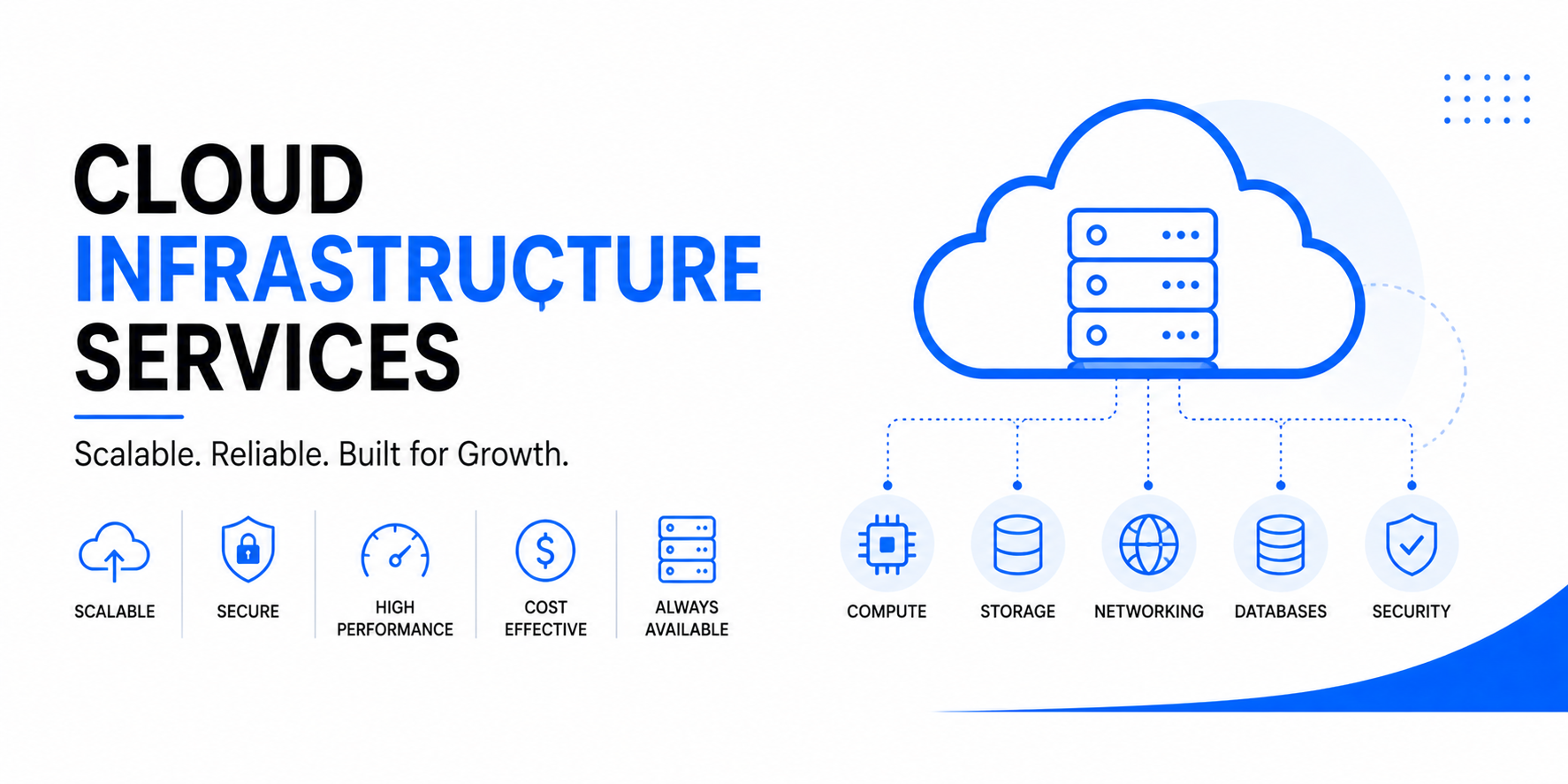
Core Components
| Component | What It Does | Why It Matters |
|---|---|---|
| Compute | Runs applications | Handles processing power |
| Storage | Stores data | Keeps information secure and accessible |
| Networking | Connects systems | Enables communication between services |
| Databases | Manages structured data | Ensures fast and reliable access |
| Security | Protects systems | Safeguards data and operations |
Each component plays a vital role in delivering reliable and efficient cloud infrastructure services.
How Cloud Infrastructure Works
When a user interacts with your product, several processes happen in the background:
- A request is sent to your backend
- The system processes it using compute resources
- Data is retrieved or updated in databases
- A response is sent back to the user
All of this happens on cloud servers—quickly and efficiently.
This seamless process is what makes cloud infrastructure services essential for modern applications.
Types of Cloud Infrastructure Models
Cloud infrastructure is not one-size-fits-all. Different models offer different levels of control and flexibility.
Cloud Models
| Type | Description | Best For |
|---|---|---|
| Public Cloud | Shared infrastructure | Cost-effective scaling |
| Private Cloud | Dedicated infrastructure | High security needs |
| Hybrid Cloud | Combination of both | Balance of control and flexibility |
Choosing the right model depends on your product requirements and growth strategy.
Benefits of Cloud Infrastructure Services
Cloud infrastructure offers several advantages that make it indispensable.
Key Benefits
- Scalability
Easily handle increased traffic and demand - Cost Efficiency
Pay only for the resources you use - Reliability
High uptime and consistent performance - Flexibility
Adapt quickly to changing requirements - Security
Advanced protection and compliance features
These benefits allow businesses to grow without being constrained by infrastructure limitations.
How Cloud Infrastructure Supports Growth
Traditional infrastructure struggles with scaling. It requires manual upgrades, hardware purchases, and long setup times.
Cloud infrastructure eliminates these challenges.
Growth Comparison
| Factor | Traditional Infrastructure | Cloud Infrastructure |
|---|---|---|
| Scaling | Manual and slow | Automatic and fast |
| Cost | High upfront investment | Pay-as-you-go |
| Maintenance | Time-consuming | Managed by provider |
| Flexibility | Limited | Highly adaptable |
With cloud infrastructure services, scaling becomes seamless and predictable.
Common Use Cases
Cloud infrastructure supports a wide range of applications.
Common Use Cases
- Web and mobile applications
- Data storage and analytics
- SaaS platforms
- E-commerce systems
- Real-time applications
Regardless of the industry, cloud infrastructure provides the backbone for performance and scalability.
Common Misconceptions About Cloud Infrastructure
Despite its widespread adoption, several misconceptions still exist.
Misconceptions
- “It’s only for large companies”
Small teams benefit the most from flexibility - “It’s too expensive”
Pay-as-you-go models reduce costs - “It’s less secure”
Cloud providers invest heavily in security - “It’s too complex”
Managed services simplify everything
Understanding these points helps you make informed decisions about adopting cloud infrastructure services.
Getting Started with Cloud Infrastructure Services
Transitioning to the cloud doesn’t have to be complicated.
Step-by-Step Approach
1. Assess Your Needs
Determine performance, storage, and scalability requirements.
2. Choose the Right Model
Select public, private, or hybrid based on your goals.
3. Set Up Core Components
Configure compute, storage, and networking.
4. Implement Security
Ensure data protection and compliance.
5. Monitor and Optimize
Continuously improve performance and efficiency.
This structured approach helps you build a strong and scalable foundation.
Why Managed Cloud Services Make Sense
Managing cloud infrastructure internally can be complex.
This is where managed services come in.
Benefits of Managed Services
| Benefit | Description |
|---|---|
| Expertise | Access to experienced professionals |
| Efficiency | Faster implementation |
| Cost Savings | No need for large in-house teams |
| Scalability | Easily adjust resources as needed |
Managed cloud infrastructure services allow you to focus on your product while experts handle the infrastructure.
Common Mistakes to Avoid
When adopting cloud infrastructure, avoid these pitfalls:
- Overprovisioning resources (wasting costs)
- Ignoring security best practices
- Not monitoring performance
- Choosing the wrong cloud model
- Delaying optimization
Avoiding these mistakes ensures that your infrastructure remains efficient and cost-effective.
Key Takeaways
- Cloud infrastructure replaces physical servers with scalable, remote systems
- It enables faster growth, better performance, and lower operational complexity
- Core components include compute, storage, networking, and security
- Managed services simplify implementation and maintenance
- A structured approach ensures long-term success
Conclusion: Build on a Foundation That Scales
Cloud infrastructure is not just a technical layer—it’s the backbone of modern digital products.
By leveraging cloud infrastructure services, you can:
- Scale without friction
- Improve system reliability
- Reduce operational overhead
- Focus on building and innovating
The right infrastructure doesn’t just support your product—it accelerates it.
🚀 Ready to Move to the Cloud?
If your system feels slow, difficult to scale, or expensive to maintain, it may be time to rethink your infrastructure.
With the right cloud infrastructure services, you can:
- Improve performance
- Scale efficiently
- Build a system that grows with your vision
Start by evaluating your current setup and take the first step toward a more flexible, reliable, and scalable foundation.