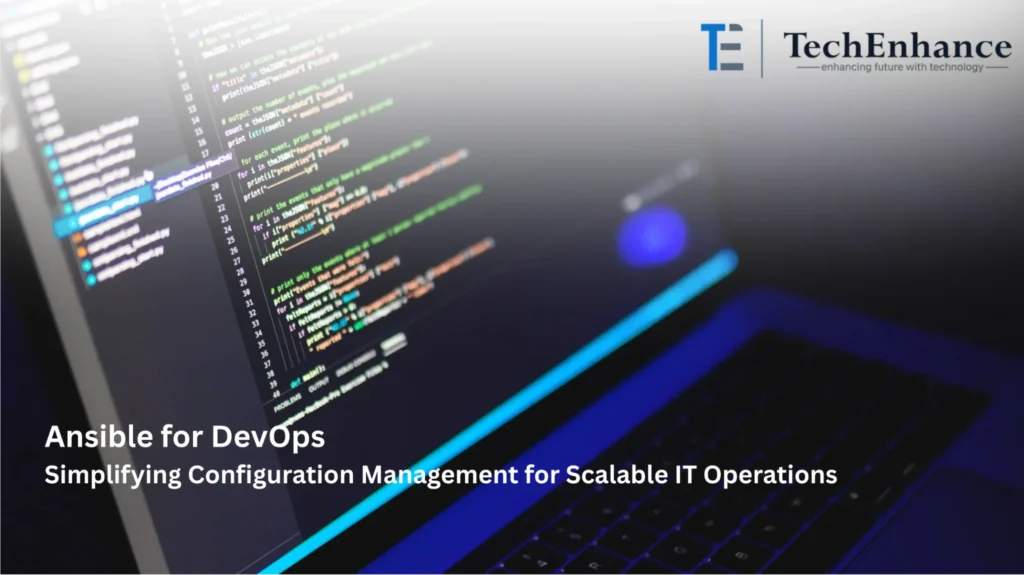
In today’s fast-paced digital landscape, organizations are increasingly adopting DevOps practices to accelerate software delivery, improve collaboration between development and operations teams, and maintain high-quality deployments.
One of the critical challenges in a DevOps environment is configuration management the process of standardizing and automating the setup of servers, applications, and network environments.
Manual configuration is prone to errors, difficult to replicate, and can lead to inconsistencies across multiple environments, which can disrupt workflows and impact business performance.
This is where Ansible, an open-source automation tool, plays a pivotal role. It simplifies configuration management by enabling teams to automate repetitive tasks, enforce consistency, and streamline deployment processes.
With its agentless architecture and easy-to-read YAML-based playbooks, Ansible empowers organizations to manage infrastructure efficiently without the complexity of traditional configuration tools.
At TechEnhance, we leverage Ansible as part of our DevOps Consulting services to help clients implement robust, scalable, and automated infrastructure. Our approach integrates Ansible with cloud solutions, continuous integration/continuous deployment (CI/CD) pipelines, and AI-driven insights, ensuring that IT environments remain stable, secure, and optimized. By combining Cloud Consulting and Managed IT Services, we help businesses achieve operational efficiency, reduce manual intervention, and accelerate software delivery.
In this article, we will explore what Ansible is, why configuration management is critical in DevOps, and how businesses can leverage this tool, along with TechEnhance’s expertise, to achieve proactive, automated, and reliable IT operations.
What is Ansible?
Ansible is a powerful open-source automation tool designed to simplify configuration management, application deployment, task automation, and IT orchestration. Unlike traditional configuration management tools,
Ansible operates in an agentless architecture, which means it does not require additional software to be installed on target machines. Instead, it communicates over SSH or Windows Remote Management (WinRM), making it lightweight, secure, and easy to deploy across diverse environments.
At its core, Ansible uses playbooks, written in YAML, to define a series of tasks that need to be executed on servers or applications. These playbooks are human-readable, modular, and reusable, allowing teams to automate complex workflows, enforce standardized configurations, and eliminate inconsistencies across development, testing, and production environments. Its idempotent nature ensures that tasks always achieve the desired state, regardless of the current system configuration, which significantly reduces the risk of errors.
For organizations embracing cloud and hybrid infrastructure, Ansible provides seamless integration with major cloud providers such as AWS, Azure, and Google Cloud. TechEnhance incorporates Ansible into its Cloud Consulting solutions, enabling businesses to automate cloud resource provisioning, manage configuration drift, and optimize infrastructure performance. Additionally, through AI Development Services, TechEnhance enhances monitoring and automation with predictive insights, allowing teams to detect potential issues before they impact operations.
In summary, Ansible is a versatile, scalable, and efficient solution for automating configuration management, ensuring consistent IT environments, and enabling DevOps teams to focus on delivering value rather than managing manual processes. By integrating Ansible with TechEnhance’s DevOps, cloud, and AI-driven solutions, organizations can achieve higher operational efficiency, faster deployments, and a more resilient IT infrastructure.
Importance of Configuration Management in DevOps

Configuration management is a cornerstone of successful DevOps practices, as it ensures that infrastructure and applications are consistently deployed, maintained, and scaled across multiple environments.
Without an effective configuration management system, organizations face challenges such as configuration drift, manual errors, slow deployments, and difficulties in troubleshooting issues. These challenges can lead to downtime, security vulnerabilities, and decreased productivity.
In a DevOps environment, where speed and reliability are critical, configuration management tools like Ansible help standardize processes and automate repetitive tasks.
By defining infrastructure as code, teams can deploy identical environments across development, staging, and production, ensuring consistency and reliability. This reduces the risk of discrepancies that could otherwise disrupt application performance or deployment schedules.
At TechEnhance, we integrate Ansible into our DevOps Consulting services to help clients implement robust configuration management practices. Our experts design automated workflows, integrate CI/CD pipelines, and ensure that monitoring and compliance are built into every stage of deployment.
Additionally, through our Managed IT Services, we maintain and update configurations proactively, reducing downtime and operational overhead for businesses.
Effective configuration management also enables organizations to scale operations seamlessly. When adding new servers, applications, or cloud resources, Ansible’s automated workflows ensure that these components are configured correctly, reducing manual effort and accelerating time-to-market.
Combined with TechEnhance’s Cloud Consulting, businesses can manage hybrid or multi-cloud infrastructures efficiently while maintaining high reliability and performance standards.
Key Features of Ansible for DevOps
Ansible stands out among configuration management tools due to its simplicity, flexibility, and powerful automation capabilities. Some of its key features make it particularly valuable for DevOps teams:
- Agentless Architecture: Ansible does not require agents on target systems, which simplifies deployment, reduces overhead, and enhances security.
- YAML-Based Playbooks: Its human-readable playbooks enable teams to write, understand, and maintain automation scripts with minimal effort.
- Idempotency: Tasks in Ansible are idempotent, ensuring that applying the same playbook multiple times produces consistent and predictable results.
- Extensive Module Library: Ansible provides hundreds of modules for servers, cloud platforms, network devices, and applications, allowing seamless automation of complex workflows.
- Integration with CI/CD Pipelines: Ansible integrates with Jenkins, GitLab CI/CD, and other DevOps tools, enabling automated, continuous deployments without manual intervention.
- Scalability and Extensibility: From a few servers to large-scale cloud environments, Ansible scales effortlessly, making it ideal for both startups and enterprise organizations.
TechEnhance leverages Ansible’s features in combination with its AI Development Services to introduce predictive automation, where potential configuration issues can be detected and resolved automatically. Additionally, our Web Development and Mobile App Development teams benefit from Ansible by automating deployment processes, reducing errors, and ensuring smooth performance across all environments.
By utilizing Ansible’s robust capabilities, businesses can streamline IT operations, improve deployment speed, and maintain consistent environments, all while aligning with modern DevOps practices. Combined with TechEnhance’s end-to-end services, organizations gain a reliable, automated, and scalable IT infrastructure that supports growth and innovation.
Benefits of Using Ansible in DevOps
Using Ansible in DevOps environments delivers significant operational, technical, and business benefits. By automating configuration management, organizations can reduce errors, improve deployment speed, and maintain consistency across multiple environments. One of the most important advantages is reliability.
Ansible ensures that servers, applications, and network components are configured consistently, preventing configuration drift and minimizing the risk of downtime or performance issues.
Another key benefit is efficiency. Manual configuration and deployment processes are time-consuming and prone to errors. Ansible automates repetitive tasks, allowing DevOps teams to focus on higher-value activities such as feature development, testing, and performance optimization. This automation reduces operational overhead while improving response times for updates, patches, and new deployments.
Ansible also enhances scalability. Whether managing a small set of servers or a large hybrid cloud environment, its modular playbooks and idempotent operations make it easy to scale operations without introducing risk or complexity. Organizations can deploy new applications, servers, or services rapidly, ensuring that infrastructure grows seamlessly alongside business needs.
TechEnhance leverages Ansible in combination with its Managed IT Services and Cloud Consulting offerings to deliver measurable business outcomes. By integrating AI-powered insights through AI Development Services, we help clients proactively detect potential issues, optimize configurations, and maintain high performance. This combination ensures that DevOps teams can focus on innovation while maintaining reliable, efficient, and scalable IT environments.
In summary, Ansible not only simplifies configuration management but also drives operational excellence, cost savings, and accelerated time-to-market, making it an essential tool for modern DevOps practices.
How Ansible Integrates with DevOps Practices
Ansible is most effective when integrated seamlessly into DevOps workflows, providing continuous automation, monitoring, and orchestration. One of its key applications is in CI/CD pipelines. By integrating with tools like Jenkins, GitLab CI/CD, and Azure DevOps, Ansible ensures that code deployments, server provisioning, and configuration changes occur automatically and consistently. This integration reduces manual effort, accelerates release cycles, and maintains a high level of reliability.
Ansible also plays a vital role in Infrastructure as Code (IaC). By defining infrastructure in reusable, version-controlled playbooks, organizations can deploy and maintain cloud, on-premise, or hybrid environments with confidence. TechEnhance incorporates Ansible into its Cloud Consulting solutions, enabling clients to manage multi-cloud infrastructure efficiently while ensuring that all configurations remain consistent and compliant.
For application and environment monitoring, Ansible can automate alerts, updates, and remediation actions. Combined with TechEnhance’s Managed IT Services, businesses can maintain continuous oversight of their systems, ensuring rapid response to any anomalies or performance issues. Furthermore, integrating AI-driven insights through AI Development Services allows predictive problem-solving, helping DevOps teams detect potential failures before they impact users.
In addition, Ansible’s extensibility supports containerized environments (Docker, Kubernetes), network automation, and orchestration of multi-tier applications. By combining these capabilities with TechEnhance’s Virtual CTO Services, organizations can strategically adopt DevOps best practices, optimize IT operations, and scale infrastructure while maintaining security and compliance.
In essence, Ansible becomes a central enabler of automation, consistency, and efficiency in DevOps, bridging the gap between development, operations, and business objectives.
How TechEnhance Can Help?

While Ansible provides a robust framework for configuration management and automation, successful implementation requires strategic planning, integration expertise, and ongoing support. TechEnhance specializes in helping businesses harness Ansible’s capabilities to achieve seamless DevOps automation and optimized IT operations.
Through our DevOps Consulting services, TechEnhance designs and implements automated workflows using Ansible, ensuring that configuration management aligns with CI/CD pipelines and organizational processes. This allows teams to deploy applications faster, maintain consistency across environments, and reduce the likelihood of errors that can impact performance or downtime.
In addition, TechEnhance combines Ansible with Cloud Consulting to manage cloud infrastructure efficiently. Automated provisioning, configuration management, and monitoring ensure that resources are optimized and scalable, whether deployed on AWS, Azure, Google Cloud, or hybrid setups.
Our Managed IT Services ensure continuous oversight, monitoring, and updates of systems automated via Ansible. By leveraging AI Development Services, TechEnhance enhances predictive monitoring, identifying potential configuration issues or performance bottlenecks before they impact operations.
Furthermore, businesses can leverage TechEnhance’s Virtual CTO Services to receive strategic guidance on adopting Ansible and other DevOps best practices. Whether it’s scaling cloud infrastructure, orchestrating multi-tier applications, or automating complex workflows, TechEnhance ensures that automation aligns with business goals, improves operational efficiency, and reduces costs.
By combining Ansible’s automation capabilities with TechEnhance’s expertise across DevOps, cloud, AI, and IT management, organizations can transform configuration management from a manual, error-prone process into a strategic advantage.
Conclusion
Ansible has emerged as one of the most effective tools for simplifying configuration management in DevOps environments. Its agentless architecture, easy-to-read playbooks, idempotent tasks, and extensive module library make it ideal for organizations looking to automate repetitive tasks, enforce consistent configurations, and accelerate deployments.
By adopting Ansible, DevOps teams can minimize manual errors, optimize infrastructure management, and maintain consistent environments across development, staging, and production.
When combined with TechEnhance’s comprehensive services, the value of Ansible increases exponentially. Through DevOps Consulting and Cloud Consulting, businesses can implement automated, scalable, and secure infrastructure.
Managed IT Services and AI Development Services allow predictive problem-solving and continuous monitoring, ensuring that automation drives both operational efficiency and business outcomes. Strategic guidance through Virtual CTO Services ensures that Ansible adoption aligns with long-term IT strategy and growth goals.
In summary, Ansible for DevOps is not just a configuration management tool—it is a catalyst for operational excellence. By integrating Ansible with TechEnhance’s expertise, organizations gain a reliable, scalable, and automated IT ecosystem that enables faster deployments, reduces risks, and drives measurable business value.
For businesses aiming to modernize IT operations, streamline DevOps processes, and achieve end-to-end automation, TechEnhance provides the knowledge, tools, and support to make it happen.